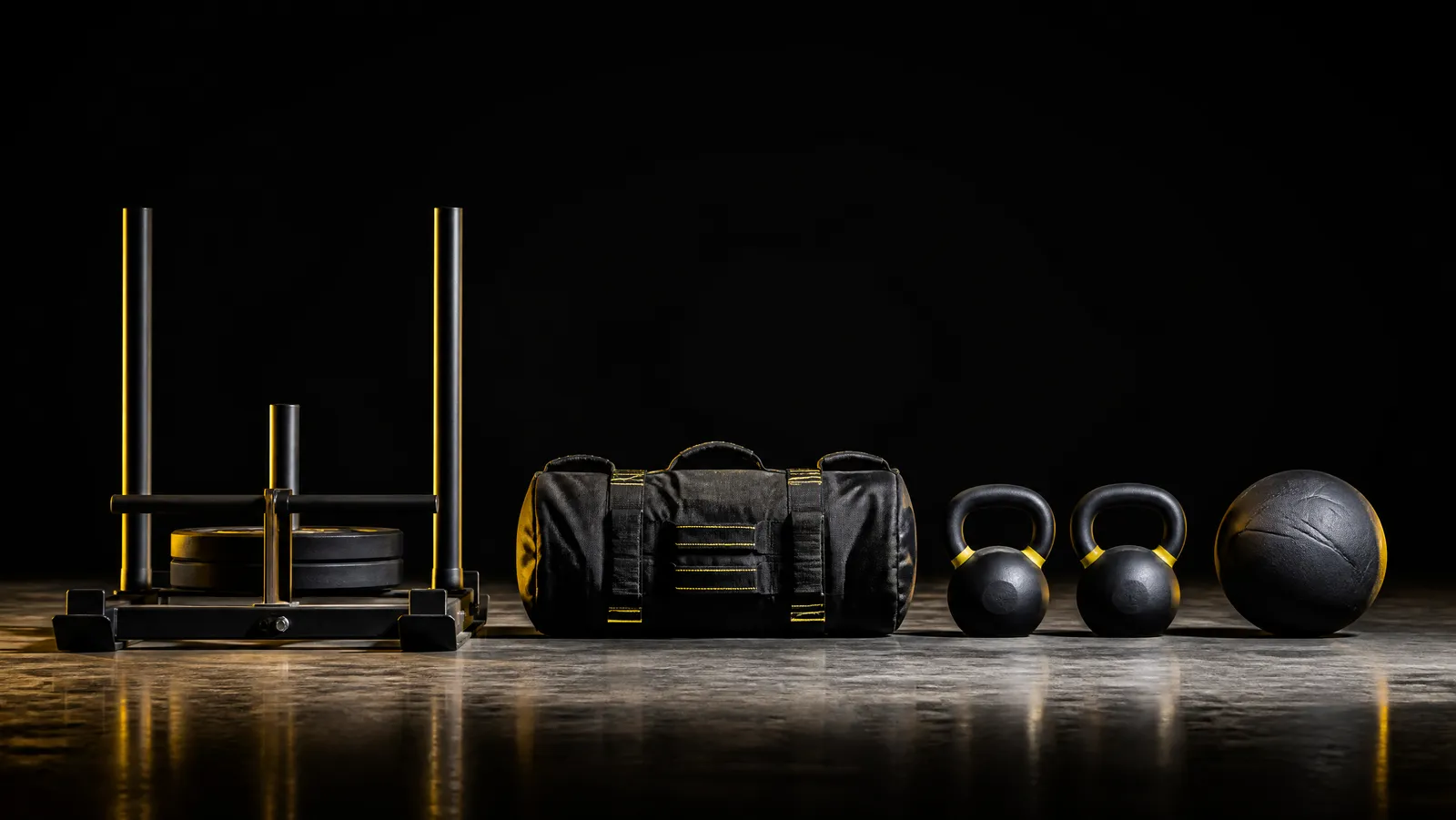
Hyrox vs CrossFit: which training style fits you?


Contains affiliate links. Our policy.
Hyrox vs CrossFit is not a rivalry. It is a choice between two different things. Hyrox is a fixed endurance race — the same eight 1 km runs and the same eight stations, in the same order, at every event on the planet. CrossFit is a training methodology, deliberately varied and skill-heavy, that also happens to have a competitive season attached. Pick by what you want to get good at.
That is the honest framing, and it is more useful than the tribal version. The real difference between Hyrox and CrossFit is standardization versus variance. Hyrox gives you one known test, which makes it trainable, comparable and easy to program for. CrossFit refuses to give you a known test on purpose, which builds a broader athlete but a less predictable one. Neither is a better answer to "should I train?" — they are answers to different questions.
Below we break down what each one actually is, what a training week looks like in both, whether Hyrox is genuinely harder, and which one fits a home gym athlete better. If Hyrox is where you are leaning, The Circuit's home Hyrox guide is the deeper version of that path.
What Hyrox actually is: one race, repeated worldwide
Hyrox is a single, fixed-format fitness race. You run 1 km, complete one functional station, run 1 km, complete the next station, and repeat until you have finished eight runs and eight stations. The station order never changes: SkiErg, sled push, sled pull, burpee broad jumps, rowing, farmers carry, sandbag lunges, wall balls. We cover the eight Hyrox stations individually elsewhere, but the structural point matters more here than any single station.
That structure is the entire product. Because the distances, the loads and the order are identical in Chicago, Hamburg and Hong Kong, every finish time in the world sits on one leaderboard. According to Hyresult's breakdown of the Hyrox run, the eight run segments are each approximately 1 km — the exact distance varies slightly by venue — and total roughly 8.7 km once the Roxzone transitions between the run course and the stations are counted.
Two numbers frame the sport. Per HyroxDataLab's analysis of 700,000-plus race results, the average finish is around 1:35 for men and 1:50 for women — this is a long day, not a sprint. And it is growing fast: BOXROX reports that more than 1.5 million athletes raced in the 2025/26 season, with Hyrox expecting to pass two million athletes across 107 race weekends on six continents in 2026/27.
What CrossFit actually is: a methodology first, a sport second
CrossFit is not a race. It is a training system that then holds a competition. CrossFit's own definition describes it as "a global fitness brand with a community and a methodology of constantly varied functional movements performed at relative intensity" — the classic shorthand being constantly varied functional movements at high intensity. In practice that means barbell work, gymnastics, monostructural cardio and odd-object work, mixed in combinations you do not know until you walk in.
The competitive side has a clear ladder, and it changed for 2026. According to CrossFit's published 2026 season structure, the pathway runs:
- The Open (February 26 to March 16) — three weeks, three workouts, done at your affiliate or home gym with scores submitted online. Anyone can enter.
- Quarterfinals (March 26-30) — back on the calendar for 2026 after being dropped, with the top 25% of individuals worldwide advancing from the Open and completing workouts at affiliates over five days.
- Semifinals (April to June) — the top 2,000 men and 2,000 women from Quarterfinals, split across in-person events and an online competition.
- The Games (July 24-26, SAP Center, San Jose) — the top 30 men, top 30 women and 20 teams.
Scale is the other contrast. CrossFitDataLab's 2026 Open analysis counts 379,235 athletes competing across 17 divisions — still short of the sport's pre-COVID high, when the 2018 Open drew more than 415,000 registrations. That is a large field by any normal standard — and roughly a quarter of Hyrox's current race participation.
Hyrox training vs CrossFit: the head-to-head
| | Hyrox | CrossFit | | --- | --- | --- | | Format | One fixed race: 8 x 1 km runs, 8 stations, same order everywhere | Constantly varied daily workouts; a four-stage competitive season | | Variance | Near zero — the test is published | High by design; you rarely repeat a workout | | Skill ceiling | Low to moderate. No station is technically hard to learn | High. Olympic lifts, muscle-ups, handstand walks, barbell cycling | | Equipment needed | Sled, SkiErg, rower, sandbag, dumbbells, wall ball, running shoes | Barbell and plates, pull-up bar, rings, dumbbells, kettlebells, box, rower | | Time to competence | Weeks to build toward a first finish; months to get fast (our judgment) | Months to years, because gymnastics and Olympic lifting take time (our judgment) | | Measuring progress | One number: your finish time, comparable worldwide | Many numbers: benchmark WODs, 1-rep maxes, skill unlocks, Open rank | | Home-gym friendliness | Good. Most stations have honest substitutes | Moderate. Doable, but needs more equipment and self-coaching |
Read that table as two philosophies rather than two scorecards. Hyrox optimizes for comparability. CrossFit optimizes for breadth. If you love the idea of a single number you can chase for years, Hyrox has built exactly that. If you would be bored senseless doing the same eight stations for a season, CrossFit has built exactly that instead.
What a training week actually looks like in each
This is where the difference stops being philosophical.
A Hyrox week looks a lot like a hybrid runner's week. The common shape we see is five or six sessions: two or three runs (one easy, one interval session at or near race pace, one longer aerobic run), two strength-endurance sessions built around the loaded stations, and at least one "compromised running" session where you run, hit a station, and run again to rehearse legs that already hurt. Roughly half of the training is running, because roughly half of the race is running.
A CrossFit week is usually five classes, each with the same internal shape: a warm-up, a strength or skill piece, then a conditioning workout somewhere between four and twenty minutes. The specific movements change daily. Over a month you might squat heavy, learn a kipping pull-up, do a 20-minute AMRAP and a 500 m row test — and never once run more than 800 m.
The practical consequence: Hyrox training is programmed backwards from a known event; CrossFit training is programmed forwards from a general goal. One is a plan. The other is a practice.
Is Hyrox harder than CrossFit?
The honest answer is that Hyrox is not harder than CrossFit. It is a different kind of hard, and the distinction is sustained pace versus peak intensity.
Hyrox difficulty is durability. With average finishes near 1:35 to 1:50 per HyroxDataLab, you are asking your body to hold a manageable-but-uncomfortable effort for well over an hour while your legs get progressively worse. Nothing in the race is technically demanding. The suffering is long, aerobic and largely self-inflicted through pacing errors — go too hard on the SkiErg and the sleds and you pay for it at the wall balls, which sit dead last on purpose.
CrossFit difficulty is spikier and more technical. A typical metcon is far shorter, so the intensity is higher, and there is a second axis Hyrox does not have: skill gating. You cannot will your way through a set of ring muscle-ups or a heavy snatch complex the way you can grind out a farmers carry. Plenty of very fit people are locked out of CrossFit workouts by a movement they have not learned yet. Almost nobody is locked out of a Hyrox station.
So: if your engine is your strength, Hyrox will feel more accessible. If your strength and skill are your strengths, CrossFit will. We are not making any claim about which is safer or which carries more injury risk — we have not found data we would stand behind on that, and we would rather say so than guess.
The crossover: what each athlete is missing
Athletes cross over between these two constantly, and the gaps are predictable.
The CrossFitter trying Hyrox almost always needs more running volume. They arrive with a strong engine, comfortable wall balls, competent lunges and a rower they already know how to pull. Then eight kilometres of running, broken into eight pieces, exposes a lack of run-specific fitness — and specifically the ability to restart running after a station, which feels nothing like starting a fresh run. The second gap is pacing patience. CrossFit rewards going hard early. Hyrox punishes it.
The runner or endurance athlete trying Hyrox has the mirror-image problem: plenty of aerobic ceiling, not enough strength endurance. The sled push, sled pull, farmers carry and sandbag lunges are all loaded, and they are where a lightly built runner loses the most time. Grip is usually the first thing to fail.
The Hyrox racer trying CrossFit discovers the skill wall. Their engine transfers immediately and their capacity for repeated effort is excellent, but barbell cycling, gymnastics and the Olympic lifts are a genuinely new curriculum that takes months of practice, not a few sessions.
Pick this if…
No winner here, just a decision.
Pick Hyrox if:
- You want a specific event on the calendar to train toward.
- You like knowing exactly what the test is, so every session has an obvious purpose.
- You already run, or you want a reason to start.
- You train mostly alone, at home, and need programming you can build yourself.
- You want one comparable number that tracks your progress over years.
Pick CrossFit if:
- You want to become a broadly capable athlete rather than good at one test.
- You want to learn skills — Olympic lifts, gymnastics, barbell cycling — and enjoy the process of learning.
- You are motivated by a class, a coach and a group, and would skip solo sessions.
- Novelty keeps you consistent, and repetition makes you quit.
- You have access to a well-equipped gym, or are willing to build one.
And an underrated third answer: do CrossFit and race Hyrox. The methodology builds the general fitness; the race gives it a deadline. Add running volume and it is a genuinely strong combination.
Training for either at home
This is where the two diverge most for our readers. Hyrox is unusually home-friendly because the test is fixed and most of it is either running or loaded carries. A sandbag, a pair of dumbbells or kettlebells, a wall ball and somewhere to run covers a large share of the race. The sled and the SkiErg are the honest gaps, and both have workable substitutes. If you own nothing at all, our guide to no-equipment Hyrox workouts shows how far bodyweight and running alone can take you.
CrossFit at home is more demanding on both budget and self-discipline. You need a barbell and plates, a pull-up bar, dumbbells, kettlebells and ideally rings before you can run the methodology as intended — and then you need programming, because "constantly varied" chosen by yourself tends to drift toward whatever you are already good at. The class model is not incidental to CrossFit; for many people it is the product.
The bottom line
Hyrox vs CrossFit is a question about your relationship with the unknown. Hyrox hands you a syllabus and asks how fast you can get. CrossFit hides the exam and asks how prepared you can be for anything. Both build serious fitness. Only one of them tells you exactly what to do on Monday morning.
For a home gym athlete with limited equipment and no coach, we think the fixed target is the bigger advantage — which is why most of what we publish here starts from the assumption that you are going to train for a Hyrox race at home. A first month that works for most people we hear from is mostly running, one loaded strength-endurance day, and some rehearsal of running straight off a station.
If you would rather learn a snatch than shave three minutes off a sled push, go and find a good affiliate instead. That is a legitimate answer to the same question.
What to know before you buy
Field Notes
Is Hyrox harder than CrossFit?
Neither is objectively harder — they are hard in different ways. Hyrox is a long, sustained-pace race; HyroxDataLab's analysis of 700,000-plus results puts the average finish at roughly 1:35 for men and 1:50 for women, so the difficulty is aerobic durability and pacing. CrossFit workouts are usually shorter and spikier, and part of the difficulty is skill — you cannot brute-force a muscle-up or a heavy snatch.
Can CrossFit training prepare you for Hyrox?
Partly, and better than most training styles. CrossFit already builds the work capacity and strength endurance the stations demand, and wall balls, rowing, lunges and burpees are all in the CrossFit vocabulary. What it usually does not build is running volume. A Hyrox race is eight separate 1 km runs, and the common gap we see is dedicated run training, especially running well straight off a station.
Do you need a gym membership for either?
For Hyrox, no. Most of the eight stations have workable home substitutes, and the running costs nothing but shoes. The sled and the SkiErg are the two real gaps, and both can be rehearsed with alternatives. CrossFit is harder to replicate alone because the methodology leans on a barbell, a pull-up bar, rings and coaching on technical lifts. A garage gym can do it, but the equipment list is longer.
Which suits a home gym better, Hyrox or CrossFit?
In our editorial view, Hyrox. The test never changes, so you always know exactly what to train, and a sandbag, a pair of dumbbells or kettlebells, a wall ball and running shoes cover most of it. CrossFit's constant variance is a strength in a coached class and a weakness alone in a garage, where most people quietly default to the workouts they already like.
Who put in the work
The Coach
Your Coach
Darlene Schmitt
I am a fitness instructor and promoter who truly enjoys helping others become the best they can be! My mission is to help people find the love of fitness and to help them develop a lifelong habit of exercise. I am a firm believer that fitness should be fun, and I make it my mission to ensure that my classes are always enjoyable. I am also a certified nutritionist and personal trainer, so I am able to offer my students comprehensive and well-rounded support.