Are adjustable dumbbells safe? Locking failures, drops and the recall record

Contains affiliate links. Our policy.
Yes, for normal use inside the manufacturer's instructions - and with one caveat big enough to change a purchase. The category has a documented recall history. On June 05, 2025 the US Consumer Product Safety Commission announced a recall of about 3,844,200 BowFlex 552 and 1090 adjustable dumbbells because "The weight plates can dislodge from the handle during use, posing an impact hazard." That is the largest of at least eight US recalls of adjustable dumbbells since 2012 — seven of them since 2024 — and every one of those notices names weight plates coming off the handle.
Asked plainly - are adjustable dumbbells safe to train with at home? - yes, and not the alarming version of it. These are safe tools with a learnable set of handling rules, plus one failure mode that three separate CPSC notices describe in nearly identical words. The rules matter more than the badge on the handle. If you are still choosing hardware, Exercise Legend's adjustable dumbbell guide covers the mechanisms and the money; this page is only about what goes wrong and how to stop it.
One caution first. Nothing here is medical advice. If you are returning from a shoulder, wrist, elbow or back problem, get assessed by a clinician or a qualified coach before you load anything overhead on a bell whose plates are held on by a selector.
How adjustable dumbbells fail, by mechanism
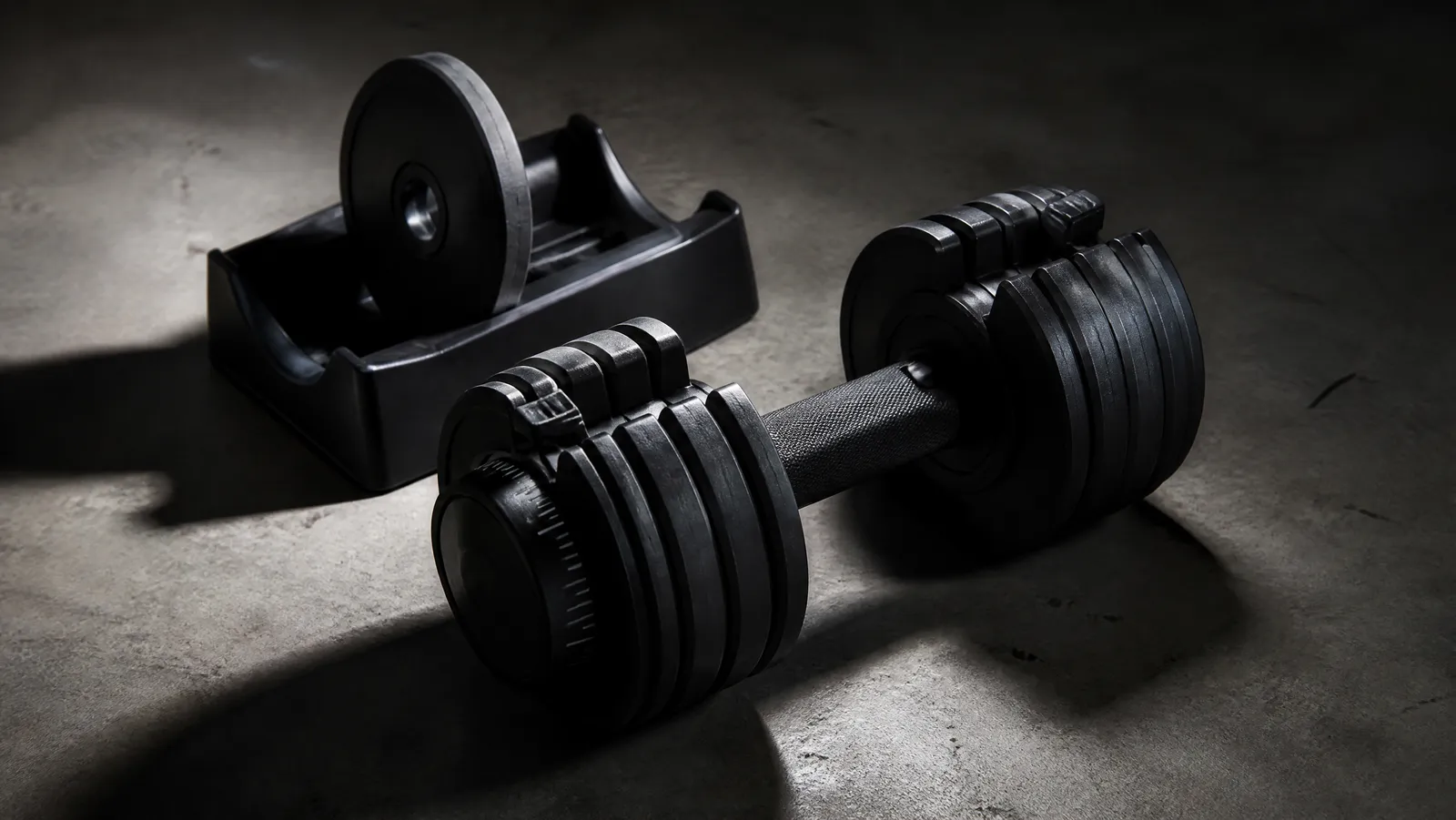
Three mechanical modes, and the mechanism comes first or the failures make no sense - how do adjustable dumbbells work is the plumbing diagram for everything below.
Partial selection, with the dial parked between settings. This is the mode makers design against most explicitly. Bowflex's BD552 owner's manual has owners deliberately set a knob "to a position that is between the numbers 5 and 7.5" - its own table reads 5lb (2.27kg) and 7.5lb (3.4kg) - which it calls "an incomplete weight selection where the adjustment knob has not fully selected a weight." Its answer is a lockout: the mechanism "is designed to lock the dumbbell handle to the base if either adjustment knob is not fully engaging the selected weight plates." The confirmation it asks of you is sensory - "You will know you have fully and correctly selected the number when you feel the adjustment knob settle into a notch (known as a detent)." Read the limit on our inference: none of the three CPSC notices below states a root cause, so we cannot say partial selection caused those recalls. What the manual says is that its maker built a lockout for the mode and asks owners to test it "periodically (once a month)."
Collars loosening on plate-loaded handles. A spin-lock handle has no selector to misalign; it has a threaded collar that is only as tight as you left it, and repetitive loading works against it. The clearest published statement of the consequence comes from Kerr, Collins and Comstock, in the American Journal of Sports Medicine: "It is essential to inspect weights regularly for defects and ensure all components of free weights are secured tightly to ensure that weights do not fall in the middle of a set." That is guidance drawn from injury surveillance, not a bench test of collars; we found no study measuring how fast a collar backs off.
Worn or cracked plastic in the selector. Selectorised bells carry load through moulded parts, and reviewers with testing programmes treat that as a known weak point. Garage Gym Reviews' dumbbell testing methodology singles out durability "particularly in adjustable dumbbells, which may contain plastic components," and states the preference plainly: "we don't like to see too many plastic moving parts on adjustable dumbbells." The limit is that this is a reviewer's protocol scored one to five, not a fatigue test across thousands of cycles. Nobody publishes that data.
Do adjustable dumbbells break? Drops are the weak point
Yes, and dropping is the way. Here the manufacturer's own documents are blunter than any review.
Bowflex's warning list instructs owners to "Never allow the dumbbells to drop freely to the ground. Damage to the product and potential personal injury may occur," and its operation section repeats it: "Do not drop the dumbbell. Dropping the dumbbell will damage the weight plates and locking mechanism." The warranty removes any ambiguity about who pays. Top of the list of what it does not cover: "Damage to the product due to dropping the dumbbell." Garage Gym Reviews does drop them - "Our testers will even drop the dumbbells from various heights to see if any moving parts break or come loose" - and reports that sets earning 3 out of 5 for durability "shouldn't be dropped regularly."
This part is mechanics and our editorial judgement, not a published finding: we have found no comparative drop test across dumbbell types, but on the documents above, a selectorised bell is the least drop-tolerant dumbbell on sale. A cast-iron hex dumbbell has no mechanism to misalign, and as kettlebell vs dumbbell sets out, a bell is a single casting. A selector bell is a gearbox you press overhead.
The adjustable dumbbell recall record
Three CPSC notices, three brands, one hazard sentence. Per the BowFlex notice, the 552 spans 5lb (2.27kg) to 52.5lb (23.9kg) and the 1090 spans 10lb (4.5kg) to 90lb (40.8kg).
| Recall | Date | Units | Incidents and injuries | Remedy | |---|---|---|---|---| | BowFlex 552 and 1090, no. 25-311 | June 05, 2025 | About 3,844,200 | 337 incidents and 111 injuries for units sold by Nautilus; 12 incidents and no injuries for units sold by Johnson Health Tech Trading | Refund as a voucher, or replacement | | ProForm Rapid Strike 50 LB, no. 24-310 | July 25, 2024 | About 54,400, plus about 650 in Canada | Eight reports of plates dislodging during use, three with injuries | Free replacement of the moulded tray | | FitRx SmartBell Quick-Select, no. 26-431 | April 23, 2026 | About 50,000 | More than 115 reports of plates dislodging, at least six injuries | Free replacement of dumbbell and tray |
The hazard wording barely moves between them. BowFlex: "The weight plates can dislodge from the handle during use, posing an impact hazard." ProForm repeats that sentence with "impact injury hazard." FitRx: "Weight plates can dislodge from the handle during use, posing a risk of serious injury due to impact hazard."
Read the injuries precisely. The BowFlex notice lists "concussions, abrasions, broken toes or contusions"; the FitRx notice lists "broken toes, bruises, contusions and lacerations." Those are impact injuries from a falling plate, not structural collapses mid-press. The instruction is the same in each case; the BowFlex notice puts it: "Consumers should immediately stop using the recalled Bowflex adjustable dumbbells."
The ProForm remedy is the telling one: "a free repair in the form of a replacement for the molded tray." The fix was the base the plates sit in, not the handle - on a selectorised bell the cradle is part of the mechanism.
The limits cut both ways, and most coverage skips this part. A notice reports incidents known to the firm and the regulator; it is not a failure rate. In the BowFlex case, 337 incidents against about 3.84 million units is a very small proportion - and also an undercount of unreported events by an unknown amount. Neither reading is safe to quote as a probability.
Testing programmes did not catch this one either. Consumer Reports tested the 552 in 2021 and recommended it, noting that "our evaluators didn't experience any safety issues with it during testing"; after the recall it withdrew the recommendation and labelled the product Do Not Buy. Its senior policy analyst Gabe Knight also called the remedy short: "Consumers should be able to receive their money back in full, no strings attached." A low-probability mechanical failure can survive a review cycle - an argument for handling rules, not a different badge.
What the safety standards actually require
Less than the marketing implies. The closest ASTM document we could find is F3105-20, Standard Specification for Externally Loaded Strength Training Equipment, Strength Training Benches and External Weight Storage Equipment. Its published abstract frames the ambition modestly: the specification "aims to assist designers and manufacturers in reducing the possibility of injury" when the products "are used in accordance with the operational instructions." Its scope restricts them to indoor use and "for use only by an individual age 13 and older."
Read two limits. ASTM sells the clauses rather than publishing them, so we are quoting the public scope and abstract, not the requirements. And a specification of this kind is design guidance for manufacturers, not a certification stamped on a finished dumbbell.
In Europe, the general document is EN ISO 20957-1:2024, Stationary training equipment - Part 1: General safety requirements and test methods, which applies to "indoor stationary training equipment" and classifies domestic kit as "equipment for domestic use (class H)." A dumbbell is not stationary equipment, so in our reading that is the wrong document to point at a free weight, whatever a product page claims.
What is left doing the work is the recall process: reactive by design.
The injury numbers, and what they cannot tell you
There is a national dataset here, narrower than it looks. Kerr, Collins and Comstock, in the American Journal of Sports Medicine analysed the CPSC's National Electronic Injury Surveillance System and reported that "From 1990 to 2007, 25 335 weight training injuries were seen in US emergency departments, correlating to an estimated 970 801 injuries nationwide." Two findings matter for this page. "The most common mechanism of injury was weights dropping on the person (65.5%)." And "A large number of injuries occurred with free weights (90.4%)."
Now the limits, in the authors' own words, because they are large. NEISS captures emergency-department visits only - "Only injuries treated in EDs are captured, excluding less severe injuries that may have not received any medical attention or that may have been treated in other health care settings." It carries no denominator: "The NEISS data also does not include denominator data (ie, the number of persons participating in weight training)." And the authors note it "did not uniformly address other variables that may have had an impact on risk of injury, such as mechanism of injury, type of equipment used, amount of instruction prior to using weights, the site of injury (eg, school fitness center, gym, home)."
So NEISS cannot tell you whether adjustable dumbbells are more dangerous than fixed ones. It does not distinguish them, does not know how many people own either, and stops at the emergency-department door. What it supports is narrower and still useful: across all weight training, the dominant mechanism is a weight landing on a person, and nine in ten of those injuries involved free weights rather than machines.
The handling rules that follow from the evidence
Every rule below traces to a source above.
- Confirm the setting before every set, by feel. Bowflex's manual defines a correct selection as the knob settling "into a notch (known as a detent)" with "a slight, but audible, clicking noise." If you did not feel the detent, you did not select the weight.
- Lift the bell vertically off the cradle, never at an angle. The same manual: "When either returning or removing the dumbbell to or from the base, use a vertical motion, perpendicular to the base. Do not tilt the dumbbell or move it laterally (parallel to the base) until it is fully clear of the unselected weight plates."
- Never change the weight away from the base. Bowflex instructs owners to "Never attempt to force the adjustment knob to rotate when the dumbbell has been removed from the dumbbell base." Mid-set adjustments are not a thing these bells do.
- Set it down. Do not drop it. The warranty excludes "Damage to the product due to dropping the dumbbell," and the locking mechanism is the part you least want damaged.
- Inspect before each session, test the lockout monthly. Bowflex's warnings say to "Inspect the dumbbells prior to each use. Do not use a dumbbell with worn or damaged parts," and to "Periodically inspect and test the locking mechanism for proper function" - the manual suggests "once a month."
- Tighten collars on plate-loaded handles every session. Per Kerr and colleagues, ensure "all components of free weights are secured tightly to ensure that weights do not fall in the middle of a set."
- Store the bells seated in the cradle. It keeps the plates supported, keeps the selector clean - the manual's troubleshooting blames "dirt, debris or other obstruction in the dumbbell base" for knobs that will not turn - and keeps the dial out of a child's reach.
- Check your serial number once, today. All three notices are indexed on cpsc.gov by model and serial - printed on the tray, not the handle.
If a selector is already slipping or a knob no longer clicks, stop using the bell. How to fix adjustable dumbbells is a separate question, and the manual's own answer is to "Discontinue use of the product immediately until proper service can be provided."
Who should be more careful
Three situations change the stakes rather than the odds. These are handling decisions, not medical advice.
Overhead pressing. A plate that disengages above your head has your skull, collarbone and foot beneath it, and the BowFlex notice records "concussions" among reported injuries. Overhead is where the detent check stops being optional.
Training alone. Kerr and colleagues recommend that "persons lifting free weights should lift with a spotter, or at least, with other persons present, to assist control of the weights" - advice written for a gym, while most adjustable dumbbells live in a spare room. Keep a phone within reach instead.
Lifting above a child or a pet. Nationwide Children's Center for Injury Research and Policy reports that "over 12,000 children a year are treated in U.S. emergency departments" for injuries involving home exercise equipment, and that children "especially those 4 years and younger, get hurt when they touch moving parts of equipment." Bowflex's warning is categorical: "Never allow children to use or play near this equipment."
Are adjustable dumbbells good, then? The honest verdict
Yes - with the handling rules treated as part of the equipment rather than as fine print.
The sourced position is this. One hazard dominates the category: plates leaving the handle during use, named in nearly identical language across three CPSC notices issued between July 2024 and April 2026, covering about 3.95 million units. The mitigations are unglamorous - confirm the detent, lift vertically, never adjust off the base, set the bell down, inspect each session, test the lockout monthly, tighten collars, store in the cradle. No notice states a root cause, so the recall record neither shows these bells failing at random nor rules it out - and nothing in it supports a probability estimate either way, because no notice publishes a failure rate.
We will not turn that into a purchase recommendation. What weight adjustable dumbbells to buy is a separate decision - the trade-offs run through choosing adjustable dumbbells for a home gym and, if your training is conditioning-led, through hyrox home gym equipment. Any of them will hurt you if a plate is half-selected.
The bell is not the risk. The half-turn is.
What to know before you buy
Field Notes
Is there a mandatory safety standard for adjustable dumbbells?
Not one we could find. The document that reads closest to the category is [ASTM F3105-20, Standard Specification for Externally Loaded Strength Training Equipment, Strength Training Benches and External Weight Storage Equipment](https://store.astm.org/f3105-20.html), whose own abstract says it "aims to assist designers and manufacturers in reducing the possibility of injury" only "when the products are used in accordance with the operational instructions," and whose scope restricts the products to users "age 13 and older." Read two limits. ASTM publishes the requirements themselves behind a paywall, so we are quoting the public scope and abstract rather than the clauses. And the European general standard, [EN ISO 20957-1:2024, Stationary training equipment - Part 1: General safety requirements and test methods](https://online.standard.no/en/ns-en-iso-20957-1-2024), is written for "indoor stationary training equipment" with a class H category for "equipment for domestic use (class H)" - and a dumbbell is not stationary equipment. In our reading that leaves the recall process, not a certification mark, doing most of the safety work in this category.
Can you drop adjustable dumbbells?
The maker of the set at the centre of the category's largest recall says no, in the warning section and again in the warranty. [Bowflex's BD552 owner's manual](https://cdn.shopify.com/s/files/1/0604/6708/5501/files/BFX_SelectTech552.pdf) instructs owners to "Never allow the dumbbells to drop freely to the ground. Damage to the product and potential personal injury may occur," and its limited warranty lists "Damage to the product due to dropping the dumbbell" first among what the warranty does not cover. Independent testing treats drops as a differentiator rather than a given: [Garage Gym Reviews' dumbbell testing methodology](https://www.garagegymreviews.com/ggr-dumbbell-testing-methodology) says "Our testers will even drop the dumbbells from various heights to see if any moving parts break or come loose," and that a set scoring 3 out of 5 for durability "shouldn't be dropped regularly." Plan your sessions so the bell is set down, not released.
How do I check whether my adjustable dumbbells have been recalled?
Find the model number and serial number first - on these products they live on the moulded plastic tray rather than the handle. The [CPSC notice for the ProForm Rapid Strike 50 LB set](https://www.cpsc.gov/Recalls/2024/iFIT-Recalls-ProForm-50-LB-Adjustable-Dumbbells-Due-to-Impact-Injury-Hazard) says the model number "is printed on a sticker under the lip at the base of the molded tray," and the [notice for the FitRx SmartBell Quick-Select](https://www.cpsc.gov/Recalls/2026/Tzumi-Electronics-Recalls-FitRx-SmartBell-Quick-Select-Adjustable-Dumbbells-Due-to-Serious-Injury-from-Impact-Hazard) limits the recall to model 8361 within two specific serial ranges, printed on the side of the storage tray. Then search those numbers against cpsc.gov rather than against a brand's own page, because two of the three recalls we found were announced by a company other than the one named on the dumbbell.
Are plate-loaded spin-lock dumbbells safer than selectorised ones?
We have found no study, test programme or regulator document comparing the two, so this is mechanics and our editorial judgement rather than evidence. A spin-lock handle has fewer moving parts and no plastic selector to crack, and it fails slowly and visibly - a collar backs off over several sets - where a selector failure is instant. The price is that the collar is now your job every session. [Kerr, Collins and Comstock, in the American Journal of Sports Medicine](https://pubmed.ncbi.nlm.nih.gov/20139328/) make that point directly in their recommendations: "It is essential to inspect weights regularly for defects and ensure all components of free weights are secured tightly to ensure that weights do not fall in the middle of a set." Neither design removes the handling rules; they move them around.
Are adjustable dumbbells safe to keep in a house with small children?
Only stored, and storage is the whole answer. [Nationwide Children's Hospital's Center for Injury Research and Policy reports that "over 12,000 children a year are treated in U.S. emergency departments"](https://www.nationwidechildrens.org/cirp-home-exercise-equipment) for injuries involving home exercise equipment, and that younger children "especially those 4 years and younger, get hurt when they touch moving parts of equipment." Its advice is framed for parents rather than lifters: "Parents can tell young children that exercise equipment is not a toy and should not be played with." [Bowflex's own warning list](https://cdn.shopify.com/s/files/1/0604/6708/5501/files/BFX_SelectTech552.pdf) goes further for its product: "Never allow children to use or play near this equipment. Teenagers under the age of 18 must always have parental supervision and instruction on the use of this product." A selector dial that a toddler can turn is a reason to store the bells seated in the cradle, out of reach.
Who put in the work
The Coach
Your Coach
Darlene Schmitt
I am a fitness instructor and promoter who truly enjoys helping others become the best they can be! My mission is to help people find the love of fitness and to help them develop a lifelong habit of exercise. I am a firm believer that fitness should be fun, and I make it my mission to ensure that my classes are always enjoyable. I am also a certified nutritionist and personal trainer, so I am able to offer my students comprehensive and well-rounded support.