How do adjustable dumbbells work? Dial, pin and plate mechanisms compared

Contains affiliate links. Our policy.
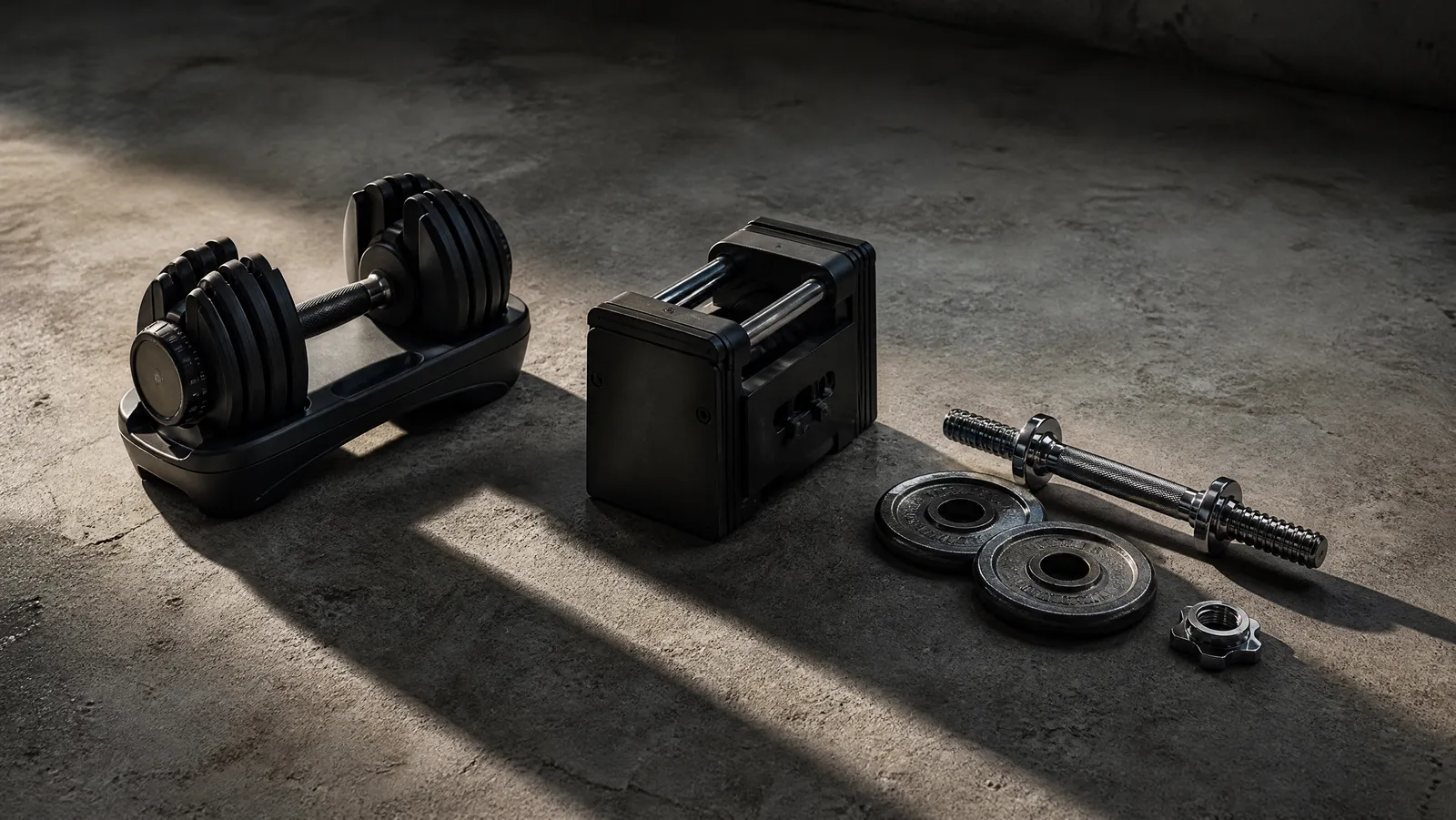
Every adjustable dumbbell answers one question: where does the weight you are not lifting go? Three mechanisms answer it differently. A dial engages plates that stay behind in a cradle, a pin selects shells from a nested stack, and a threaded handle takes loose plates you slide on by hand. Speed, length, handle feel and what survives a drop all follow from that single choice.
That is the short version of how do adjustable dumbbells work, and in our reading the mechanism family tells you far more than the brand name on the end cap. Our position is that you choose the mechanism first and the model second, because the mechanism decides what the bell can do in your actual room. If you are still at the buying stage, adjustable dumbbells for home gym handles that decision; this page is only about the machinery.
One caution before the mechanics, because it is the most consequential fact on this page. On 5 June 2025 the US Consumer Product Safety Commission published recall 25-311, covering about 3,844,200 BowFlex 552 and 1090 adjustable dumbbells, on the grounds that "The weight plates can dislodge from the handle during use, posing an impact hazard." The same notice records 337 reports of plates dislodging on units sold by Nautilus, "including 111 resulting in injuries" described as concussions, abrasions, broken toes or contusions, plus 12 further reports with no injuries on units sold by Johnson Health Tech Trading, and it instructs that "Consumers should immediately stop using the recalled Bowflex adjustable dumbbells." If you own either model, check your serial number against that notice before your next session. And if you have a history of foot, hand or shoulder injury, get assessed by a clinician or a qualified coach before you load anything overhead.
The three adjustable dumbbell mechanisms, in one line each
Three families cover the whole market. Almost every bell you can buy is a variation on one of them.
- Dial or selector, also called selectorised. A rotating dial or sliding lever at one or both ends grips a subset of discs nested in a base. Turn the dial, lift the handle, and the unselected discs stay standing in the cradle. Bowflex SelectTech, NordicTrack, Core Fitness and most bells advertised as one-second adjustments live here. The twist-handle designs such as NUOBELL are a sub-family: Rogue's listing describes changing the weight by twisting the handle, with "no pins, levers, or bulky selector dials", across a 5 to 80lb (2.3 to 36.3kg) range in 5lb steps.
- Pin or block selector. A stack of U-shaped steel shells sits inside a rectangular cage, and a pin through the handle decides how many shells come up with you. PowerBlock is the archetype. Its Elite EXP spec sheet describes a "Magnetic selector pin" and sums up the operation as "Just insert pin and lift."
- Spinlock or plate-loaded. A bare threaded handle plus loose plates and a nut. Body-Solid's SDA14T is the plain version — a 1-inch standard threaded dumbbell handle with collars, listed at 14.50 inches (36.8cm) long and 3.90lb (1.8kg) bare. Ironmaster's Quick-Lock is the engineered version of the same idea, using a locking screw rather than a spun nut.
Each family fails, ages and handles differently. The rest of this article is those differences.
Dial adjust vs selectorised dumbbell: what the dial actually moves
Nothing, mechanically, until the bell is seated. That is the detail most explainers skip, and it changes how you program a session.
The Bowflex SelectTech 552 owner's manual is explicit that the locking mechanism "will only allow the adjustment knobs to be rotated when the dumbbell handle is completely inserted and engaging the dumbbell base," and it instructs owners to "Never attempt to force the adjustment knob to rotate when the dumbbell has been removed from the dumbbell base." The second half of that mechanism is the safety half: it is designed to "prevent deselecting (dropping) weight plates from the dumbbell when it is NOT in the dumbbell base."
So a dial bell is a two-part product. The handle is the dumbbell; the cradle is the gearbox. Every weight change is a round trip to the stand.
The increments are not as even as the marketing suggests. Bowflex lists the range as "5 to 52.5 lbs (2.27kg to 23.9kg) on both adjustment knobs" and publishes the full ladder — "There are 15 weight increments" at 5, 7.5, 10, 12.5, 15, 17.5, 20, 22.5, 25, 30, 35, 40, 45, 50 and 52.5lb. Read that list carefully: the steps are 2.5lb (1.1kg) up to 25lb (11.4kg), then 5lb (2.3kg) steps to 50lb (22.7kg), then a final 2.5lb step. The fine granularity exists exactly where a novice needs it and disappears exactly where a stalling lifter needs it.
The handle also has to be put back the way it came out. The manual instructs a "vertical motion, perpendicular to the base" when removing or returning the bell, with no tilting or lateral movement "until it is fully clear of the unselected weight plates." It also documents offset weight selection — different numbers on each end — and warns that with offset loads "you must return the dumbbell to the base in the same orientation" so the plates drop back into their vacant slots. None of that is hard. All of it is a habit, and it is where we think most mechanism damage starts.
One more number worth knowing: Bowflex gives the full assembly weight as "Approximately 58 lbs (26.3 kg)" per dumbbell, cradle included. The 52.5lb (23.8kg) bell is not the thing you carry upstairs.
Spinlock dumbbell explained: the mechanism with no mechanism
A threaded handle is the only adjustable dumbbell with nothing inside it to break. That is its entire argument, and the price is time.
Body-Solid's standard handle is a 1-inch (25.4mm) threaded bar with spin-lock collars that thread down the sleeve until they sit flush against the plates (Body-Solid SDA14T). Because the collar is a nut on a thread rather than a clamp on a smooth sleeve, it does not depend on friction to hold. Body-Solid's 5 to 50lb pro-style set ships with "16x 5 lb. plates, 4x 2.5 lb. plates, and 2x threaded dumbbell handles w/ spin lock collars" (Body-Solid pro-style adjustable dumbbell pair), so your increment is whatever two matched plates you own — 5lb (2.3kg) per dumbbell from a pair of 2.5lb plates.
Ironmaster sells the engineered middle ground. Its Quick-Lock system is listed as adjusting from 5 to 75lb (2.3 to 34kg) per dumbbell in 2.5lb (1.1kg) steps, changed by a partial turn of a locking screw rather than a spun-off nut, under what its own listing cites as US patent 7,182,716 (Ironmaster Quick-Lock 75lb system), a grant Google Patents titles "Dumbbell with quick release bolt" and records to an individual inventor. Same physics as a spinlock, far fewer rotations.
The honest trade on plate-loaded bells is that the weight change is a two-handed, floor-level job involving loose iron. That is slow between supersets and fiddly mid-circuit, which is why nobody runs a conditioning piece on them. What you get back is a load path made of steel and thread with no selector gearing to strip.
How to use adjustable dumbbells without wrecking the mechanism
This is the part of how do adjustable dumbbells work that owners learn the hard way. The rules are mechanism-specific, and they come down to not asking the selector to do a job it was not built for.
- Set the weight with the bell supported, not in the air. On dial bells this is not optional — the knob will not turn out of the base. On a block selector, PowerBlock's instruction is the whole procedure: "Just insert pin and lift." On a spinlock, do it on the floor with the handle flat.
- Confirm the lock before the first rep. Bowflex suggests repeating its own locking-mechanism test "once a month" to confirm proper function, which is a reasonable cadence for any selector-based bell. Lift the handle an inch, feel for free play, then load it. What fails in these mechanisms and how to spot it early is the subject of are adjustable dumbbells safe.
- Read the increment ladder, not the headline increment. PowerBlock's sheet says "Increments 2.5 lbs", but the Stage 1 list it publishes runs 5, 7.5, 10, 15, 17.5, 20, 25, 27.5, 30, 35, 37.5, 40, 45, 47.5 and 50lb — no 12.5 and no 22.5. Dial bells cluster their fine steps at the bottom of the range instead, and plate-loaded handles give you whatever plates you bought.
- Do not drop them. Any of them. That applies to all three families, and the next-but-one section is why.
- Expect a handle that feels different. PowerBlock lists a 38mm TPR grip at 4.75 inches long on the Elite EXP, against the average fixed dumbbell in Garage Gym Reviews' own spec table, listed at "4.8″ length, 32 mm diameter for 5-50 lbs". A spinlock handle is thinner again at 1 inch (25.4mm). Grip diameter changes how hard a heavy row is to hold — mechanics and our editorial judgement, not a published finding, because we found no trial measuring it.
If your selector has already started slipping or sticking, that is a repair question rather than a technique question, and how to fix adjustable dumbbells is a topic we treat separately.
The geometry tax nobody puts on the spec sheet
The length of an adjustable bell changes the lift, and the numbers are public.
The Bowflex SelectTech 552 owner's manual gives one dumbbell as 16.9 x 8.3 x 9 inches (43cm x 21.2cm x 22.8cm) — a figure its own dimension drawing takes with the bell seated in its base — and that figure does not move with the setting, because the plate pack is the same physical object whether you selected 5lb or 52.5lb. PowerBlock's Elite EXP sheet grows instead of staying fixed: Stage 1 at 12 x 6.3 x 6.5 inches (30.5cm x 16cm x 16.5cm), Stage 2 at 14 inches (35.6cm) long and Stage 3 at 16 inches (40.6cm), all at the same 6.3-inch (16cm) width.
Hold those against the lifts. A 16.9-inch (43cm) bell is awkward racked on the shoulders, catches the thigh in a lunge, and sits high off the floor at the bottom of a Romanian deadlift. A 12-inch (30.5cm) cage 6.5 inches (16.5cm) tall is a different object in the same hand. This part is mechanics and our editorial judgement, not a published finding: we have found no trial comparing range of motion or kinematics between adjustable and fixed dumbbells at matched loads, so treat length as a fitting constraint you measure, not a performance penalty anyone has quantified. If your bench is narrow or your rack uprights are close, measure the gap before you order — the same clearance arithmetic we run in 5 best home gym benches.
This is also the honest version of the adjustable dumbbells vs fixed dumbbells argument. Fixed bells shrink as they get lighter. Adjustable bells mostly do not.
Durability: what the mechanism tells you, and what nobody publishes
Here is the limit of this entire article. No manufacturer we found publishes failure rates, cycle counts or mean time between failures for a selector mechanism. What exists is mechanism-level reasoning plus the drop testing that review outlets do, and we will label which is which.
What is published. Garage Gym Reviews' dumbbell testing methodology states that "Our testers will even drop the dumbbells from various heights to see if any moving parts break or come loose," that a middling durability score goes to dumbbells that "seem like they'd hold up but shouldn't be dropped regularly," and — directly on the point — "we don't like to see too many plastic moving parts on adjustable dumbbells." The same methodology scores adjustment speed, reserving its top marks for "fast-adjusting dumbbells that only need a twist of the handle" and a middling score for designs that "may require you to move a pin on either side, but it doesn't take too long in total." That is a testing programme's judgement, not a measured lifespan.
What the manufacturers admit. Bowflex's manual contains the plainest durability statement in the category: "Do not drop the dumbbell. Dropping the dumbbell will damage the weight plates and locking mechanism, which could void the warranty of this product," alongside the safety-section line "Never allow the dumbbells to drop freely to the ground." PowerBlock's sheet counters with materials rather than warnings, specifying "Solid steel plates" and a "5 year limited warranty."
What the record shows can fail. Selector and plate-locking mechanisms have produced at least eight CPSC recalls, seven of them since 2024. The 2025 notice is the large one; the earlier, smaller case is the more diagnostic: in recall 12-194, dated 7 June 2012 and covering about 17,000 SelectTech 1090 dumbbells, the hazard was that "The weight selector dial on the units can fail," dropping plates as the bell was lifted from its cradle, with 16 reports of dial failure "including three reports of injuries to the user's foot or leg." The same failure mode has since been recalled on five other brands' bells — NordicTrack's iSelect 50lb (22.7kg), about 15,400 units and ProForm's Rapid Strike 50lb (22.7kg), about 54,400 units in 2024, PowerBlock’s Commercial Pro 100 5lb (2.3kg) grip handles in October 2024, FitRx’s SmartBell XL, about 12,400 units in March 2025, FitRx's SmartBell Quick-Select, about 50,000 units in April 2026 and Amazon Basics' 55lb (24.9kg) bell, about 2,900 units in May 2026 — every notice citing weight plates dislodging from the handle. None of those notices publishes a failure rate. It is a demonstration that the dial is the part that matters.
Our reading, labelled as such. On mechanism alone, a threaded steel handle with a steel nut has the fewest ways to fail, a pin through a steel cage has few more, and a geared plastic selector has the most. None of the three tolerates being dropped, which is the thing a home-gym lifter most wants permission to do. If your training involves dumbbell snatches, devil's presses or anything you will want to put down fast — the pattern set that dominates hyrox home gym equipment lists — no mechanism in this category rescues you. It is the same compromise we traced through best adjustable kettlebells: a one-handle system buys floor space by adding joints, and joints are where things come apart.
Choosing a mechanism, not a model
Work backwards from the thing you cannot change. If speed between sets matters, a twist or dial bell wins on seconds and loses on length. If you want a short bell with 2.5lb (1.1kg) adder weights available across it, a block selector does that in a 12-inch (30.5cm) package at Stage 1. If you plan to own these for fifteen years, a threaded handle has the least to go wrong.
Asked properly, how do adjustable dumbbells work is a question about which compromise you are buying. The mechanism sets your adjustment time, your shortest usable increment, your clearance on a bench and your tolerance for mistakes, and no model-shopping inside a family changes any of it.
For the buying decision this sets up, with current configurations and the trade-offs priced out, see our complete adjustable dumbbell guide.
A dumbbell that adjusts is a dumbbell with moving parts. The question is never whether that costs you something. It is which cost you would rather pay.
What to know before you buy
Field Notes
How many fixed dumbbells does one adjustable pair actually replace?
Fewer than the marketing arithmetic implies, because the count is of settings rather than of useful settings. PowerBlock's own Elite EXP spec sheet claims the system "Replaces up to 27 dumbbell pairs" ([PowerBlock Elite EXP specifications](https://cdn.shopify.com/s/files/1/0862/1694/files/Elite_EXP.pdf)), while the [Bowflex SelectTech 552 owner's manual](https://cdn.shopify.com/s/files/1/0604/6708/5501/files/BFX_SelectTech552.pdf) states "There are 15 weight increments" between 5 and 52.5 lbs. This part is arithmetic and our editorial judgement, not a published finding: a rack of 15 fixed pairs lets two people train at once and lets you superset two loads, and one adjustable pair does neither. The replacement claim is about floor space, not about capability.
What is the difference between a 1-inch and a 2-inch dumbbell handle?
The bore of the plate it accepts, which decides what you can buy to load it. Body-Solid lists its SDA14T as a 1-inch standard threaded dumbbell handle with collars ([Body-Solid SDA14T](https://bodysolid.com/standard-threaded-dumbbell-handle-with-collars)), sized for standard plates with a 1-inch (25.4mm) hole. Body-Solid sells a separate 2-inch Olympic dumbbell handle, the OB20 ([Body-Solid OB20](https://www.bodysolid.com/home/ob20c/olympic_dumbbell_handle)), for Olympic-bore plates. The two are not interchangeable, and in our reading that is the single most common ordering mistake in the plate-loaded category.
Why will my dial dumbbell not come out of the cradle?
Usually because a knob is parked between two numbers, and that is the mechanism working rather than failing. The [Bowflex SelectTech 552 owner's manual](https://cdn.shopify.com/s/files/1/0604/6708/5501/files/BFX_SelectTech552.pdf) describes a mechanism "designed to lock the dumbbell handle to the base if either adjustment knob is not fully engaging the selected weight plates," and its own test has you set a knob between 5 and 7.5 to confirm the handle "cannot be removed with light pressure, as it can normally." The manual also warns against brute force on a locked knob, because "Excessive force may damage the locking mechanism." Rotate both knobs to a full click on a printed number and lift straight up.
Does the warranty cover the adjustment mechanism?
Sometimes, and dropping the bell is the usual exclusion. PowerBlock's Elite EXP sheet lists a "5 year limited warranty" ([PowerBlock Elite EXP specifications](https://cdn.shopify.com/s/files/1/0862/1694/files/Elite_EXP.pdf)). The [Bowflex SelectTech 552 owner's manual](https://cdn.shopify.com/s/files/1/0604/6708/5501/files/BFX_SelectTech552.pdf) is blunter: "Do not drop the dumbbell. Dropping the dumbbell will damage the weight plates and locking mechanism, which could void the warranty of this product," and it points readers to "specific warranty limitations related to dropped dumbbells." Read those two documents together and the pattern is clear enough — the moving parts are warranted against defects, not against the floor.
Will an adjustable dumbbell fit between my hands on a bench press?
Measure before you assume, because the length difference across mechanisms is large. Bowflex lists the 552 at 16.9 x 8.3 x 9 inches (43cm x 21.2cm x 22.8cm) per dumbbell ([Bowflex SelectTech 552 owner's manual](https://cdn.shopify.com/s/files/1/0604/6708/5501/files/BFX_SelectTech552.pdf)), while PowerBlock lists the Elite EXP Stage 1 at 12 x 6.3 x 6.5 inches (30.5cm x 16cm x 16.5cm) ([PowerBlock Elite EXP specifications](https://cdn.shopify.com/s/files/1/0862/1694/files/Elite_EXP.pdf)). That is roughly a 5-inch (12.7cm) difference in length per hand at comparable loads, on figures Bowflex measures with the bell in its base. We have found no published testing that quantifies what that does to pressing mechanics, so treat the geometry as a fitting problem rather than a performance claim.
Who put in the work
The Coach
Your Coach
Darlene Schmitt
I am a fitness instructor and promoter who truly enjoys helping others become the best they can be! My mission is to help people find the love of fitness and to help them develop a lifelong habit of exercise. I am a firm believer that fitness should be fun, and I make it my mission to ensure that my classes are always enjoyable. I am also a certified nutritionist and personal trainer, so I am able to offer my students comprehensive and well-rounded support.