Rucksack or weighted vest: which should you train with?

Contains affiliate links. Our policy.
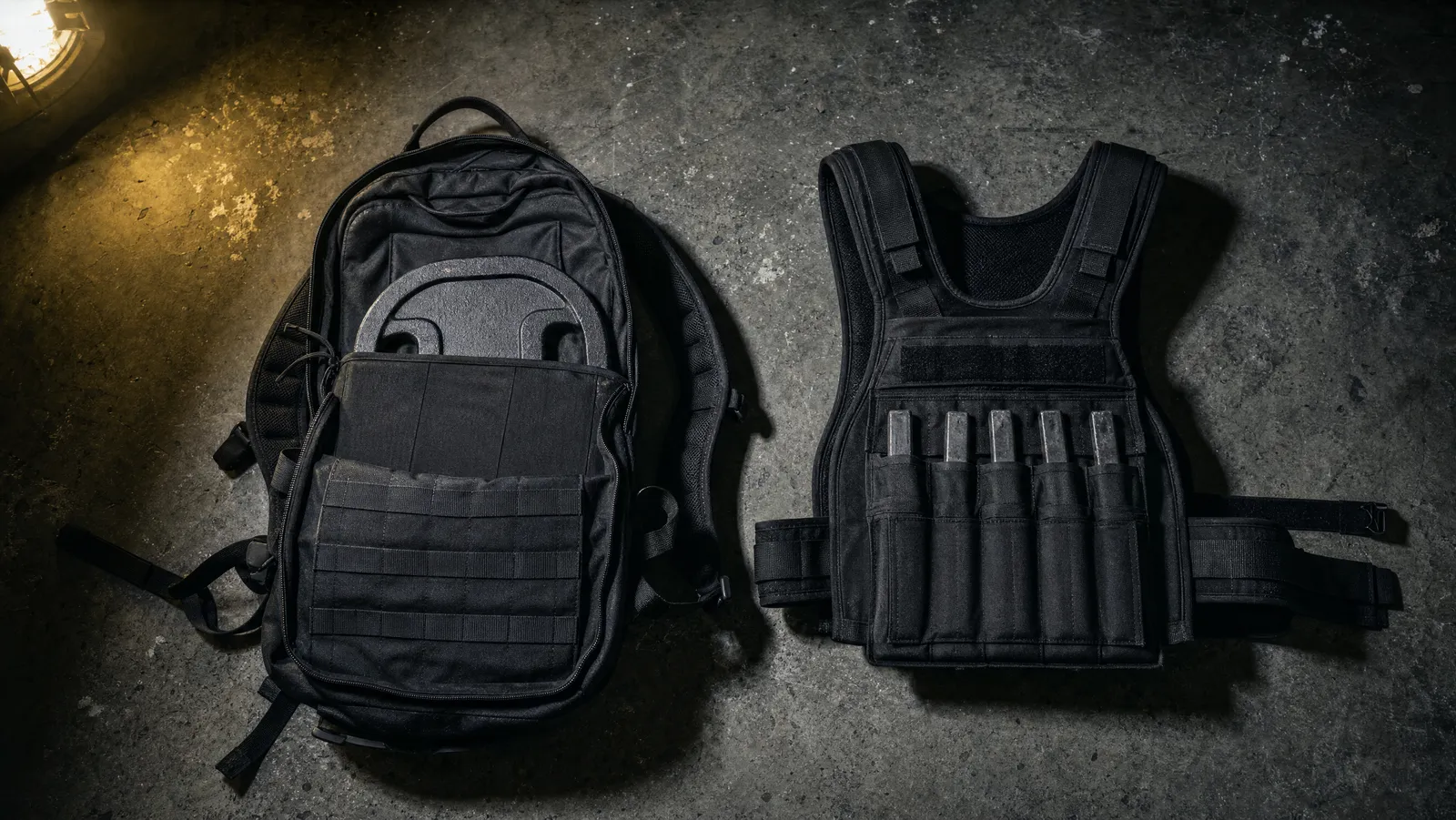
A rucksack for distance, a weighted vest for short conditioning work. The pack sits high on your back and can hand part of the load to your hips, which is what keeps it tolerable for miles. A vest wraps the same weight around your torso, close to your centre of mass, so it moves less, costs less energy to carry, and suits shorter, harder sessions.
That is the rucking vs weighted vest question in outline, and the rest of this article is about which trade-offs you are buying. The two carriers are not interchangeable. At an identical weight they produce measurably different energy costs, different pressure points, and different limits on how long you can keep going. If weighted walking is new to you, our guide to rucking for beginners covers the setup and the first month; this piece is only about the choice of carrier. One caveat before we go further: if you are pregnant, managing a health condition, or returning from an injury, hanging load on your torso is a conversation for a doctor or a qualified coach before it is a conversation for an article.
Rucking vs weighted vest: the short answer
| | Rucksack | Weighted vest | | --- | --- | --- | | Where the load sits | Behind you, high on the back | Wrapped round the torso, front and back | | Energy cost at the same weight | Higher | Lower | | Comfortable duration | Hours, when it fits properly | Usually a session, not an afternoon | | Main pressure points | Shoulder straps and traps | Ribcage, chest, whole torso | | Weight increments | As fine as you like | Whatever the maker chose | | Carries water and layers | Yes | No | | Breathing | Heavy packs also reduce lung volumes | Can restrict chest expansion | | Best at | Distance, hills, time on feet | Intervals, carries, bodyweight work |
Two lines in that table do most of the work. The pack is the distance tool because it can offload to your hips and because it holds your water. The vest is the conditioning tool because it stays put when you move fast, which a loaded pack does not.
Everything else is detail. Useful detail, though, because the two carriers fail in different ways, and knowing which failure you are more likely to meet is most of the decision.
Weighted vest vs rucksack: where the load sits
The clearest evidence on this comes from an unlikely place: the US Army's mission-planning software. In a 2024 paper in Medicine and Science in Sports and Exercise, David Looney and colleagues at the US Army Research Institute of Environmental Medicine explain that the Army's Load Carriage Decision Aid "has yet to be adapted for vest-borne load carriage, which is commonplace in tactical populations, and differs in energetic costs to backpacking and other forms of load carriage."
They then built the missing equation. Twenty military-age adults — 16 men and 4 women — walked at speeds up to 1.97 metres per second while carrying vest loads of 0, 22, 44 and 66 percent of body mass, with oxygen uptake measured throughout. The point of the exercise was that a backpack and a vest cannot share a formula.
Their explanation of why is the useful bit for the rest of us. "The metabolic cost of load carriage is heavily dependent upon its position relative to the center of mass, with loads placed at distal extremes bearing a higher cost," the authors write, adding that "even distributing a load mass further away from the body within a backpack results in significantly increased metabolic demands." A vest sits closer to the middle of you and splits the weight front to back, which means "the magnitude of biomechanical adaptations necessary for maintaining balance" goes down.
The oldest number in the argument is still the most quotable. Looney's team cites a seminal study by Datta and Ramanathan showing that carrying a load on the front and back of the torso "reduced metabolic demand by 9% compared with carrying the same load in a backpack." Their own conclusion runs the same direction: "military rucksacks have a higher metabolic cost to carry than weighted vests."
Read that as a feature of the pack, not a fault. If you want a walk to cost more, the pack gives you more per pound.
Does a pack really make you lean forward?
This is where the sources stop agreeing, and it is worth showing the seam.
Looney and colleagues state it flatly: "the posterior placement of the load in a backpack results in excessive forward lean of trunk, which greatly reduces movement economy." That is the standard account, and it is why so much rucking advice tells you to keep the pack high and tight.
A 2017 study in the International Journal of Exercise Science by Strube and colleagues found something more complicated. Twenty male Army ROTC cadets were tested unloaded and with rucksacks of 16 kg and 20.5 kg — roughly 20 and 26 percent of their body mass. Mean postural sway velocity rose significantly, by 16 to 52 percent depending on stance and whether the eyes were open. But the study reported "no significant alterations" in forward trunk lean or in pelvic girdle motion at those loads.
Our reading is that both are right about different loads. Forward lean is a documented response to heavy posterior loading; at the 20 to 25 percent range most recreational ruckers actually use, the cadet data suggests posture holds up better than the folklore claims. What does change at those moderate loads is balance. If you ruck on uneven ground, at dusk, or on cambered pavement, that is the finding to take seriously.
Rucking backpack vs weighted vest over distance
Distance is where the pack's design advantage and its worst failure mode both live.
The failure mode has a name. A 2021 case series in Military Medicine by McShea and colleagues describes three active-duty service members who developed isolated nerve injuries from rucksack carriage — one spinal accessory nerve and two long thoracic nerve injuries. One case followed a single 13-mile ruck march carrying 65 pounds in an older internal-frame pack. The authors note that such cases "typically present with weakness, paresthesia, sensory loss, or atrophy," and recovery was slow: one patient had returned to full duty without restrictions by 17 months after the injury, though he still could not do weighted overhead presses.
Those are military loads over military distances, and nothing in that paragraph describes a normal Saturday with 20 pounds. The mechanism is what transfers. A narrative review by Faghy and colleagues in Physiological Reports relays the ergonomic guidance that "the maximum forces applied to each shoulder should not exceed 145 N and maximum pressures 20 kPa." Straps concentrate force in a small area; time under that pressure is the variable nobody tracks.
The fix is not a vest — it is a hip belt and a frame, which move some of the load off your shoulders entirely. A vest has no hip belt and no way to offload, which is precisely why it does not scale to distance. If your pack digs in at mile two, the answer is a better pack, and our guide to the best rucking backpacks for beginners goes through what actually distinguishes them.
Breathing, heat and chafing
The vest's problem is that it is wearing you as much as you are wearing it.
Faghy and colleagues collect the respiratory data in one place. Dominelli and Sheel observed an 8 percent reduction in forced vital capacity with a 35 kg backpack, and Armstrong and colleagues found that as torso-borne load rose from 12 to 47 kg, reductions ran "from 8% to 15% and 6% to 14% for FVC and FEV1 respectively." Those are big loads, and the seam is worth naming: those measurements were taken on backpack and body-armour loads, not on training vests. The direction is what transfers rather than the number — strapping mass around the torso appears to cost you some chest expansion, and a vest is by definition strapped around the ribcage. Note what that also means for the pack: a heavy backpack is not the breathing-neutral option either.
Even the Army researchers had to negotiate it. In the methods of the 2024 vest study, the team notes that straps were "fitted to a level of tightness that minimized sway without excessive thoracic compression" — tight enough to stop the load bouncing, loose enough to breathe. That is the same dial you will be turning at home, without a lab to tell you where it should sit.
Heat is the other tax. The Physiological Reports review notes that increased coverage from carried equipment "will reduce heat dissipation," which raises sweat rate and adds cardiovascular strain. A vest covers the whole torso, front and back. A pack covers a panel of your back. In July, that difference is not academic — and more covered skin under load also means more places to chafe.
Which one actually makes a walk harder?
Less than most people assume, and hills matter more than the weight does.
An American Council on Exercise study run by Len Kravitz and Jeremy McCormick at the University of New Mexico in 2013 put 13 untrained women on a treadmill at a constant 2.5 mph across grades of 0, 5, 10 and 15 percent, wearing vests of 0, 10 and 15 percent of body mass. On flat ground, there was no significant difference in energy cost between wearing nothing and wearing a 10 percent vest. Reaching a significant change on the flat required about 15 percent of body mass, which produced roughly a 12 percent rise in calorie expenditure. At a 15 percent grade, both vest loads produced about 11 percent higher expenditure than no vest at all. How much any load changes a walk in the first place, before you pick a carrier, is the question behind rucking vs walking.
The gradient numbers dwarf all of that. Averaged across vest conditions, the same 2.5 mph walk cost 3.56 kcal per minute on the flat, 4.93 at a 5 percent grade, 6.9 at 10 percent and 8.7 at 15 percent. Adding a hill did more than adding a vest, by a wide margin.
One result deserves a flag. Participants could not reliably tell the 10 percent vest from the 15 percent vest by feel — there was no significant difference in rating of perceived exertion between them. Perceived effort is a poor instrument for judging torso load, which is an argument for choosing a number deliberately rather than by sensation. Our breakdown of how much weight to ruck with works through the published percentage ranges in detail.
Adjustability, increments and cost
This section is judgment rather than research, so we will mark it as ours.
A pack is infinitely adjustable. Ruck plates, a sandbag, bottled water, a bag of rice — you can move in two-pound steps or half-pound steps, and you can take weight out mid-walk if the session goes badly. A vest gives you whatever increments the manufacturer built. Adjustable models use removable bags or bars in fixed sizes; plenty of vests do not adjust at all. That matters more than it sounds, because progression in load carriage is a small-increment game.
The pack also carries things. Water, a shell, a phone, keys, a headlamp. On any walk longer than about an hour that stops being a nice-to-have.
Cost pushes the same way for most beginners. A backpack you already own plus something heavy is a zero-dollar experiment, which is the cheapest possible way to find out whether you like weighted walking at all. A vest is a purchase before the first session. When you do get to the point of choosing one, our best weighted vests for rucking guide is the piece to read; on the pack side, our rucking backpack roundup covers frames, belts and plate sleeves.
Can you ruck with a weighted vest?
Yes, with two adjustments and one honest limitation.
The first adjustment is the number. Because vest-borne load costs less to carry than the same weight on your back, matching your usual ruck weight in a vest gives you an easier walk, not an equivalent one. Adding grade is the cleaner fix — the ACE gradient data suggests a hill buys more than extra pounds do.
The second adjustment is duration. Shoulder straps are what limit a pack; ribcage compression and heat are what limit a vest. Long, slow sessions are where the vest's disadvantages compound, so we would keep vest walks shorter and use the pack when the plan calls for time on feet.
The limitation is unglamorous: you have nowhere to put anything. For an event with a required pack weight, or any route where you need to carry water, the vest is simply the wrong object.
Pick this if
Pick a rucksack if most of your weighted work is walking; if your sessions run over an hour; if you want fine control over the load; if you need to carry water, layers or gear; if you are training for a ruck event; or if you want the greater metabolic cost per pound that the Army data attributes to back-carried loads.
Pick a weighted vest if your weighted work is short and mixed — intervals, step-ups, hill repeats, bodyweight circuits; if you want your hands and hips clear; if a bouncing pack bothers you when you move quickly; if you plan to wear load indoors; or if shoulder-strap pressure is what has stopped you rucking before.
Own both, eventually, if you are doing this for years. They are not competitors so much as two different ways of applying the same idea, and they cost different amounts of money and comfort to use.
The verdict
If you buy one thing and walk with it, buy the pack. It costs more energy per pound, it carries your water, it adjusts in any increment you like, and it is the object the whole sport is built around. The vest is the better second purchase — a specialist tool for short, dense sessions where a pack would swing.
The evidence supports treating them as separate implements rather than substitutes. The Army researchers needed two different equations because one would not fit both; the flat-ground vest data shows how little a modest torso load changes an easy walk; and the strap-pressure literature explains exactly which failure you are avoiding when you choose the other one.
Whichever you pick, the variable that decides whether this works is how often you go out, not what the weight is hanging from. Our full guide to getting started with weighted walking covers the first four weeks either way — start there, start light, and let the carrier be the smaller decision.
What to know before you buy
Field Notes
Is a weighted vest as good as rucking?
Not at the same weight, if what you want is a harder walk. The 2024 study by Looney and colleagues at the US Army Research Institute of Environmental Medicine, published in Medicine and Science in Sports and Exercise, notes that "military rucksacks have a higher metabolic cost to carry than weighted vests," and it cites Datta and Ramanathan's finding that splitting a load across the front and back of the torso "reduced metabolic demand by 9% compared with carrying the same load in a backpack." A vest is a different tool, not a weaker pack. It is quieter, it moves less, and it leaves your hands and hips free.
Can you ruck with a weighted vest?
You can, and plenty of people do. Two things change. First, the same number on the label buys you less work, because the Army load-carriage research treats vest-borne and backpack loads with separate equations and rates the vest effect as the milder of the two. Second, a vest wraps your ribcage. The review by Faghy and colleagues in Physiological Reports reports that torso-borne loads from 12 to 47 kg produced reductions in forced vital capacity of 8 to 15 percent. Neither is a reason not to, but both are reasons to start conservatively.
Which is easier on your shoulders, a ruck or a vest?
A well-fitted pack with a hip belt takes weight off the shoulders entirely; a badly fitted one concentrates it there. Faghy and colleagues relay the ergonomic guidance that "the maximum forces applied to each shoulder should not exceed 145 N and maximum pressures 20 kPa." A 2021 case series in Military Medicine by McShea and colleagues describes three service members with nerve injuries from rucksack use, one after a single 13-mile march carrying 65 pounds. A vest spreads pressure across the whole torso instead, and rucksack palsy is described in that literature as a strap injury — though we found no study comparing the two carriers head to head.
How much weight should a weighted vest be for walking?
Published research clusters around 10 to 15 percent of body mass. A 2013 American Council on Exercise study run by Len Kravitz and Jeremy McCormick at the University of New Mexico tested 13 untrained women at 2.5 mph in vests of 0, 10 and 15 percent of body mass. On flat ground, the 10 percent vest produced no significant change in energy cost; 15 percent was needed for a significant difference, worth about a 12 percent increase in calorie expenditure. Add a hill and the 10 percent vest starts to count.
Who put in the work
The Coach
Your Coach
Darlene Schmitt
I am a fitness instructor and promoter who truly enjoys helping others become the best they can be! My mission is to help people find the love of fitness and to help them develop a lifelong habit of exercise. I am a firm believer that fitness should be fun, and I make it my mission to ensure that my classes are always enjoyable. I am also a certified nutritionist and personal trainer, so I am able to offer my students comprehensive and well-rounded support.