Best rucking backpack for beginners: what to buy first

Contains affiliate links. Our policy.
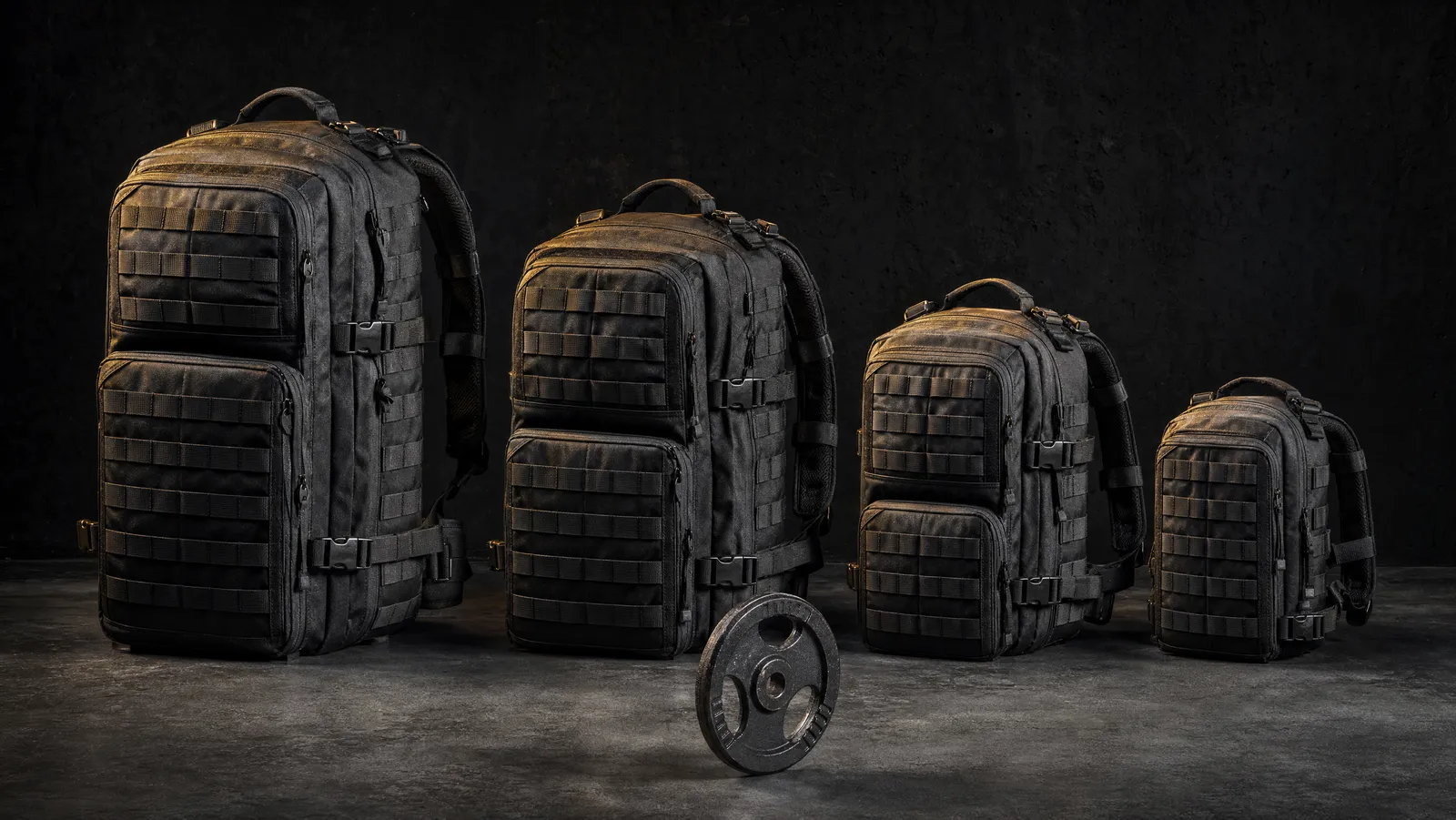
The best rucking backpack for beginners is, for most people, not a rucking backpack. It is a sturdy 40L tactical pack plus one flat plate — about $75 for the pair, as of August 2026 — and our pick is the REEBOW GEAR 40L Military Tactical Backpack. Purpose-built rucks are better made. They also cost several times as much, before you know whether rucking will stick.
Exercise Legend is reader-supported: if you buy through our links we may earn a commission, at no extra cost to you. We build these picks from manufacturer specs and the load-carriage principles below rather than a hands-on test, so read them as informed category judgment rather than a field review.
The cheap route does cost you something, and we would rather name where than gloss it: stitching at the shoulder yoke, load sag in a frameless bag, MOLLE webbing that is not to spec, and a hydration sleeve sized for a bladder you do not own yet. Below are four packs, two plates and the fit rules that matter more than any of them. One caveat first: start light, change one variable at a time, and if you are managing a health condition or returning from an injury, have that conversation with a doctor or a qualified coach before you load a bag. Our guide to starting out with rucking covers the walking; this article is only about the kit.
What actually separates a rucking backpack from a hiking pack
Both carry weight. They solve different problems. A hiking pack is engineered to make a large volume of soft, bulky gear feel manageable across a long day, which is why it has load lifters, a real frame and a hip belt that does most of the work. A rucking pack carries less volume and far more density: one hard, heavy object, for forty minutes, several times a week, for years. Density is the whole design problem.
Four things follow from it, and they are the four specs worth reading before you buy.
Stitching at the shoulder yoke. A dense load concentrates force where the straps meet the pack body. Double-stitched or reinforced stress points are the single most useful line on a cheap pack's spec sheet, and they are also the line most listings quietly omit.
A frame, or something doing its job. None of the four packs below lists an internal frame, which is typical of tactical packs at this price. A rigid plate held flat against the back panel partly substitutes for one; a loose jumble of soft gear does not, and the pack sags away from you.
Waist support. This is where the injury literature is least ambiguous. A 2021 Military Medicine case series, Isolated Mononeuropathy From Rucksack Palsy, describes rucksack palsy as an injury in which "a prolonged load over the shoulder region results in a compression or traction injury to the brachial plexus or surrounding nerves." The authors put estimated military incidence at 29.7 to 53.7 cases per 100,000 service members annually and recommend proper rucksack construction with frames and hip belts, plus education on correct donning. Beginner ruck loads are a fraction of a military load, but the mechanism is the same one, and shifting weight onto your hips is free.
Compression. Side and front compression straps pull the load in toward your spine. On a frameless pack this is the cheapest available substitute for engineering.
The picks at a glance
| Pack or plate | Capacity | Price, as of August 2026 | Best for | | --- | --- | --- | --- | | REEBOW GEAR Military Tactical Backpack | 40L | $40.99 | The default first ruck | | QT&QY 45L Military Tactical Backpack | 45L | $35.99 | Published build specs | | REEBOW GEAR 38L Tactical Backpack | 38L | $38.99 | Shorter torsos | | Hannibal Tactical MOLLE Assault Backpack | 45L | $24.99 | Spending as little as possible | | Yes4All Attachable Rucking Weight | 10 lb plate | $33.59 | Your first weight | | GORUCK Ruck Plate | 10 lb plate | $59 | GORUCK pack owners |
Prices are as of August 2026 and move; treat the ranking as the durable part.
Our pick: the REEBOW GEAR 40L, the do-everything starter ruck
The REEBOW GEAR 40L wins on the combination rather than on any single spec. It is double-stitched with heavy duty zippers, it has a side and front load compression system, the back area and shoulder straps are ventilated mesh over padding, and it is hydration compatible — the bladder is not included, which is true of every hydration-ready pack here.
The dimension that matters most is the one people skim past. At roughly 20 inches of panel height, there is room to seat a plate high, above the small of your back, rather than letting it settle at the bottom of a 40L cavity. Combine that height with the compression straps and you have a workable answer to the frameless-pack problem: not discomfort, but drift.
Its honest weakness: REEBOW GEAR lists no hip belt or waist strap on this model. Every pound rides on your shoulders. For a 10 lb plate and a 45-minute walk most people are unlikely to notice it; if you progress toward 30 lb and an hour, it becomes the reason to upgrade.
Best build for the money: the QT&QY 45L
On paper, the QT&QY 45L is the best-specified pack in this roundup and it costs the second least. It is the only one that publishes a denier — 900D polyester — and QT&QY states that it is reinforced and double stitched at all stress points, with a coating that makes it water resistant and scratch proof. Crucially, it is the only pack here whose adjustable waist straps come with a design claim attached: they are built not to slide loose through the buckles. A waist strap that creeps open mid-walk is a waist strap you stop using.
The five-compartment layout includes a 17-inch laptop or device compartment, which is the de facto plate pocket in any non-purpose-built ruck, and the main compartment opens flat to 180 degrees.
Why it is not our top pick: QT&QY does not list hydration bladder compatibility. Everything else here does. For 45-minute rucks that is survivable; for anything longer in summer it means carrying water some other way. And 45 litres is a large bag to walk around with a single plate in.
Best for a shorter torso: the REEBOW GEAR 38L
The REEBOW GEAR 38L is the same family of construction as our top pick — high density water-resistant fabric, double stitching, heavy duty zippers, compression straps, ventilated mesh shoulder straps — in a smaller footprint: roughly 11 inches wide by 18 tall by 12 deep. It also states hydration compatibility with a 2.5L bladder.
Two inches of panel height sounds trivial. It is not. A pack panel longer than your torso pushes the load below your hip line and hangs the rest off your shoulders, which is the geometry you are specifically trying to avoid. If you measure short, the 38L is the better buy of the two REEBOW packs, and that is the practical answer to the "best rucking backpack for women beginners" question — not a women's badge, but a shorter back panel.
The drawback here is unusually well documented, because the manufacturer documents it: REEBOW GEAR notes the MOLLE spacing is less than half an inch and is not to standard spec. If you plan to hang standard MOLLE pouches off it, they may not weave on. For a beginner carrying one plate and a water bladder, that is close to irrelevant. For anyone who wants to build the pack out later, it is a hard ceiling. Like the 40L, no hip belt is listed.
Best budget entry: the Hannibal Tactical 45L
At $24.99 as of August 2026, the Hannibal Tactical 45L is the cheapest honest answer to "what backpack for rucking" that we would put our name to. It is water-resistant high density fabric with two main compartments, two small front compartments and a rear compartment sized for a 3L bladder — the largest hydration figure in this group. Shoulder straps are padded and adjustable over a thick mesh padded back panel, and it has an expanding waist belt, which the two REEBOW packs do not list.
The feature we would actually use daily is the elastic strap inside the large compartment. It is nominally for a laptop; it is the cheapest mechanism in this roundup for stopping a plate sliding to the floor of the bag. One compartment also opens fully like a suitcase, which makes loading a rigid plate easy.
What you give up: Hannibal publishes neither a denier figure nor a stitching spec. At this price that is the omission we care about most, because stitching at the yoke is exactly what a dense load tests. The included flag patch, D-rings and webbing dominators are trim, not load-carriage features.
What goes in the bag: why a flat plate beats a pile of dumbbells
You do not strictly need a plate. GORUCK, which sells purpose-built rucks, says so itself in its beginner rucking guide: "We recommend Ruck Plates, specifically designed to fit GORUCK Rucksacks, but anything works to start. Dumbbells, bricks, books, even a bag of soil. Wrap it for padding and stability."
The catch is in that last sentence. The case against loose weight is not cost, it is shape and behaviour. GORUCK's own positioning rule is to "keep the weight high and stable next to your back," and a dumbbell will not do that. It rolls, it finds the bottom of the bag, and once it is down there the load is pulling you backward and rotating with every step. Bricks are cheap and dense but sharp-cornered; books work better than expected if you stand them on end, but they compress and shift.
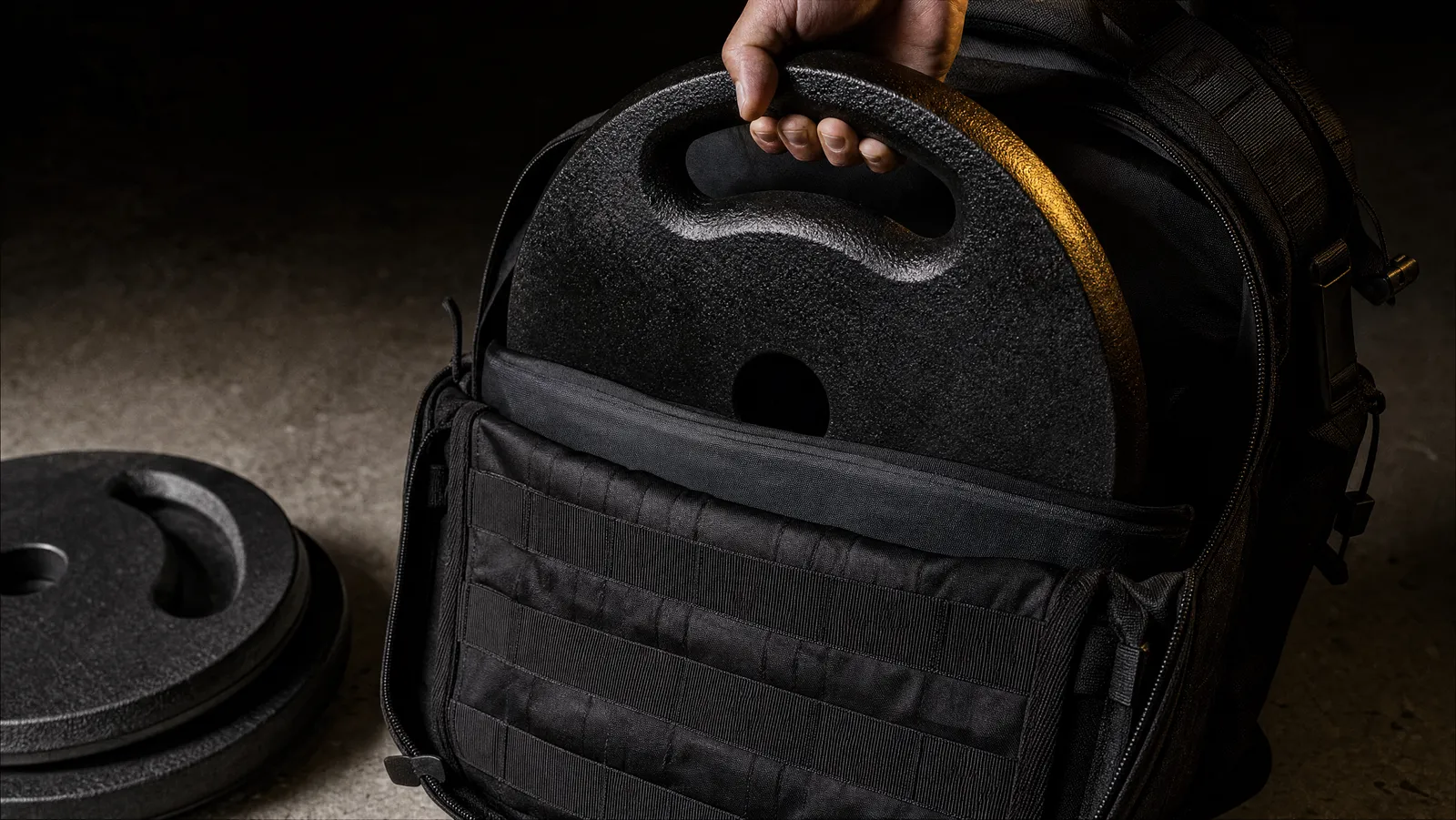
A flat, one-piece cast iron plate solves all of that geometrically. The Yes4All 10 lb rucking weight is our starter recommendation because Yes4All sizes it to fit a standard laptop compartment — though of the packs above, only the QT&QY publishes a dedicated one — has four rounded edges to spare the bag's interior, and carries dual strap slots so a second plate attaches to it later rather than replacing it. The GORUCK 10 lb plate is the better-finished object, with a rust-resistant powder coat and a stated break strength of over 90,000 lbs, but GORUCK designs it to fit GORUCK packs, and at $59 as of August 2026 you are paying about $25 more for the same 10 lb.
How heavy that plate should be is its own decision, and we work through it in how much weight should you ruck with. Two adjacent questions we are writing up separately: best weighted vests for rucking, and rucking vs a weighted vest, which is really a question about whether you want the load on your shoulders at all.
How much weight a beginner should actually carry
Every credible source we found lands lower than the internet's instinct. Cleveland Clinic sports medicine physician Matthew Kampert, DO, told Cleveland Clinic's health essentials that "you might start your initial ruck with 5 pounds and work your way up," and that increasing frequency and intensity at the same time is how people get hurt — his rule is to raise one variable by roughly 10% a week. He also makes the point that undoes a lot of confident gym-goers: "Lifting weights at the gym isn't the same as carrying 20 pounds on your back for several miles."
GORUCK's beginner guidance is a little higher — "when in doubt, start with 10-20 pounds" — with a stated rule of thumb of not carrying more than one third of your bodyweight. A review of military load-carriage biomechanics and musculoskeletal injury notes that an oft-cited study puts the safety ceiling at or below 30% of bodyweight, and that substantial gait modifications start appearing above about 20%.
Those are ceilings, not targets, and they come from soldiers carrying operational loads. The same review reports that in one survey it covers, 116 of 338 responding personnel — 34% — said they had sustained a load-carriage-related injury during their military career, and that in Knapik and colleagues' data, road marching with load-carrying equipment accounted for 15% of new injury encounters. Nobody rucking three times a week with 10 lb is in that population, but the direction of the evidence is consistent: the failure mode in load carriage is doing too much too soon, not owning the wrong bag.
Our editorial position, clearly marked as ours: buy one 10 lb plate, walk with it for a month, then decide whether you want a second one or a better pack. That is not a research finding. It is what the sourced guidance above implies once you stop shopping.
Fit beats brand: torso length, straps and the belt you actually use
Pack sizing runs on torso length, not height. Fitting guides such as Switchback Travel's backpack fit and sizing guide measure from the C7 vertebra — the bony bump at the base of your neck when you tilt your head forward — down to the midpoint of your iliac crest, and report that typical results run 14 to 21 inches, with most people between 15 and 19. Tall people can have short torsos and vice versa, which is why guessing from height is unreliable. Women's-specific packs exist because they are built on shorter torso and narrower hip ranges, and when you are between sizes the standard advice is to take the shorter one, since an over-long pack cannot get weight onto your hips.
None of the four packs here publishes a torso-length range, which is one of the real costs of shopping in the tactical category rather than the hiking one. What you can do is compare panel heights: roughly 20 inches for the REEBOW 40L and the Hannibal, about 18 for the REEBOW 38L and the QT&QY. Measure yourself first and buy toward the shorter number if you are close.
Then use the waist strap. Of the four, only the QT&QY and the Hannibal list one — adjustable waist straps designed not to slide loose, and an expanding waist belt, respectively. That is a strong reason to prefer them once you pass 20 lb, given that the rucksack palsy case series cited above specifically recommends hip belts.
Where the load should sit inside the pack
Position matters more than the bag. Backpacking guidance is unusually consistent here: heavy, dense items belong in the middle of the pack, right up against your spine and roughly between your shoulder blades, as REI's guide to loading a backpack sets out. Too low and the pack sags and drags you backward; too high and it feels tippy. GORUCK's shorthand for the same idea is to keep the weight "high and stable next to your back."
In a frameless tactical pack, the practical version of that rule is:
- Put the plate in the laptop or device sleeve, flat against the back panel, not in the main cavity.
- If there is no sleeve, use the retention strap or lash it through the plate's strap slots so it cannot drop.
- Pack soft filler — a towel, a jacket — under the plate to stop it sliding down, and around it so no corner is against your spine.
- Cinch the side and front compression straps until the load stops moving when you jump.
That last test takes five seconds and tells you more than any spec sheet: if the pack thumps, the weight is loose, and a loose 10 lb behaves like a heavier one.
Where the cheap route actually costs you
We have argued that a $40 tactical pack is the right first purchase. Here is the bill, itemised.
You lose published fit data — no torso ranges, no women's-specific sizing, so you are matching your own measurement against a panel dimension. None of the four lists a frame either, which means the plate has to do the frame's job. On two of these four you lose a hip belt entirely. You lose MOLLE that reliably accepts standard pouches, at least on the 38L, where the manufacturer says so plainly. And on the cheapest pack you lose the stitching and fabric specs that would tell you how the yoke will hold up.
What you do not lose is the training effect, which is the same reason we favour kit that fits in a cupboard when choosing Hyrox home gym equipment. Upgrade when a specific limitation starts costing you: shoulder pressure past 20 lb, a plate you cannot keep still, or a panel that plainly does not match your back.
What we would buy
For most beginners: the REEBOW GEAR 40L and one Yes4All 10 lb plate, about $75 together as of August 2026. If you measure a shorter torso, swap to the REEBOW 38L. If specs matter more to you than a bladder sleeve, the QT&QY 45L is better documented for less money. For the lowest cost of entry, the Hannibal Tactical 45L at $24.99 is a defensible first bag with a genuinely useful retention strap.
The plate is the part you keep. Packs get replaced when training gets serious; cast iron outlives all of them.
And the part worth repeating, because it is the part that actually determines whether this goes well: start at 5 to 10 lb, change one variable at a time, keep the weight high and tight against your back, and speak to a doctor or a qualified coach first if you are managing a condition or coming back from an injury. If you want the walking side rather than the buying side, our guide to rucking for beginners is the place to start.
What are you actually solving for — the cheapest way to start, or the pack you will still be using in two years? The answer changes which row of that table you buy.
Gear we'd put on our own floor
The Picks

The default first ruck for most beginners
Roughly 13 inches wide by 20 inches tall by 11 inches deep for 40L of capacity, in a high density fabric REEBOW GEAR describes as durable and water-resistant.
Price as of
Roughly 13 inches wide by 20 inches tall by 11 inches deep for 40L of capacity, in a high density fabric REEBOW GEAR describes as durable and water-resistant. Seams are double-stitched, the zippers are heavy duty with utility-style cord pulls, and a side and front load compression system pulls the contents in against your back instead of letting them swing. MOLLE webbing runs across the front and both sides, the back area and shoulder straps are ventilated mesh over padding, and the pack is hydration compatible, though the bladder is not included.
// What We Like
The compression system is the part that matters for rucking, because dense weight held tight and high behaves nothing like dense weight allowed to swing. Double stitching and heavy duty zippers address the two things that fail first on a cheap pack, the ventilated mesh back area and padded straps spread pressure rather than concentrating it, and 20 inches of panel height leaves room to position a plate well above the small of your back.

The best-specified build here, if you can live with the volume
900D polyester, reinforced and double stitched at all stress points, with a coating QT&QY says makes it water resistant and scratch proof.
Price as of
900D polyester, reinforced and double stitched at all stress points, with a coating QT&QY says makes it water resistant and scratch proof. It is the only pack in this roundup that publishes a denier figure. Capacity is 45L across roughly 18 by 13.2 by 11.6 inches, split into five compartments including a 17-inch laptop or device compartment and a hidden back pocket, and the main compartment opens flat to 180 degrees. Shoulder straps are double stitched and padded over a mesh back panel, and the adjustable waist straps are designed not to slide loose through their buckles.
// What We Like
Two specs do most of the work. Reinforcement and double stitching at all stress points targets exactly the failure mode a dense load exploits, and waist straps built to hold their adjustment are what let you move weight off your shoulders and onto your hips. The 17-inch device compartment doubles as a plate pocket that keeps weight flat and high against your spine, and a main compartment that opens flat to 180 degrees makes loading that plate straightforward.

The shorter panel, for a shorter torso
38L across roughly 11 inches wide by 18 inches tall by 12 inches deep, which makes it the shortest and narrowest back panel in this roundup.
Price as of
38L across roughly 11 inches wide by 18 inches tall by 12 inches deep, which makes it the shortest and narrowest back panel in this roundup. The fabric is the same high density water-resistant material as the 40L, with double stitching, heavy duty zippers and a side and front load compression system. The back area is padded and the shoulder straps are ventilated mesh over padding. It is hydration compatible and works with a 2.5L bladder, which is not included. REEBOW GEAR notes that the MOLLE spacing is less than half an inch and is not to standard spec.
// What We Like
An 18-inch panel on an 11-inch width is a friendlier starting geometry for a 15 to 17 inch torso than a 20-inch panel is, and torso length is what decides whether a load settles on your hips or hangs off your neck. You still get the double stitching, the compression straps and the ventilated mesh shoulder straps from the 40L, plus an explicit 2.5L bladder compatibility figure.

The cheapest way to find out whether rucking sticks
45L across roughly 12 inches wide by 20 inches tall by 13 inches deep, in a water-resistant high density fabric.
Price as of
45L across roughly 12 inches wide by 20 inches tall by 13 inches deep, in a water-resistant high density fabric. There are two main compartments, two small front compartments and a rear compartment sized for a 3L hydration bladder, which is not included. The large compartment has an elastic strap meant to hold a laptop or stabilise the contents, and one compartment opens fully like a suitcase. Shoulder straps are padded and adjustable over a thick mesh padded back panel, there is an expanding waist belt, and MOLLE runs across the front and both sides.
// What We Like
The elastic retention strap inside the main compartment is the sleeper feature: it is the cheapest mechanism here for stopping a plate migrating to the bottom of the bag. An expanding waist belt and a thick mesh padded back panel are more than the price implies, the 3L bladder compartment is the largest hydration figure in this group, and a compartment that opens like a suitcase makes packing a rigid object much easier.

The first weight to buy, and the one most beginners should stop at
A single 10 lb cast iron training plate in a solid one-piece design, with wide textured ergonomic handles at both ends and four rounded edges intended to protect the inside of your bag.
Price as of
A single 10 lb cast iron training plate in a solid one-piece design, with wide textured ergonomic handles at both ends and four rounded edges intended to protect the inside of your bag. Recessed sides and dual strap slots let you lash several plates together as you progress. Yes4All sizes it to fit standard laptop compartments and designs it for even load distribution in a backpack, which is exactly where you want a plate to sit: flat, high and against your back.
// What We Like
The shape is the entire argument. A flat one-piece plate with rounded edges sits against your spine and stays there, while dumbbells and loose barbell plates roll to the bottom of the bag and pull you backward. Fitting a standard laptop compartment means it works in every pack in this roundup, and the dual strap slots mean your next 10 lb attaches to this one rather than replacing it.

The premium plate, and only if you own the pack it was built for
Cast iron with a matte black powder coating for a rust-resistant finish, ergonomic rounded edges and wide grab-and-go handles.
Price as of
Cast iron with a matte black powder coating for a rust-resistant finish, ergonomic rounded edges and wide grab-and-go handles. GORUCK designed it specifically to fit its own Rucker and Ruck Plate Carrier packs, and states a break strength of over 90,000 lbs. It is designed in Jacksonville Beach, Florida and produced in Mankato, Minnesota, and GORUCK lists it as made in the USA.
// What We Like
If you own or plan to buy a GORUCK Rucker or Ruck Plate Carrier, this is the plate those packs were designed around, and the fit is the whole case for it. The powder coating addresses the rust that bare cast iron picks up in a sweaty pack, and the rounded edges and wide handles make loading and unloading a one-handed job.
Our top three, ranked
The Leaderboard
The default first ruck for most beginners
Roughly 13 inches wide by 20 inches tall by 11 inches deep for 40L of capacity, in a high density fabric REEBOW GEAR describes as durable and water-resistant.
Check PricePrice as of
The best-specified build here, if you can live with the volume
900D polyester, reinforced and double stitched at all stress points, with a coating QT&QY says makes it water resistant and scratch proof.
Check PricePrice as of
The shorter panel, for a shorter torso
38L across roughly 11 inches wide by 18 inches tall by 12 inches deep, which makes it the shortest and narrowest back panel in this roundup.
Check PricePrice as of
What to know before you buy
Field Notes
What backpack should you use for rucking?
Almost any sturdy pack, to start. GORUCK, which sells purpose-built rucks for a living, still says in its own beginner guide that while it recommends Ruck Plates, "anything works to start. Dumbbells, bricks, books, even a bag of soil." The same permission applies to the bag. What you actually want is double-stitched construction, compression straps to hold the load tight, and enough panel height to keep weight above the small of your back. Our top pick, the REEBOW GEAR 40L, lists all three and costs $40.99 as of August 2026.
How much weight should a beginner put in a rucking backpack?
Less than you expect, for longer than you expect. Cleveland Clinic sports medicine physician Matthew Kampert, DO, tells beginners "you might start your initial ruck with 5 pounds and work your way up," and to raise only one variable by about 10% a week. GORUCK's own beginner guidance is 10 to 20 pounds, with a stated rule of thumb of no more than one third of bodyweight. A single 10 lb plate covers most of that beginner range on its own, which is why we treat a second plate as a later purchase rather than part of the first order.
What is the best rucking backpack for women beginners?
The one that matches your torso length, which is not the same thing as your height. Fitting guides such as Switchback Travel measure torso from the C7 vertebra at the base of your neck to the midpoint of your iliac crest, and report typical results of 14 to 21 inches with most people landing between 15 and 19. Women's-specific packs are built on shorter torso and narrower hip ranges for that reason. Measure first, then pick the shorter panel: the 38L here is about 18 inches tall against the 40L's 20.
Do you need a rucking backpack with weights included?
No, and bundles are rarely the cheaper route. A pack plus a separate 10 lb plate runs about $75 as of August 2026, and buying them separately lets you keep the plate when you outgrow the bag. The real case against improvised weight is shape rather than cost. GORUCK's guidance is to keep the weight "high and stable next to your back," and dumbbells, kettlebells and loose barbell plates will not stay there. If you do improvise, wrap it for padding and strap it down.
Who put in the work
The Coach
Your Coach
Darlene Schmitt
I am a fitness instructor and promoter who truly enjoys helping others become the best they can be! My mission is to help people find the love of fitness and to help them develop a lifelong habit of exercise. I am a firm believer that fitness should be fun, and I make it my mission to ensure that my classes are always enjoyable. I am also a certified nutritionist and personal trainer, so I am able to offer my students comprehensive and well-rounded support.