Adjustable dumbbells vs fixed: cost per pound, floor space and set-change time

Contains affiliate links. Our policy.
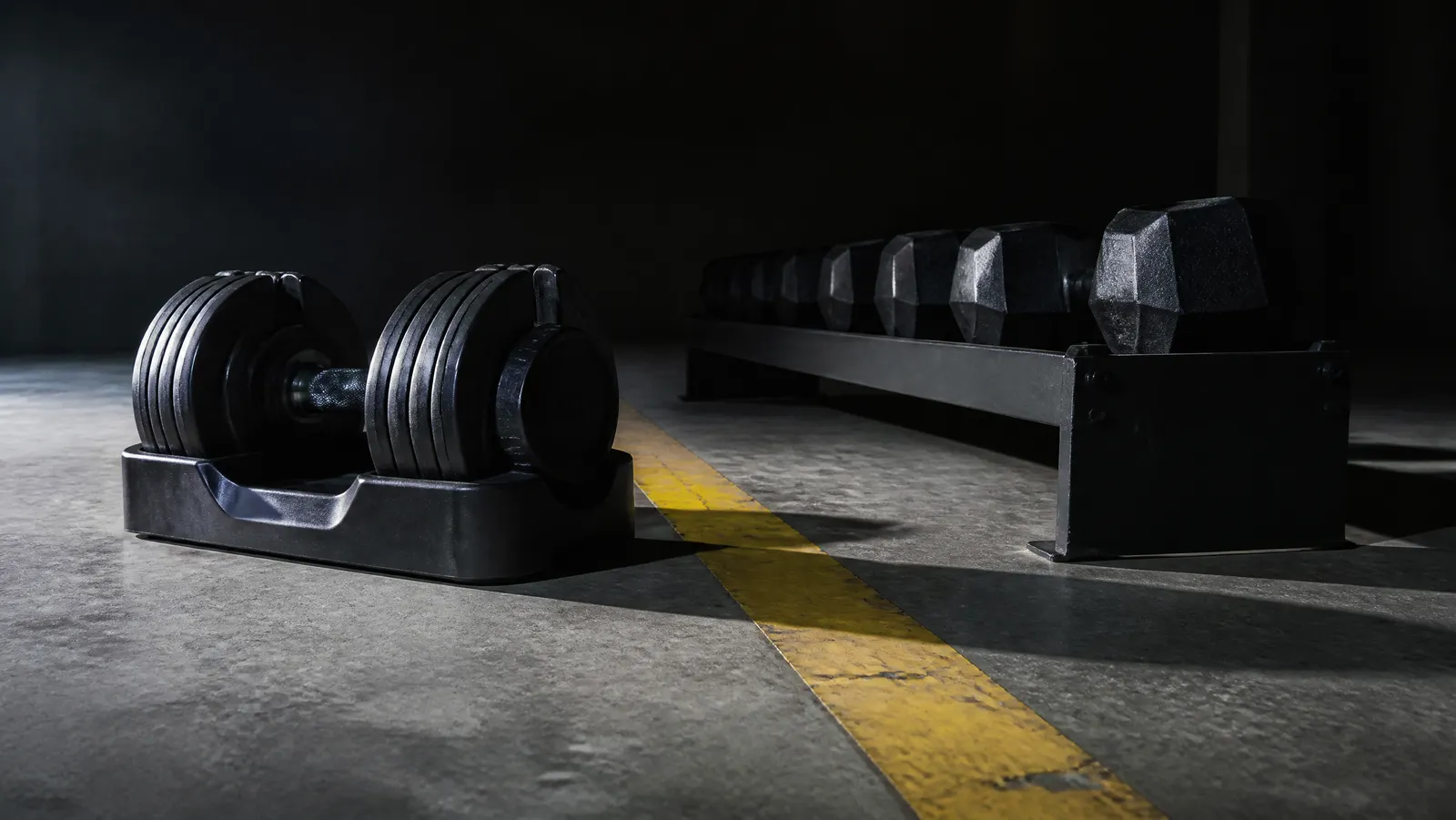
Three numbers decide adjustable dumbbells vs fixed dumbbells, and none of them is a feeling: dollars per pound of usable load, square feet of floor, and seconds between sets. Fixed iron wins the first on raw metal and loses it on range. Adjustable wins floor space by roughly five to one. Fixed wins the clock outright, and it is not close.
Our position is that you buy for whichever of those three is your binding constraint and let the other two go. If you are at the beginning of that decision rather than the end of it, the full buying case sits in adjustable dumbbells for a home gym. This page is only the arithmetic underneath it.
One caveat first, because the object in question is heavy. Kerr, Collins and Comstock, in the American Journal of Sports Medicine in 2010, analysed 18 years of US emergency-department data and report that "From 1990 to 2007, 25 335 weight training injuries were seen in US emergency departments, correlating to an estimated 970 801 injuries nationwide," that "The most common mechanism of injury was weights dropping on the person (65.5%)," and that "A large number of injuries occurred with free weights (90.4%)." Their recommendation applies to both formats: "It is essential to inspect weights regularly for defects and ensure all components of free weights are secured tightly to ensure that weights do not fall in the middle of a set." If you are returning from injury or new to loading, have a clinician or a qualified coach look at your progression before you chase the top of either range.
Adjustable vs fixed dumbbell cost: cheap metal against cheap range
Fixed iron is the cheapest strength equipment per pound that you can buy. Garage Gym Reviews' fixed-dumbbell guide prices REP Fitness rubber-coated hex dumbbells at "As low as $1.76" per pound, roughly $3.88 per kg, and notes that "With costs hovering around $1 per pound, these REP Fitness dumbbells are certainly suitable for wallet-minded athletes." Coatings move that figure a long way. The same guide puts Rogue's urethane dumbbells at "Starts at $4" per pound and flags an "Expensive cost starting at $54 for a pair of 5-pound weights."
Now price a real ladder, because that is the number you actually pay. A useful fixed spread is 10-50 lb (4.5-22.7 kg) per hand in 5 lb (2.3 kg) steps, which is nine pairs. Body-Solid's own SDR product data sheet lists the comparable factory set, the SDRS550, as "5-50lb (pairs in 5lb increments)," and its 5 to 50 lb rubber dumbbell set page spells the contents out as "Includes 20 dumbbells. (2 each): 5,10,15,20,25,30,35,40,45,50; 550 lbs Total." Our nine-pair version is 540 lb (244.9 kg) of metal. At $1.76 per pound that is about $950, and a rack is extra: the Body-Solid GDR363B is listed at "SALE $220.00" against an "MSRP: $285.00." Call it $1,170 all in. That arithmetic is ours, on their published prices.
Then flip the denominator. The $950 of iron buys 50 lb (22.7 kg) per hand of top-end load, which is 100 lb (45.4 kg) across the pair, so measured against the heaviest set you can do with it, fixed costs about $9.50 per pound of top end, or $11.70 once the rack is in. Our own live price sourcing for this tower, done in November 2026, put adjustable sets between $1.37 and $4.83 per pound of top-end load. At those rates the same 100 lb (45.4 kg) of combined top end lands between about $140 and $485, though the bottom of that range comes from loose-plate kits and the extrapolation is ours.
The spread inside that range is mechanism-driven, with threaded plate-loaded kits at the bottom and selector bells at the top, for reasons covered in how adjustable dumbbells work. Premium adjustables climb well past our range: Garage Gym Reviews' adjustable guide puts the average adjustable dumbbell at $625 and the NUOBELL at $780, and reports that one maker's "65-pound set starts at $899, and the 125-pound option will cost $1,500."
So both camps are quoting a true number at each other. Fixed is cheap per pound of steel and expensive per pound of capability. Adjustable is the reverse. Which one is the better deal depends entirely on whether you want 540 lb of metal or 50 lb per hand of top end, a question we price out in full in are adjustable dumbbells worth it.
Floor space: where adjustable dumbbells vs regular sets stops being an argument
This is the axis with the widest margin, and published dimensions settle it. The Body-Solid GDR363B rack measures 20" x 40" x 30" (50.8 cm x 101.6 cm x 76.2 cm) and "can store ten pairs of hex dumbbells between 5-50 lbs." That is a footprint of 800 square inches, or 5.6 sq ft (0.52 m²), before you add the step-back room to lift off it.
PowerBlock's Elite EXP specification sheet lists Stage 1 at 12"L x 6.3"W x 6.5"H (30.5 cm x 16 cm x 16.5 cm) per dumbbell, with Stage 2 at 14 inches (35.6 cm) and Stage 3 at 16 inches (40.6 cm) long. A Stage 1 pair side by side covers 151 square inches, or 1.05 sq ft (0.10 m²). Expanded to Stage 3 it is 1.4 sq ft (0.13 m²). Both figures are our arithmetic on their numbers.
That is the whole case in one subtraction: 5.6 sq ft against 1.05 sq ft, a saving of about 4.5 sq ft (0.42 m²) and a ratio better than five to one. PowerBlock's own sheet claims the system "Replaces up to 27 dumbbell pairs" under the heading "Save Space: Replaces up to 27 dumbbell pairs," which is a marketing count of settings rather than of capability, but the footprint claim stands up on its own measurements.
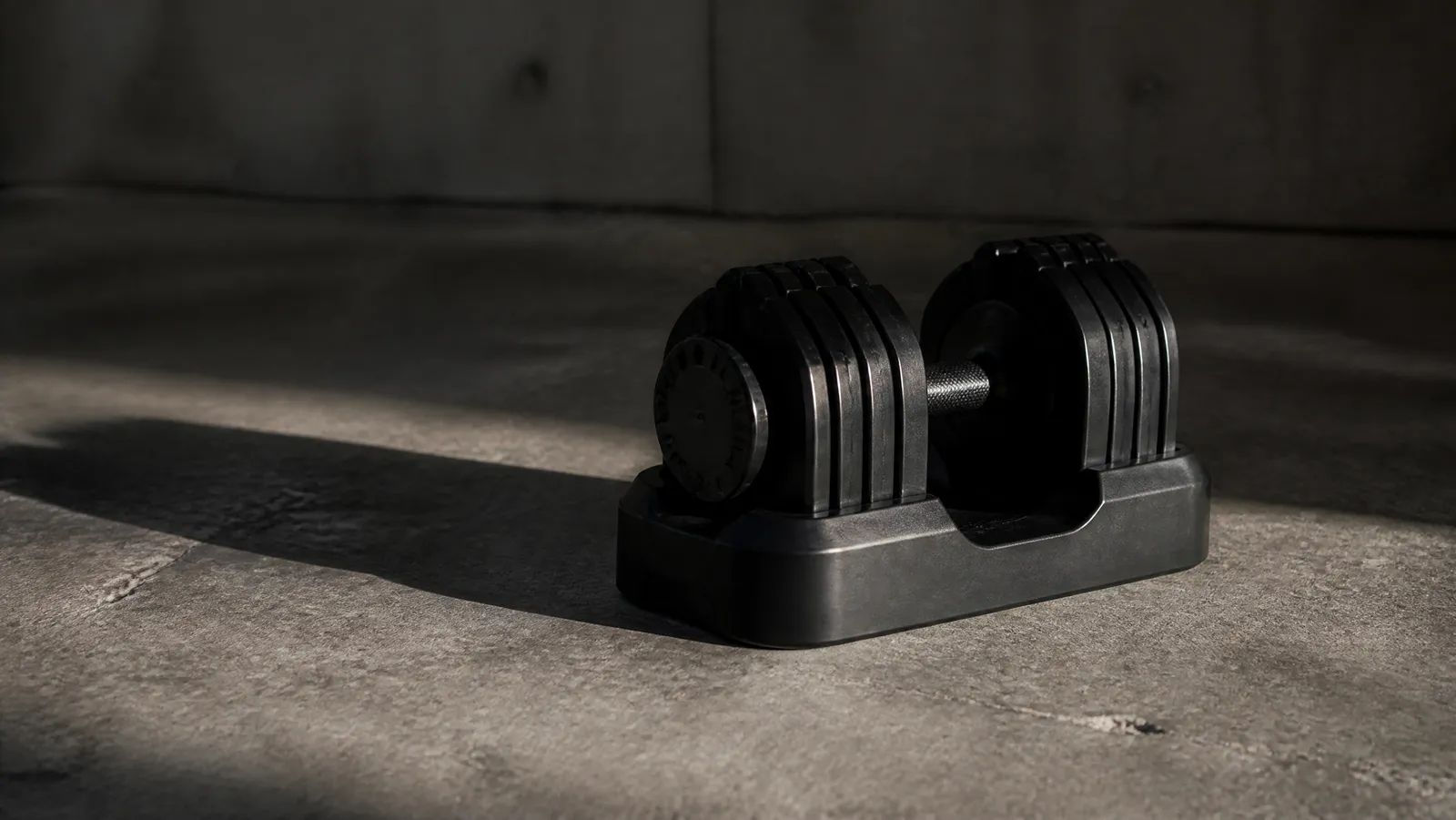
One honest qualifier, because it halves the win. If the bell comes with a cradle or you buy a stand, the saving shrinks fast. The Bowflex SelectTech 552 owner's manual lists the SelectTech 2-in-1 Dumbbell Stand at "27.75" L x 20.5" W x 24.5" H (70.5 cm x 52 cm x 62.2 H cm)," which is 3.95 sq ft (0.37 m²). Against the rack's 5.6 sq ft that is a 29 percent saving, not an 81 percent one. The manual also gives each 552 dumbbell as 16.9" L x 8.3" W x 9" H (43 cm x 21.2 cm x 22.8 cm), so a bare pair on the floor is 1.95 sq ft (0.18 m²).
Our reading: adjustable bells win floor space decisively, and the size of the win is set by what you park them in rather than by the bells.
Set-change time: the seconds fixed dumbbells hand you for free
A fixed rack changes weight in the time it takes to reach, and that is a real feature. You put one pair down, pick the next up, and no mechanism is involved. Everything below is what the alternative costs.
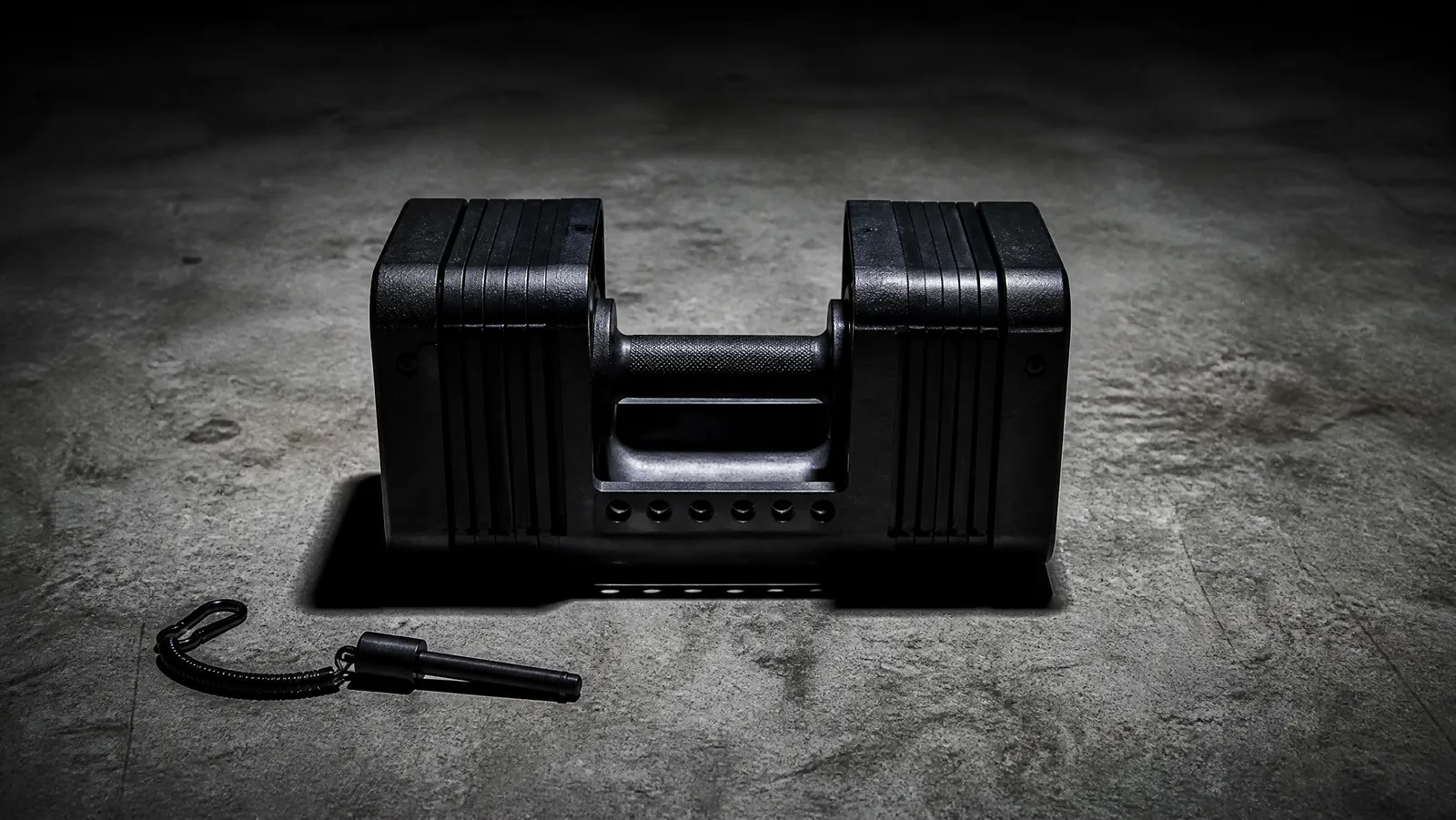
PowerBlock's Elite EXP sheet sums the whole procedure up as "Just insert pin and lift," under the heading "Quick & Easy," using what the sheet calls a "Magnetic selector pin." Dial bells are stricter: the Bowflex SelectTech 552 owner's manual states that the locking mechanism "will only allow the adjustment knobs to be rotated when the dumbbell handle is completely inserted and engaging the dumbbell base." The weight change is not something you do in your hands. It is a round trip to the base, twice, once per bell.
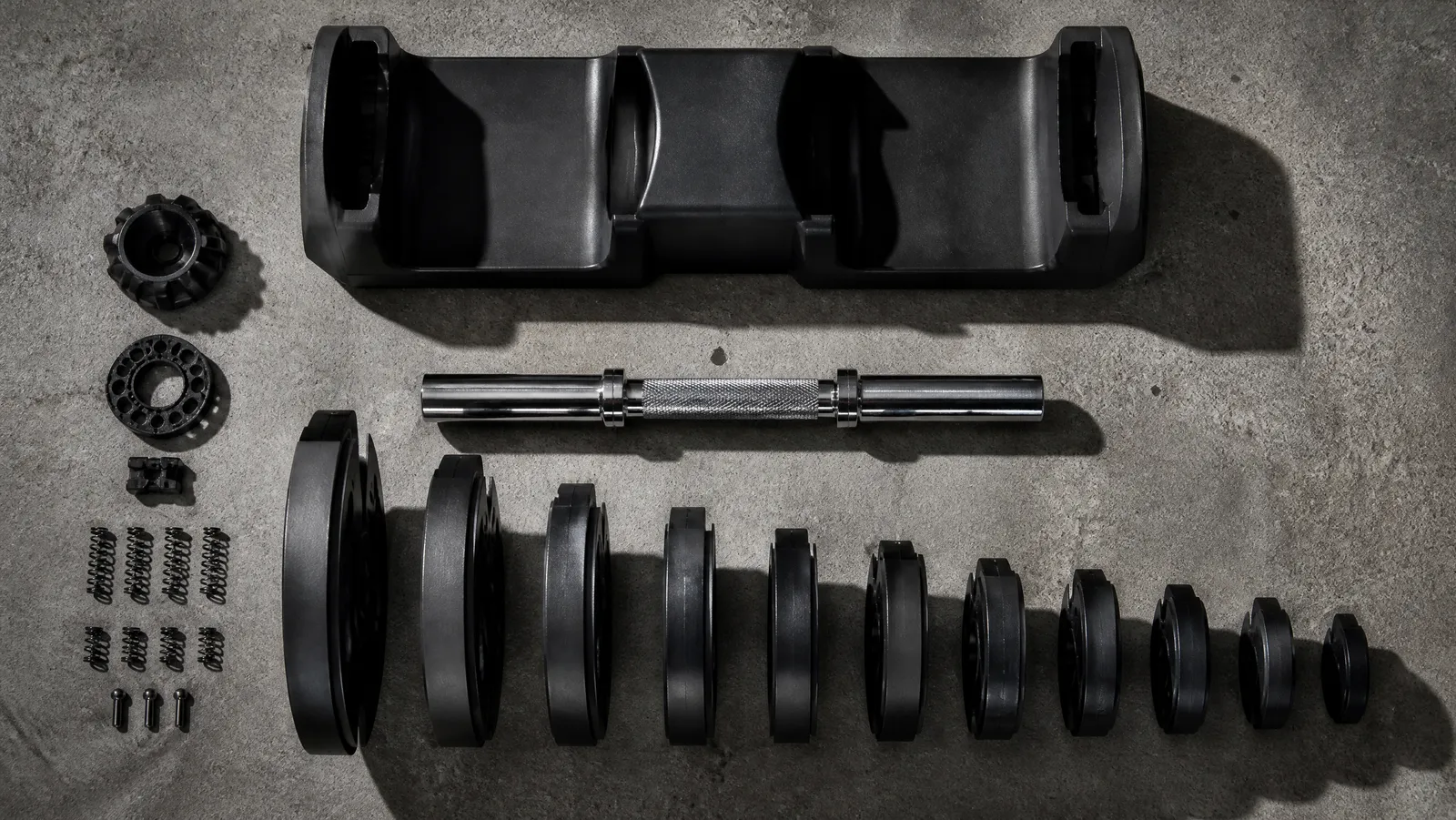
Twist-handle designs are the fast end. Rogue's own product guide for the SMRTFT NUOBELL describes a twist-lock mechanism that moves from 5 to 80 lb (2.3 to 36.3 kg) in 5 lb (2.3 kg) increments by rotating the handle (Rogue NUOBELL product guide), and Garage Gym Reviews' adjustable dumbbell guide writes that "In just a matter of seconds, you can change from 5 pounds up to 80 pounds simply by twisting the handle." The same outlet is blunt in the other direction about block selectors with adder weights, listing "Not the fastest change in weights" as a con.
Independent testing treats adjustment speed as a scored axis rather than a footnote. Garage Gym Reviews' dumbbell testing methodology says "For adjustable dumbbells, we look at how quickly users can change the weight," that "To earn a 3-out-of-5 score, a dumbbell may require you to move a pin on either side," and that "Higher scores are given to fast-adjusting dumbbells that only need a twist of the handle."
Now the part that is our judgement rather than anyone's published finding. Straight sets are indifferent to all of this, because you are resting anyway. Drop sets, supersets and circuits are not. A three-stage drop set needs two changes per hand, which on a dial bell is four trips to the cradle inside a set that is supposed to have no rest in it. Run the arithmetic on any figure you like: at ten seconds a change, six changes in a conditioning piece is a minute of session time and a materially different stimulus. That is a programming constraint, not a convenience footnote, and it is the strongest argument for keeping a few fixed pairs even in an adjustable gym.
Top-end load, and the number that decides whether one pair replaces a rack
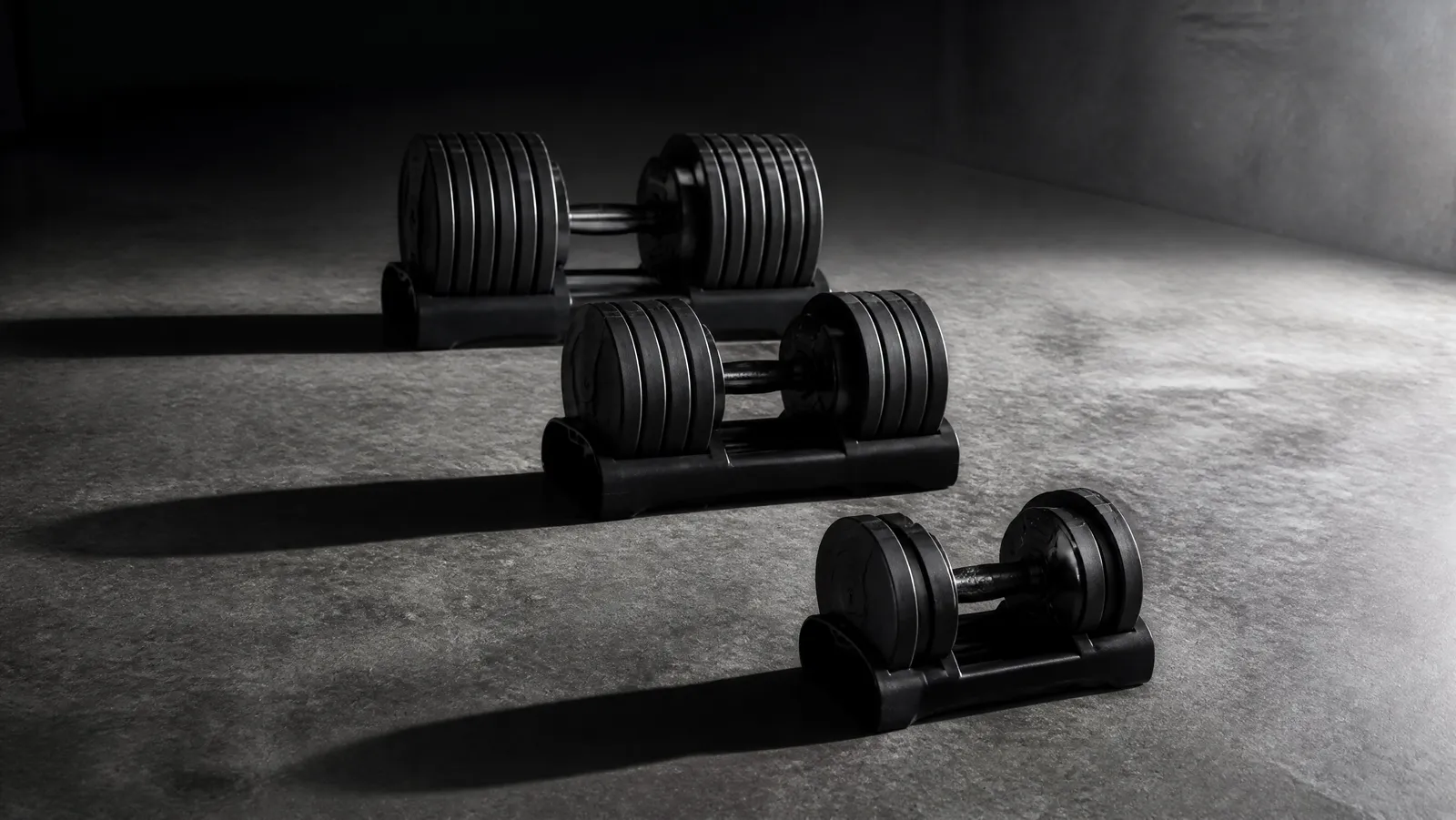
A fixed rack and an adjustable pair rarely offer the same ceiling, so compare ceilings before you compare prices. The Bowflex 552 manual documents a range of "5 to 52.5 lbs (2.27kg to 23.9kg) on both adjustment knobs" across 15 increments. PowerBlock's Elite EXP runs 5-50 lb (2.3-22.7 kg) at Stage 1 and expands to 70-90 lb (31.8-40.8 kg) at Stage 3, in 2.5 lb (1.1 kg) increments.
Those ceilings are where the per-pound comparison gets decided, because every dollar-per-pound figure on this page has top-end load in its denominator. Pick the ceiling first and the cost arithmetic follows from it, which is the exercise we run in what weight adjustable dumbbells to buy.
Two numbers that do not appear in any marketing comparison are worth putting next to each other. The manual gives the 552's "Dumbbell Assembly Weight" as "Approximately 58 lbs (26.3 kg)" per dumbbell with its cradle, which is heavier than the 52.5 lb (23.8 kg) it can deliver. A 50 lb (22.7 kg) fixed hex weighs 50 lb. Carrying an adjustable set upstairs is a different job from carrying its top set.
Adjustable dumbbell vs dumbbell: the trades that are not numbers
Handle feel is the first one, and both ends of it are published. Garage Gym Reviews' methodology describes the average fixed dumbbell it tests as having a handle of "4.8″ length, 32 mm diameter for 5-50 lbs and 34 mm diameter for 55-150 lbs." PowerBlock lists a 38 mm TPR grip, 4.75 inches (12.1 cm) long. Body-Solid's plate-loaded SDA14T threaded handle is listed at 14.5 inches (36.8 cm) long, assembled weight 3.9 lb (1.8 kg), at "SALE $18.50." We found no trial measuring what 6 mm (0.24 in) of extra grip diameter does to a heavy row, so our note is that it is noticeable and unquantified.
Durability is the second, and here the formats are not comparable. A fixed hex dumbbell has nothing to fail. Body-Solid describes the line as "Made from solid cast iron with a 6-sided anti-roll design and encased in rubber," with virgin rubber that "protects floors and equipment" (SDR product data sheet). Adjustable bells carry explicit prohibitions instead: the Bowflex manual says "Never allow the dumbbells to drop freely to the ground. Damage to the product and potential personal injury may occur," and lists "Damage to the product due to dropping the dumbbell" first among what its warranty does not cover. Garage Gym Reviews drop-tests on purpose, saying "Our testers will even drop the dumbbells from various heights to see if any moving parts break or come loose."
The recall record only runs one way. Selector and plate-locking mechanisms have produced at least eight CPSC recalls since 2012. The largest is recall 25-311 of 5 June 2025, covering about 3,844,200 BowFlex 552 and 1090 dumbbells, on the finding that "The weight plates can dislodge from the handle during use, posing an impact hazard." A smaller 2024 case shows the same failure mode on another brand: recall 24-310 of 25 July 2024, about 54,400 ProForm Rapid Strike sets, where "The firm has received eight reports of weight plates dislodging during use" with "three resulting in injuries, including contusions and abrasions." There is no equivalent list for welded hex dumbbells, which is the honest version of the safety comparison and the subject of are adjustable dumbbells safe.
Resale is the last axis, and we will label it as judgement because we found no published data on used prices: iron with no moving parts and no model year is the easier thing to sell second-hand, while a selector bell is worth what a buyer thinks its mechanism has left in it.
The verdict: buy fixed if, buy adjustable if
Buy fixed if you have the floor and you train the clock. The 5.6 sq ft (0.52 m²) of the Body-Solid rack's listed 20" x 40" footprint is the entry fee, and in exchange you get zero-second changes, two people able to train at once, drop sets and circuits that run without interruption, equipment you can set down hard, and a resale market. If your programming is conditioning-led, this is not a close call.
Buy adjustable if floor space is the constraint that actually binds. One lifter, straight sets, a room where 4.5 sq ft (0.42 m²) matters more than the seconds a change costs you, and a top end you have chosen deliberately. On our November 2026 sourcing that capability costs between $1.37 and $4.83 per pound of top-end load, against our calculated $9.50 for the fixed ladder, so you are buying range at a discount and paying for it with handling rules.
Buy both if you can, and most well-set-up garage gyms do. A pair of adjustables for the heavy work plus two or three fixed pairs at your most-used loads removes the change penalty exactly where it costs you, for the price of a few square feet.
The three numbers do the deciding. Dollars per pound of top-end load favours adjustable by roughly two to one. Square feet favours adjustable by five to one, or by only 29 percent if you buy the stand. Seconds between sets favours fixed absolutely. Weight those against your own room and programme, and for the buying decision itself, with configurations and trade-offs priced out, see adjustable dumbbells for home gym.
Nobody regrets the pounds. They regret the floor space or the seconds, and you get to choose which.
What to know before you buy
Field Notes
Are adjustable dumbbells cheaper than buying a full fixed set?
Cheaper for a given top-end load, more expensive per pound of metal. The arithmetic below is ours, built on published prices. [Garage Gym Reviews' fixed-dumbbell guide](https://www.garagegymreviews.com/best-dumbbells) prices REP Fitness rubber-coated hex dumbbells at "As low as $1.76" per pound, so a 9-pair ladder running 10-50 lb (4.5-22.7 kg) per hand, which is 540 lb (244.9 kg) of iron, works out at about $950. Add the [Body-Solid GDR363B rack](https://bodysolid.com/body-solid-dumbbell-rack) at its listed "SALE $220.00" and you are near $1,170 for 50 lb (22.7 kg) per hand of top end. Our own November 2026 price sourcing for this tower found adjustable sets between $1.37 and $4.83 per pound of top-end load, so the same 100 lb (45.4 kg) of combined top end lands between roughly $140 and $485. Different pounds, not cheaper pounds.
How much floor space do adjustable dumbbells actually save?
About four and a half square feet, if you skip the stand. The [Body-Solid GDR363B dumbbell rack](https://bodysolid.com/body-solid-dumbbell-rack) is listed at 20" x 40" x 30" (50.8 cm x 101.6 cm x 76.2 cm) and "can store ten pairs of hex dumbbells between 5-50 lbs," which is a footprint of 5.6 sq ft (0.52 m²). [PowerBlock's Elite EXP specification sheet](https://cdn.shopify.com/s/files/1/0862/1694/files/Elite_EXP.pdf) gives Stage 1 as 12"L x 6.3"W x 6.5"H (30.5 cm x 16 cm x 16.5 cm), so a pair parked side by side covers 1.05 sq ft (0.10 m²). That is our arithmetic on their published dimensions. Add a cradle and the gap narrows sharply: the [Bowflex SelectTech 552 owner's manual](https://cdn.shopify.com/s/files/1/0604/6708/5501/files/BFX_SelectTech552.pdf) lists its 2-in-1 stand at 27.75" L x 20.5" W x 24.5" H (70.5 cm x 52 cm x 62.2 cm), which is 3.95 sq ft (0.37 m²).
Do adjustable dumbbells slow down your workout?
Yes, and the manufacturers' own wording tells you by how much. [PowerBlock's Elite EXP sheet](https://cdn.shopify.com/s/files/1/0862/1694/files/Elite_EXP.pdf) sums the operation up as "Just insert pin and lift," while the [Bowflex SelectTech 552 owner's manual](https://cdn.shopify.com/s/files/1/0604/6708/5501/files/BFX_SelectTech552.pdf) states that its locking mechanism "will only allow the adjustment knobs to be rotated when the dumbbell handle is completely inserted and engaging the dumbbell base." Every change is therefore a round trip to the base. Independent testing treats the difference as a scoring axis: [Garage Gym Reviews' dumbbell testing methodology](https://www.garagegymreviews.com/ggr-dumbbell-testing-methodology) says "For adjustable dumbbells, we look at how quickly users can change the weight," that "To earn a 3-out-of-5 score, a dumbbell may require you to move a pin on either side," and that "Higher scores are given to fast-adjusting dumbbells that only need a twist of the handle." A fixed rack scores zero seconds by design.
Can you drop adjustable dumbbells the way you drop fixed ones?
No, and this is the clearest practical split in the comparison. The [Bowflex SelectTech 552 owner's manual](https://cdn.shopify.com/s/files/1/0604/6708/5501/files/BFX_SelectTech552.pdf) instructs owners to "Never allow the dumbbells to drop freely to the ground. Damage to the product and potential personal injury may occur," and its warranty section lists "Damage to the product due to dropping the dumbbell" first among what the warranty does not cover. Drops are also how reviewers separate the category: [Garage Gym Reviews' testing methodology](https://www.garagegymreviews.com/ggr-dumbbell-testing-methodology) says "Our testers will even drop the dumbbells from various heights to see if any moving parts break or come loose," and that a 3-out-of-5 durability score goes to dumbbells that "shouldn't be dropped regularly." Fixed hex bells are built for the opposite: Body-Solid describes its rubber-coated hex line as "Made from solid cast iron with a 6-sided anti-roll design and encased in rubber" ([SDR product data sheet](https://bodysolid.com/content/SDR_PDS.pdf)).
Does an adjustable dumbbell feel different in the hand?
Thicker, in the two cases where both numbers are published. [Garage Gym Reviews' dumbbell testing methodology](https://www.garagegymreviews.com/ggr-dumbbell-testing-methodology) describes the average fixed dumbbell it tests as having a handle of "4.8 length, 32 mm diameter for 5-50 lbs and 34 mm diameter for 55-150 lbs." [PowerBlock's Elite EXP sheet](https://cdn.shopify.com/s/files/1/0862/1694/files/Elite_EXP.pdf) lists a 38 mm grip of TPR, 4.75 inches (12.1 cm) long, so about 6 mm (0.24 in) fatter than the fixed average. Plate-loaded handles go the other way: Body-Solid's [SDA14T 1-inch standard threaded dumbbell handle with collars](https://bodysolid.com/standard-threaded-dumbbell-handle-with-collars) is listed at 14.5 inches (36.8 cm) long with an assembled weight of 3.9 lb (1.8 kg). We have found no published trial measuring what grip diameter does to holding a heavy row, so treat that as a fitting question rather than a performance claim.
Who put in the work
The Coach
Your Coach
Darlene Schmitt
I am a fitness instructor and promoter who truly enjoys helping others become the best they can be! My mission is to help people find the love of fitness and to help them develop a lifelong habit of exercise. I am a firm believer that fitness should be fun, and I make it my mission to ensure that my classes are always enjoyable. I am also a certified nutritionist and personal trainer, so I am able to offer my students comprehensive and well-rounded support.