What weight adjustable dumbbells should you buy? 50, 80 or 100 lb
Contains affiliate links. Our policy.
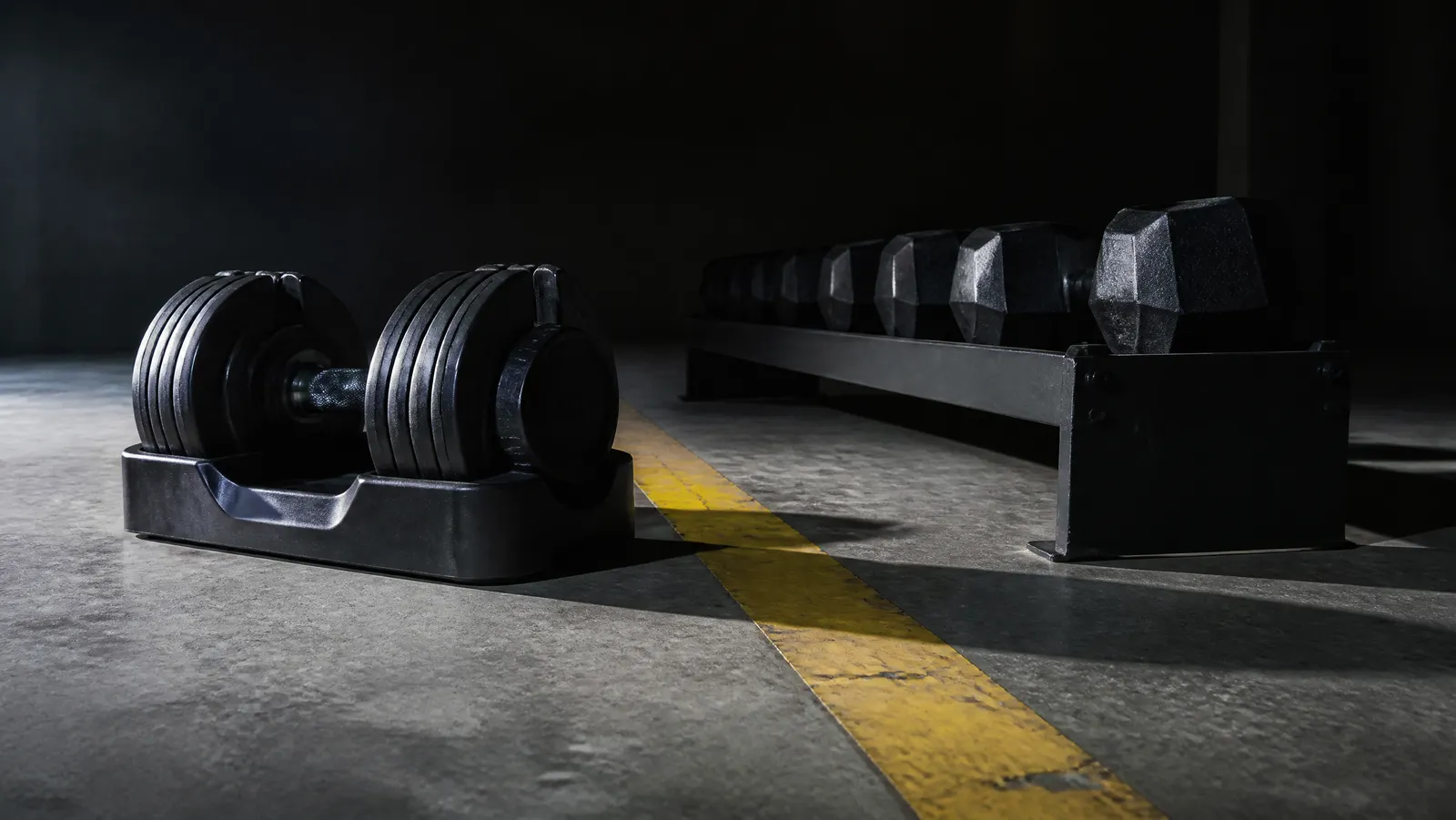
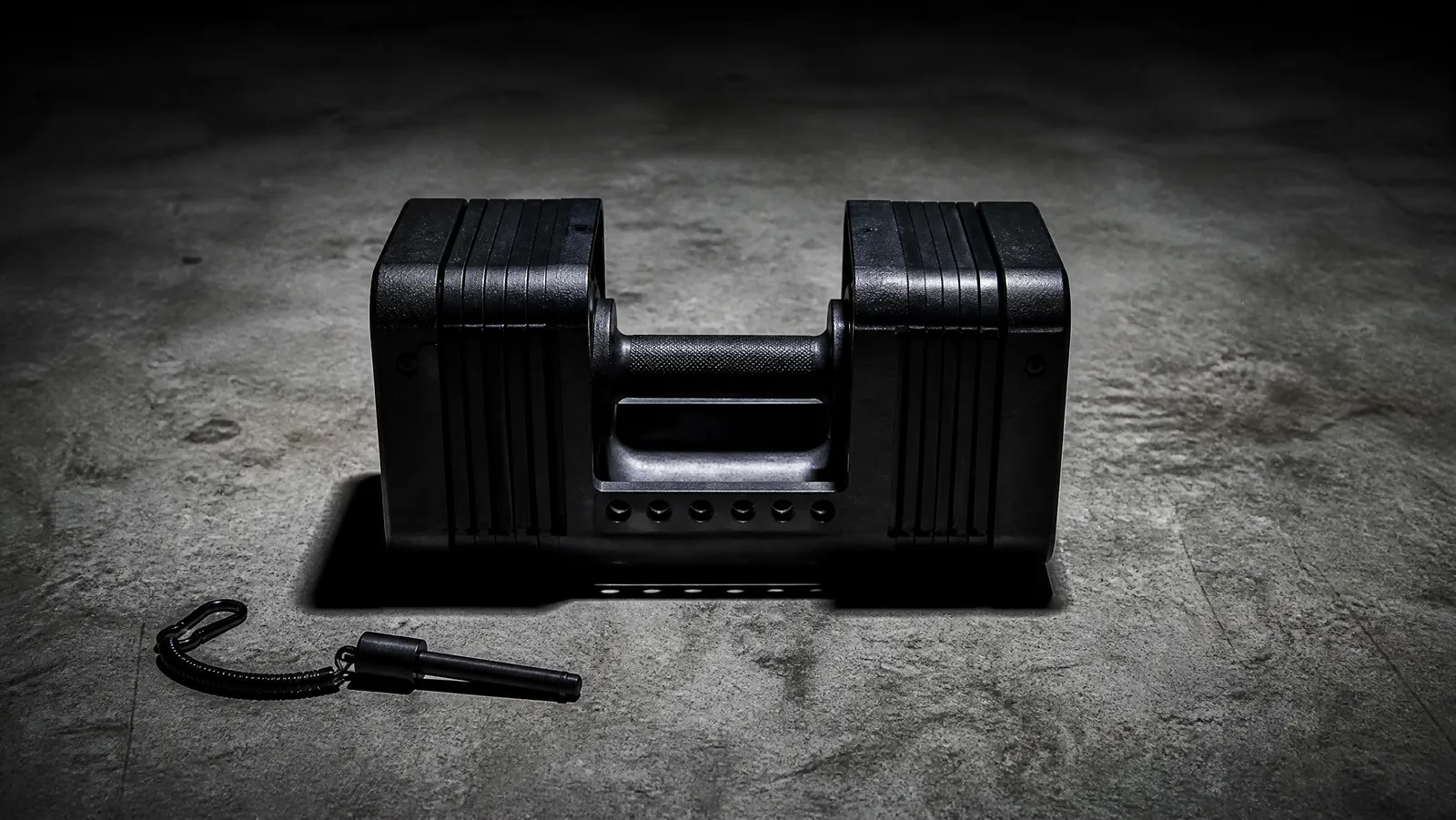
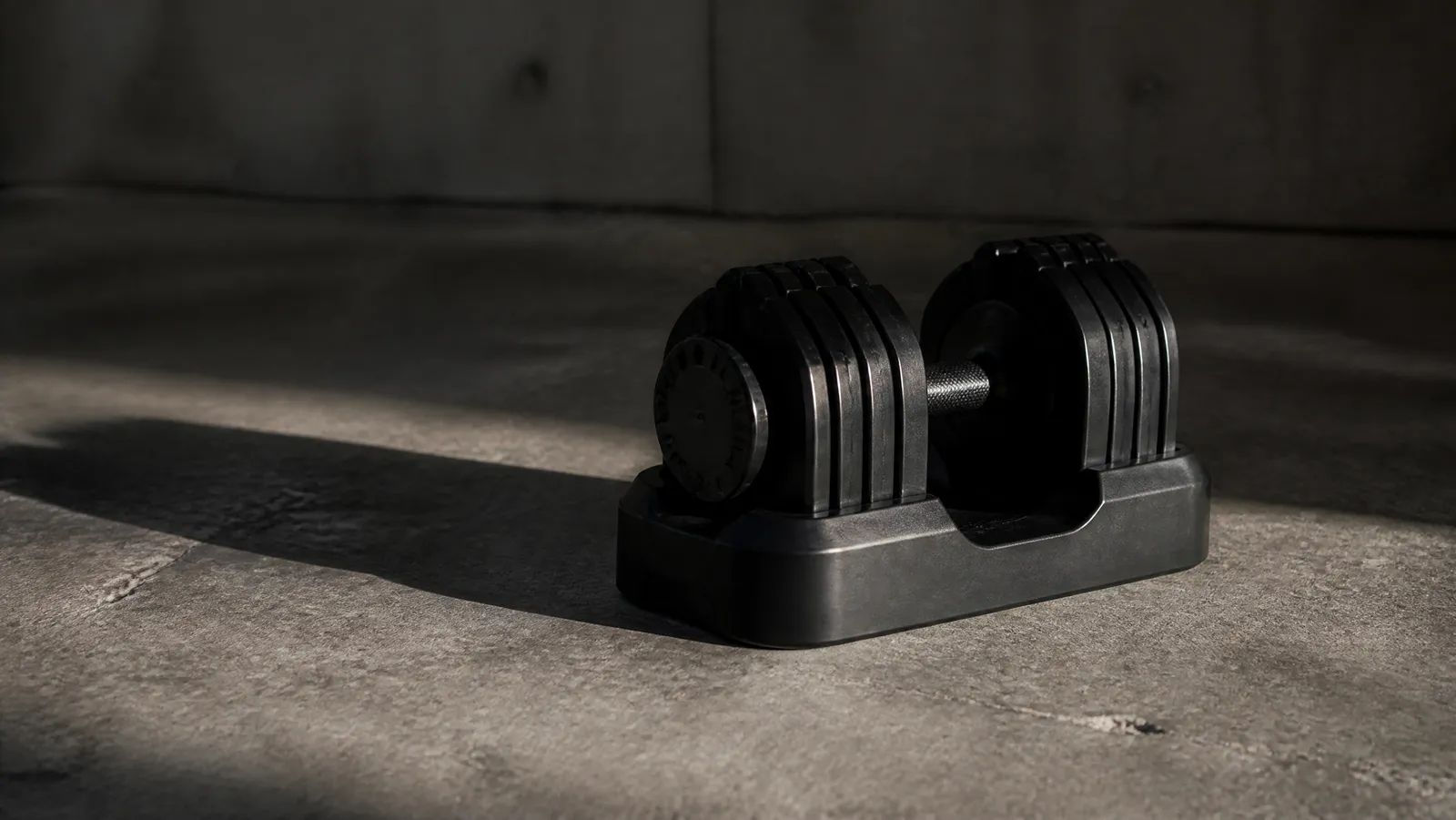
Buy the 50 to 52.5 lb (22.7 to 23.8 kg) per hand set. That ceiling covers every arm and shoulder pattern for most adults for years, and covers pressing and rowing until you cross out of the novice band. The lift that overruns it first is the one-arm row, usually as you cross from novice to intermediate. Your legs overran it before the box arrived.
Deciding what weight adjustable dumbbells to buy by picturing your bench press is how people end up paying for plates they never select. Our position is that the top end is a property of one lift rather than of your strength in general, so you build the number movement by movement. Our adjustable dumbbell buying guide handles configurations and prices across the category; this page is only the arithmetic on the ceiling.
One framing note before the numbers. Everything below is population data, and population data describes distributions, not readers. If you are new to loaded training or working around an injury, a clinician or a qualified coach comes before a spec sheet.
Your ceiling is set by one lift, not by your strength
A dumbbell ceiling is a per-pattern problem. ACSM's 2009 position stand on progression models in resistance training recommends, for novice and intermediate trainees and under its muscle hypertrophy heading, "that moderate loading be used (70-85% of 1 RM) for 8-12 repetitions per set for 1-3 sets per exercise." Its strength-training recommendation for the same group sits lower, at roughly 60 to 70 percent of 1RM, so every window in this article is the hypertrophy one. Read it as a shopping instruction. For any given lift, the top setting has to reach roughly 70 to 85 percent of your one-rep maximum in that lift, or the bell cannot deliver that prescription for that pattern.
So a pair of dumbbells has as many ceilings as you have exercises. The only question that matters is which one you hit first.
The free population anchor for dumbbell-specific lifts is Strength Level, with two caveats we hold for the rest of this article. The site describes its figures as built from "carefully filtered calculator data submitted by real lifters" (Strength Level, about), which is user-submitted rather than laboratory data, and its tiers are percentile bands rather than training plans: it defines Intermediate as "Stronger than 50% of lifters" and as someone who "has trained regularly in the technique for at least two years" (Strength Level dumbbell row standards). Note the unit too. Strength Level states that "Dumbbell weights are for one dumbbell and include the weight of the bar, normally 2 kg / 4.4 lb," so every figure below is per hand.
A per-lift ceiling table, from row to lateral raise
The 1RM columns are Strength Level's published intermediate marks. The working-load column is our arithmetic on ACSM's 70-85 percent window, not a figure either source publishes.
| Lift | Intermediate 1RM, men | Intermediate 1RM, women | 70-85% working load, men | Top end it demands | |---|---|---|---|---| | Dumbbell row | 91 lb (41.3 kg) | 48 lb (21.8 kg) | 64-77 lb (29-34.9 kg) | 70 lb (31.8 kg) or more | | Romanian deadlift | 92 lb (41.7 kg) | 61 lb (27.7 kg) | 64-78 lb (29-35.4 kg) | 70 lb (31.8 kg) or more | | Dumbbell bench press | 85 lb (38.6 kg) | 44 lb (20 kg) | 60-72 lb (27.2-32.7 kg) | 60 lb (27.2 kg) | | Shoulder press | 67 lb (30.4 kg) | 33 lb (15 kg) | 47-57 lb (21.3-25.9 kg) | 52.5 lb (23.8 kg) | | Dumbbell lunge | 63 lb (28.6 kg) | 41 lb (18.6 kg) | 44-54 lb (20-24.5 kg) | 50 lb (22.7 kg) per hand | | Dumbbell curl | 46 lb (20.9 kg) | 27 lb (12.2 kg) | 32-39 lb (14.5-17.7 kg) | 40 lb (18.1 kg) | | Lateral raise | 35 lb (15.9 kg) | 20 lb (9.1 kg) | 25-30 lb (11.3-13.6 kg) | 30 lb (13.6 kg) |
Two readings of that table, both ours rather than published findings.
- The order of failure is pull first, press second, arms never. Row and Romanian deadlift demand the same top end and demand it earliest. The bench sits one notch below them, the shoulder press and the lunge sit at the 50 lb (22.7 kg) line, and curls and lateral raises never threaten a 52.5 lb (23.8 kg) ceiling at the intermediate tier in this data, though the advanced and elite curl marks of 68 lb (30.8 kg) and 93 lb (42.2 kg) eventually do.
- Adjustable dumbbells up to 50 lbs (22.7 kg) are sized for four of those seven lifts at the intermediate tier. The three they are not sized for are the row, the Romanian deadlift and, by 7.5 lb (3.4 kg), the bench press, which is a narrower gap than the marketing for 90 lb (40.8 kg) bells implies.
When you outgrow a 52.5 lb dumbbell
The crossover sits between Strength Level's novice and intermediate bands on the row. Its male dumbbell row figures, drawn from "927,185 lifts by Strength Level users from 2017 to 2026," put Novice at 60 lb (27.2 kg) and Intermediate at 91 lb (41.3 kg) per hand. On ACSM's window the novice trains at 42-51 lb (19-23.1 kg) and fits inside a 52.5 lb (23.8 kg) bell. The intermediate trains at 64-77 lb (29-34.9 kg) and does not.
That is the whole answer to when you outgrow 52.5 lb (23.8 kg) dumbbells, and it is a percentile rather than a date.
Independent reviewers arrive at the same number from the other direction. Garage Gym Reviews' adjustable dumbbell guide, updated on November 6, 2026, writes "Typically, we'd recommend lighter adjustable dumbbells to people new to strength training—around 50 pounds or so," notes of a 52.5 lb set that "These Bowflex dumbbells max out at 52.5 pounds, which may be too light for stronger athletes," and predicts that "over time, users may require the heavier totals for exercises like goblet squats or dumbbell deadlifts."
If the row is the lift pushing you past the ceiling, the cheaper fix is often one heavy fixed pair rather than a bigger adjustable set, which is the trade we price out in adjustable dumbbells vs fixed dumbbells.
The lower-body problem home adjustable dumbbells do not solve
Bilateral leg work loads both hands, so the pair is the unit, and the pair is small. A 52.5 lb (23.8 kg) set holds 105 lb (47.6 kg) in total. A 90 lb (40.8 kg) set holds 180 lb (81.6 kg). Against that, Strength Level's squat standards, based on "24,988,444 lifts by Strength Level users from 2014 to 2026," put Intermediate at 289 lb (131.1 kg) for men and 167 lb (75.7 kg) for women.
Our arithmetic on those two sources: ACSM's 70-85 percent window on a 289 lb squat is 202-246 lb (91.6-111.6 kg), or 101-123 lb (45.8-55.8 kg) in each hand. A 100 lb (45.4 kg) pair only just reaches the bottom of that range. A 52.5 lb (23.8 kg) pair reaches about 36 percent of the same 1RM.
The same arithmetic is much kinder to smaller lifters. For a median-intermediate woman in that data, a 180 lb (81.6 kg) pair already exceeds her squat 1RM outright. The lower-body ceiling problem is a function of body mass and training history, not a property of the category, and the heavier and stronger you are the sooner it bites.
What is left when the ceiling is fixed is effort, not load, and the literature on that is reasonably clear while being narrower than the headlines suggest.
- Schoenfeld, Grgic, Ogborn and Krieger's meta-analysis in the Journal of Strength and Conditioning Research, pooling 21 studies in which sets were taken to momentary muscular failure, reports that "Gains in 1RM strength were significantly greater in favor of high- vs. low-load training" and that "no significant differences were found for isometric strength between conditions," while concluding that "muscle hypertrophy can be equally achieved across a spectrum of loading ranges."
- Lasevicius and colleagues, in the same journal in 2022, trained 25 untrained men for eight weeks of unilateral knee extension at 80 or 30 percent of 1RM, with and without going to failure and with volume equated. High-load conditions produced roughly double the 1RM gain, quadriceps cross-sectional area rose in every condition except low load stopped short of failure, and the authors report that with high loads "muscle failure does not promote any additional benefits."
Read together, in our judgement rather than theirs, that is permission to chase size with a light ceiling and a warning not to expect the same maximal-strength result. Both papers are small or narrow in scope, neither studied dumbbells, and training close to failure is the part of this that may carry added injury risk, so take the progression question to a qualified coach rather than to a spec sheet. The broader question of whether you can build muscle with dumbbells only is one we treat on its own.
Progressive overload with a fixed ceiling means the variables you move are reps, sets, tempo, pauses, unilateral stance and proximity to failure. The load column stops moving, and the programme does not have to.
Where adjustable dumbbells up to 90 lbs stop paying
The top end is the most expensive weight in the category, and it is the weight least often selected. Using Garage Gym Reviews' prices from that November 6, 2026 update, its comparison table puts the average adjustable dumbbell at "$625", the REP QuickDraw runs "around $500 for up to 60 pounds" (27.2 kg), the MX100 Evolution Series lists at $1,049 for 10-100 lb (4.5-45.4 kg), and the PowerBlock Pro 100 EXP "Starts at $539" for a 40 lb (18.1 kg) base while "The maximum weight of 100 pounds will cost nearly $1,200."
Our arithmetic on those published prices, clearly labelled as ours: the first 60 lb (27.2 kg) of ceiling costs roughly $8 per pound, and the step from a 60 lb to a 100 lb (45.4 kg) ceiling costs roughly $14 per pound. Inside a single product line, adding 60 lb (27.2 kg) per hand to that Pro 100 base more than doubles the price of the set. Why the mechanism costs what it does is the subject of why adjustable dumbbells are so expensive.
Here is the test we use, which is editorial rather than sourced. Open your training log and find the heaviest setting you actually used in the last four weeks, not your best single. If that number is more than 10 lb (4.5 kg) below the ceiling you already own, a bigger ceiling buys you nothing this year. If it is within 10 lb (4.5 kg) and the lift in question is a row, a Romanian deadlift or a bilateral squat, you are in the minority who will select the top plates.
Increment granularity beats top end for most buyers
A 2.5 lb (1.1 kg) step at the weight you train is worth more than 40 lb (18.1 kg) of ceiling you never touch. ACSM's position stand recommends that "a 2-10% increase in load be applied when the individual can perform the current workload for 1-2 repetitions over the desired number on two consecutive training sessions." On a 40 lb (18.1 kg) setting, a 5 lb (2.3 kg) jump is 12.5 percent and sits outside that range, while a 2.5 lb (1.1 kg) jump is 6.25 percent and sits inside it.
Published ladders thin out exactly where lifters stall. The Bowflex SelectTech 552 owner's manual states "There are 15 weight increments" and prints them: 5, 7.5, 10, 12.5, 15, 17.5, 20, 22.5, 25, 30, 35, 40, 45, 50 and 52.5 lb. The steps are 2.5 lb (1.1 kg) up to 25 lb (11.3 kg) and 5 lb (2.3 kg) from there to 50 lb (22.7 kg), so the fine granularity lives where a beginner needs it and vanishes where a stalling lifter needs it.
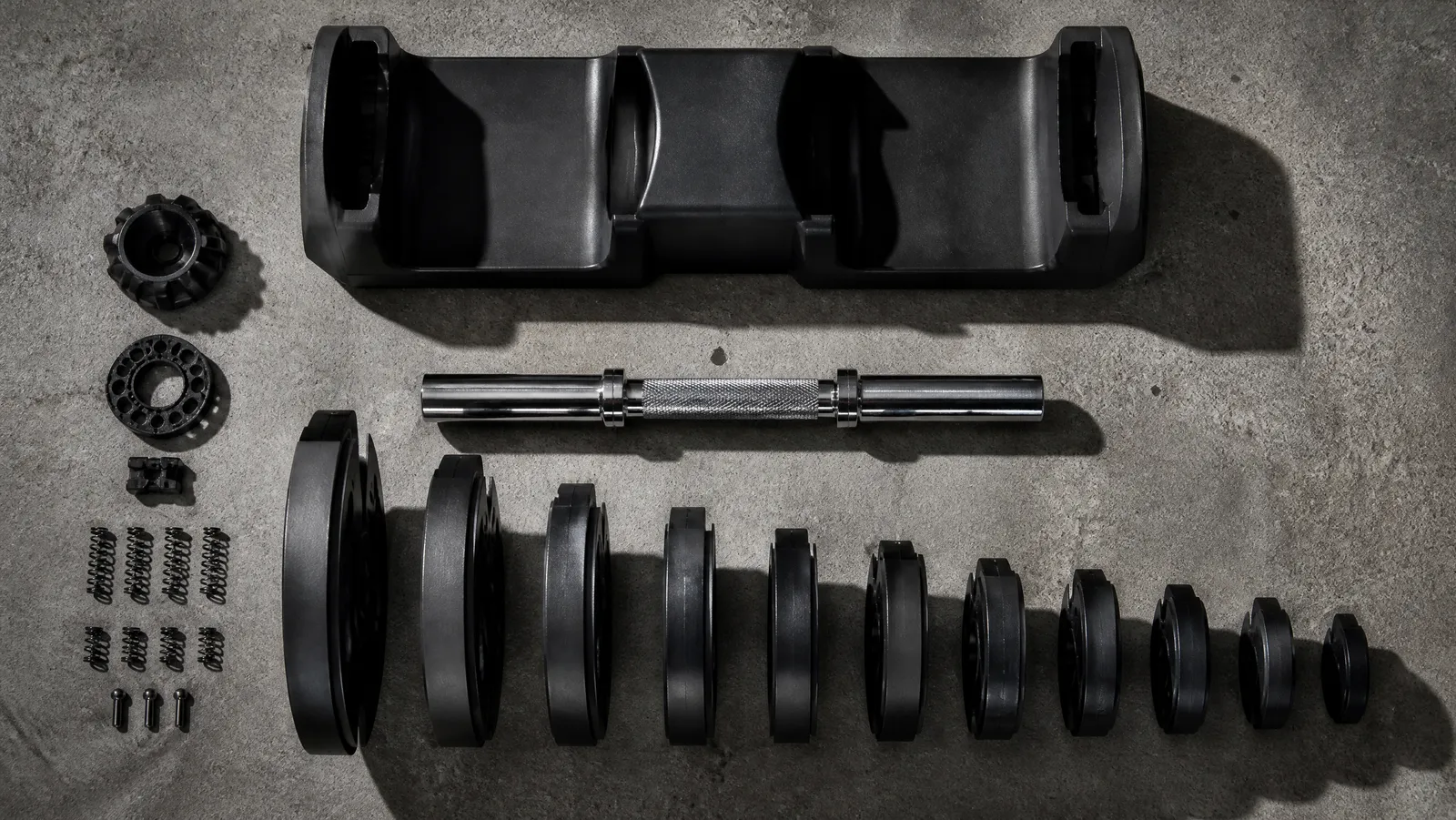
The block-selector ladder has its own holes. PowerBlock's Elite EXP spec sheet claims "Increments 2.5 lbs", yet its own published lists skip 12.5, 22.5, 32.5 and 42.5 lb at Stage 1, 52.5 and 62.5 lb at Stage 2, and 72.5 and 82.5 lb at Stage 3. The real pattern is two 2.5 lb (1.1 kg) steps followed by a 5 lb (2.3 kg) step, repeated all the way to 90 lb (40.8 kg). Garage Gym Reviews scores bells on jumps of "no more than 10-pound increments" and writes of one 10 lb (4.5 kg) step design that "10-pound jumps can make progressive overload a little tough." Where those steps come from mechanically is covered in how adjustable dumbbells work.
One recall note before you buy a 90 lb set
The heaviest selectorised bells are also the subject of the category's biggest safety action, so treat model names in this article as evidence rather than as picks. There have been at least eight CPSC recalls of adjustable dumbbells since 2012, and the largest is recall 25-311 of 5 June 2025, covering about 3,844,200 BowFlex 552 and 1090 dumbbells, on the finding that "The weight plates can dislodge from the handle during use, posing an impact hazard." The notice names "BowFlex 552, 52.5 LB Adjustable Dumbbells and BowFlex 1090, 90 LB Adjustable Dumbbells" and instructs that "Consumers should immediately stop using the recalled Bowflex adjustable dumbbells." We quote those ladders because they are published, not because we would put either model on a shortlist.
What dumbbell weights for a home gym, by reader type
New lifter, first two years: 50 to 52.5 lb (22.7 to 23.8 kg) per hand. The reason is the bottom of the range, not the top. Beginner marks in this data sit at 10 lb (4.5 kg) for the lateral raise and 16 lb (7.3 kg) for the curl, and a 52.5 lb (23.8 kg) ceiling still covers four of the seven patterns in our table at the intermediate tier.
Intermediate with a row problem: 70 to 80 lb (31.8 to 36.3 kg) per hand, and only on evidence. Run the four-week log test above. If your heaviest logged row setting is inside 10 lb (4.5 kg) of your ceiling, buy the step up. If it is not, buy the increments instead.
Strong, tall or heavy, with no barbell: 90 to 100 lb (40.8 to 45.4 kg) per hand, eyes open. That ceiling costs roughly double a 60 lb (27.2 kg) set on the prices above, and it still falls at the bottom of an intermediate man's squat window, so you are buying the pull and hinge patterns rather than solving the legs.
Pick the top end by the lift that needs it most, then spend what is left on step size. For the rest of the decision, including the mechanism and the money, see our guide to adjustable dumbbells for home gym.
The biggest number on the box is the one you are least likely to lift.
What to know before you buy
Field Notes
Is 50 lb per hand enough weight to build muscle?
For upper-body work, the published numbers say yes for a long time. [ACSM's 2009 position stand on progression models in resistance training](https://sfu.ca/~ryand/kin343/ACSMresistance.pdf) recommends for novice and intermediate trainees, in its muscle hypertrophy section, "that moderate loading be used (70-85% of 1 RM) for 8-12 repetitions per set for 1-3 sets per exercise." Hold that against [Strength Level's dumbbell bench press standards](https://strengthlevel.com/strength-standards/dumbbell-bench-press/lb), where the Intermediate mark is 85 lb (38.6 kg) per hand for men and 44 lb (20 kg) for women: 70 percent of the male figure is 60 lb (27.2 kg), so a 52.5 lb (23.8 kg) bell sits just under the window for a median-intermediate man's bench and well inside it for most women. And [Schoenfeld and colleagues, in the Journal of Strength and Conditioning Research](https://pubmed.ncbi.nlm.nih.gov/28834797/), concluded from 21 studies that "muscle hypertrophy can be equally achieved across a spectrum of loading ranges."
When do you outgrow 52.5 lb dumbbells?
On the one-arm row first, and usually around the point where you stop being a novice. [Strength Level's dumbbell row standards](https://strengthlevel.com/strength-standards/dumbbell-row/lb), based on "927,185 lifts by Strength Level users from 2017 to 2026," put the male Novice mark at 60 lb (27.2 kg) per hand and Intermediate at 91 lb (41.3 kg). Run ACSM's 70-85 percent window on those and the novice works at 42-51 lb (19-23.1 kg), inside a 52.5 lb (23.8 kg) bell, while the intermediate works at 64-77 lb (29-34.9 kg), outside it. Independent testing agrees from the other side: [Garage Gym Reviews' adjustable dumbbell guide](https://www.garagegymreviews.com/best-adjustable-dumbbells), updated on November 6, 2026, writes that "These Bowflex dumbbells max out at 52.5 pounds, which may be too light for stronger athletes."
Are 100 lb adjustable dumbbells worth the extra money?
Only if your heaviest logged setting is already near the ceiling you own. [Garage Gym Reviews](https://www.garagegymreviews.com/best-adjustable-dumbbells) prices the REP QuickDraw at "around $500 for up to 60 pounds" (27.2 kg), the MX100 Evolution Series at $1,049 for 10-100 lb (4.5-45.4 kg), and the PowerBlock Pro 100 EXP from "Starts at $539" for its 40 lb (18.1 kg) base, noting that "The maximum weight of 100 pounds will cost nearly $1,200." Our arithmetic on those published prices, not theirs: the first 60 lb of ceiling runs about $8 per pound and the step from 60 to 100 lb runs about $14 per pound. The honest case for paying it is bilateral leg work with no barbell in the room, and even then [Strength Level's squat standards](https://strengthlevel.com/strength-standards/squat/lb) show a 100 lb pair falling short of an intermediate man's working range.
Do adjustable dumbbells need 2.5 lb increments?
More than they need another 40 lb of top end, in our reading. [ACSM's 2009 position stand](https://sfu.ca/~ryand/kin343/ACSMresistance.pdf) recommends that "a 2-10% increase in load be applied when the individual can perform the current workload for 1-2 repetitions over the desired number on two consecutive training sessions." A 5 lb (2.3 kg) jump on a 40 lb (18.1 kg) setting is 12.5 percent, above that range; a 2.5 lb (1.1 kg) jump is 6.25 percent, inside it. Published ladders thin out exactly where it matters: the [Bowflex SelectTech 552 owner's manual](https://cdn.shopify.com/s/files/1/0604/6708/5501/files/BFX_SelectTech552.pdf) lists "There are 15 weight increments" with 5 lb steps from 25 lb (11.3 kg) to 50 lb (22.7 kg), and the [PowerBlock Elite EXP spec sheet](https://cdn.shopify.com/s/files/1/0862/1694/files/Elite_EXP.pdf) claims "Increments 2.5 lbs" while its own Stage 1 list skips 12.5, 22.5, 32.5 and 42.5 lb.
What dumbbell weights should a beginner buy for a home gym?
Buy for the bottom of the range as carefully as the top. [Strength Level's dumbbell lateral raise standards](https://strengthlevel.com/strength-standards/dumbbell-lateral-raise/lb) put the male Beginner mark at 10 lb (4.5 kg) per hand and the female mark at 7 lb (3.2 kg), and its [dumbbell curl standards](https://strengthlevel.com/strength-standards/dumbbell-curl/lb) put Beginner at 16 lb (7.3 kg) and 9 lb (4.1 kg). Those are the loads a first month actually uses. The [PowerBlock Elite EXP spec sheet](https://cdn.shopify.com/s/files/1/0862/1694/files/Elite_EXP.pdf) starts its Stage 1 ladder at 5 lb (2.3 kg), and the [Bowflex SelectTech 552 owner's manual](https://cdn.shopify.com/s/files/1/0604/6708/5501/files/BFX_SelectTech552.pdf) states that "The weight increments range from 5 to 52.5 lbs (2.27kg to 23.9kg) on both adjustment knobs." A bell that starts at 10 lb (4.5 kg) has already priced you out of your own first lateral raise.
Who put in the work
The Coach
Your Coach
Darlene Schmitt
I am a fitness instructor and promoter who truly enjoys helping others become the best they can be! My mission is to help people find the love of fitness and to help them develop a lifelong habit of exercise. I am a firm believer that fitness should be fun, and I make it my mission to ensure that my classes are always enjoyable. I am also a certified nutritionist and personal trainer, so I am able to offer my students comprehensive and well-rounded support.