Best weighted vest for rucking: our picks, and who actually needs one

Contains affiliate links. Our policy.
The best weighted vest for rucking, for most people, is an adjustable one, and our pick is the APEXUP 40 lb — $107.99 as of September 2026 — because it loads in removable 2.5 lb cast iron blocks rather than sewn-in sand. The harder answer is that a vest is the wrong first purchase for a good share of the people searching for one.
Exercise Legend is reader-supported: if you buy through our links we may earn a commission, at no extra cost to you. We build these picks from manufacturer specifications and the load-carriage research below rather than a hands-on test, so read them as informed category judgment rather than a field review.
A vest earns its place in a narrower set of cases than the marketing implies: you want the load high and tight for running intervals or calisthenics, your shoulders object to where a pack's straps sit, you are training for an event that specifies a vest, or you already know weighted walking has stuck. If you are still deciding, rucking vs a weighted vest is the piece that qualifies you, and if you are new to rucking, start there instead of here. One caveat we mean literally: if you are pregnant, managing a cardiac or joint condition, or returning from an injury, whether to hang load on your torso at all is a question for a doctor or a qualified coach before it is a question for a gear roundup.
Who a weighted vest is actually the right buy for
Start with what a vest is genuinely better at, because it is specific. A vest holds mass against your torso, close to your centre of mass, split front and back. It does not swing. That is why it survives running, jumping, pull-ups and burpees, and why a loaded backpack does not.
Load-carriage researchers treat the two as separate problems. In a 2024 paper in Medicine and Science in Sports and Exercise, David Looney and colleagues at the US Army Research Institute of Environmental Medicine note that the Army's Load Carriage Decision Aid "has yet to be adapted for vest-borne load carriage, which is commonplace in tactical populations, and differs in energetic costs to backpacking and other forms of load carriage." They then had 20 military-age adults walk with vest loads from 0 to 66 percent of body mass to build the missing equation. The premise matters more than the maths: a vest and a pack do not share a formula.
What a vest is worse at is distance. There is no hip belt, so every pound stays on your shoulders and ribcage, and there is nowhere to put water. If your plan is 60 to 90 minutes on a trail, our rucking backpack roundup is the more useful page, and a bag you already own plus one heavy flat object is a zero-dollar experiment.
So the short list: runners and interval trainers, calisthenics people, anyone whose shoulders dislike strap-borne load, and anyone who has already done three months of loaded walking and wants a second tool. Everyone else is buying a solution before confirming the problem.
Adjustable vs fixed weight: the one spec that decides the rest
Most vest roundups sort by price. The distinction that actually predicts whether you will still be using the thing in a year is whether the weight comes out.
A fixed vest is a single point on a curve. The weight is sewn in, usually as iron sand, and the number on the box is the only number you will ever get. A 20 lb fixed vest is a dead end the moment 20 lb is easy — and it will get easy, because that is what training does.
An adjustable vest is a system. Weights come out in small increments, so the vest follows a progression rather than defining one. That matters because the published guidance is written in percentages of body weight, and percentages move in awkward small numbers. In a February 2026 ACSM article, Len Kravitz describes starting at "roughly 5 percent of your body weight" and building toward "10 percent to 20 percent of body weight" for most users. For a 160-pound adult that first step is 8 pounds. No fixed vest lands there and then moves in useful increments from it.
The trade is money. Our two adjustable picks cost $107.99 and $159.99 as of September 2026; the fixed vests cost $63.99 and $14.99. If you already know the load you want, a fixed vest is not a mistake. If you are still finding out, buying adjustment is buying the right to be wrong.
The plate-carrier style is a third category rather than a midpoint: two dense curved plates instead of many small pockets, adjusted in whole-plate jumps.
Iron blocks versus iron sand: why the fill decides the lifespan
Iron sand is fine granular fill sewn into neoprene pockets. It conforms to the body and it is cheap to manufacture, and both ZELUS and BAGAIL use it. Its limitation is structural rather than a defect: sewn-in fill cannot be removed, redistributed or replaced, so the weight and the garment are the same object.
Iron blocks are discrete cast plates that slide in and out. APEXUP uses 2.5 lb blocks and says its reason for choosing cast iron over sand-filled pockets is to avoid sand leakage; Eric Flag uses sixteen 2.4 lb iron weights. We have not tested either vest and cannot tell you how often sand pockets actually fail, so treat leakage as the maker's argument rather than our finding. The design consequence is what we will assert: with blocks, one damaged pocket costs you one pocket.
The five picks, and what each one is for
Two adjustable, two fixed, one plate carrier. The APEXUP 40 lb is the default first vest, because 2.5 lb cast iron blocks let you move in steps small enough to matter. The Eric Flag 40 lb buys finer increments still, at a higher price. The ZELUS 20 lb is the cheap way to own a load you have already decided on; the BAGAIL 10 lb is the cheap way to find out whether you want one at all. The Northgym is the plate-carrier format, with the highest ceiling here and the thinnest spec sheet. Prices below are as of September 2026 and they move, so treat the reasoning as the durable part.
Our pick: the APEXUP 40 lb adjustable vest
The APEXUP 40 lb wins on the combination rather than any single line. It adjusts in 2.5 lb cast iron blocks, and APEXUP lists a heavy-duty 1000D nylon shell with reinforced stitching, padded shoulder straps, an adjustable waist belt and a load distributed across front and back. Reflective strips are included, and the logo detaches.
The 2.5 lb increment earns the pick. It is small enough to follow a percentage-based progression instead of jumping in tens, and the 40 lb ceiling means the vest outlasts your first year of improvement. APEXUP also publishes an unusually concrete loading suggestion: 20 lbs for rucking and brisk walks, 30 lbs for bodyweight squats and pull-ups, 40 lbs for push-ups and running intervals. That is a maker's recommendation rather than a tested protocol.
Its honest weakness: APEXUP publishes no empty vest weight and no chest-size range, so fit is the spec you buy blind. And $107.99 as of September 2026 is a real outlay for something whose main competitor is a bag already in your hallway.
Best adjustability: the Eric Flag 40 lb with 16 iron weights
The Eric Flag 40 lb is the most granular system here: sixteen removable 2.4 lb iron weights across sixteen pockets, eight on the front and eight on the back, for a stated 0 to 40 lb range. The shell is 1000D Oxford nylon that Eric Flag describes as tear- and abrasion-resistant, and Eric Flag lists the vest at 1.6 lb empty — the only published empty weight in this roundup, which means the number on the label is close to the number on your body.
The eight-front, eight-back arrangement is the geometry that makes a vest a vest. Splitting load across the torso rather than hanging it behind you is what separates the two carriers in the load-carriage literature.
What it costs you is $159.99 as of September 2026, which buys finer increments rather than a higher ceiling than our top pick. It is hand wash only, a real constraint on a garment you will sweat into repeatedly, and the claim that it "suits all body sizes" is a claim rather than a chest measurement.
Best budget fixed-weight: the ZELUS 20 lb
The ZELUS 20 lb is double-stitched neoprene filled with iron sand at a fixed weight, sold in 6, 8, 12, 16, 20, 25 and 30 lb versions as separate purchases, with detachable front zipper pockets, a rear elastic-mesh pocket and cushioned shoulder straps.
Its most useful spec is the one nobody markets: ZELUS states it fits chest sizes between 31.5 and 45 inches. That is the only published chest range across all five picks, and fit decides whether a vest gets worn or gets shelved.
Twenty pounds is also the load with the most usable research behind it. A 2021 study in Ergonomics by Gaffney, Cunnington, Rattley, Wrench, Dyche and Bampouras tested exactly this weight — 20 lb on men, 14 lb on women — across walking and running trials in 20 subjects. During running the vest raised heart rate by about 11 beats per minute in both sexes and raised oxygen uptake and energy expenditure significantly. During walking, physiological demand rose only at the 10 percent gradient, not at 0 or 5 percent, and the authors reported "no change in stride length or frequency."
Read that plainly: a 20 lb vest on flat ground is a smaller stimulus than the marketing suggests, and it becomes a real one when you run or find a hill. What else changes when you add load, and what does not, is in our comparison of rucking vs walking.
Best light starter vest: the BAGAIL 10 lb
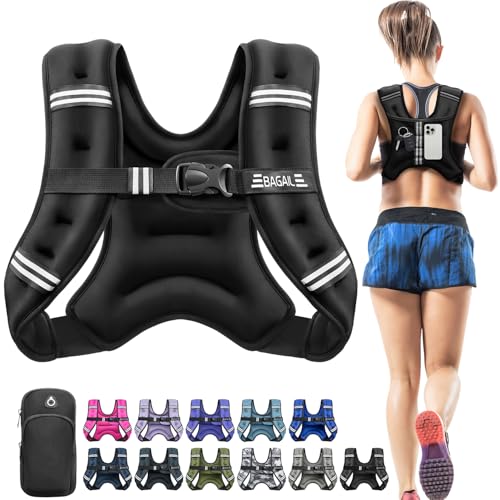
The BAGAIL Comfort-Fit 10 lb is fine iron sand in breathable neoprene at $14.99 as of September 2026, down from a $24.99 list price. There is a detachable phone pouch that BAGAIL says fits most phones up to 7 inches, a rear mesh pocket, and reflective strips front and back. The line runs from 5 to 30 lb as separate weights; this is the 10 lb.
We include it for one reason: the most useful thing a beginner can buy is information about whether they will keep doing this, and that is close to the cheapest that information gets. Ten pounds is the 5 percent of body weight starting point in the ACSM guidance above for a 200-pound adult, and sits above it for anyone lighter.
Now the part we will not repeat. The listing claims the vest helps "maintain bone density" and drives "faster weight loss." We would treat both as unsupported marketing rather than as reasons to buy. In the ACSM piece, Kravitz writes that "walking, even with added weight, does not deliver the high-magnitude compressive forces required to stimulate bone growth." The trial evidence points the same way. The INVEST in Bone Health study, a 12-month randomized clinical trial of 150 older adults with obesity published in JAMA Network Open in June 2025 by Beavers and colleagues, compared dietary weight loss alone against weight loss plus a weighted vest and weight loss plus resistance training, and found neither the vest group nor the resistance training group preserved bone mass better than diet alone. Our own review of what rucking does and does not do reached a similar conclusion. That does not make a vest useless. It makes the bone claim on the box one the evidence does not currently support.
Best plate-style carrier: the Northgym curved-plate vest
The Northgym adjustable vest is the plate-carrier entry: two curved 3D plates rather than many small pockets, sold in 14 lb, 20 lb, 30 lb and 42.5 lb plate configurations. North Gym states that the curved plates keep the load close to the body without excess pressure on the torso.
The format has a genuine argument behind it. Two dense masses held flat against the chest and back should move less than sixteen small pockets do — we have not tested it — and 42.5 lb is the highest ceiling here. If you want the feel of a plate carrier for intervals and carries, this is the shape that delivers it.
We are deliberately brief because the listing is. There is no published fabric denier, no dimensions and no empty vest weight, which is unusual at $179.99 as of September 2026 and which we will not paper over with invented numbers. Read this as a judgment about the plate-carrier format rather than a verdict on the build.
How much weight to start with in a weighted vest for walking
Short version: less than the vest you buy can hold, and the research is unusually consistent about it.
The most quoted dataset is an ACE-commissioned study run by Len Kravitz and James McCormick at the University of New Mexico, reported by ACE. Thirteen untrained women aged 18 to 55 walked at 2.5 mph across grades of 0, 5, 10 and 15 percent, wearing no vest, a vest at 10 percent of body mass, and a vest at 15 percent. On flat ground the 10 percent vest produced no significant increase in energy cost; 15 percent was needed for roughly a 12 percent rise in calories burned. Add a 5 or 10 percent grade and the 10 percent vest was worth about 13 percent more calories.
On flat ground a light vest changes less than you would hope. On a hill, the same vest starts to count. That is an argument for finding a gradient before it is an argument for adding plates.
Load also carries a cost that is easy to miss. In a 2024 study in Sports, Martínez-Noguera, Alcaraz and Marín-Pagán had 13 trained male trail runners complete a treadmill test with vests at 0, 5 and 10 percent of body mass. Time to exhaustion fell from 2,117 seconds unloaded to 1,989 seconds at 10 percent, about 6 percent. You trade duration for intensity rather than getting it free.
The full reasoning on picking a number is in how much weight should you ruck with. The ACSM version is compact: Kravitz suggests starting near 5 percent of body weight and building toward 10 to 20 percent, and he cautions against wearing a vest all day, since in his account the continuous twisting and turning under load may create a possible risk of musculoskeletal strain or joint damage. What load suits you specifically is a question for a doctor or a qualified coach.
Best rucking vest for women and men: fit, chafe and what actually differs
There is no physiological reason a vest needs a gender label, and only one of our five picks carries one. What differs is torso length, chest and bust shape, and the strap geometry that follows. A vest sized for a longer torso rides low on a shorter one and puts pressure where the ribs flare rather than across the sternum.
That makes the published chest range the most valuable spec on any of these listings, and it is why ZELUS's 31.5 to 45 inch figure is worth flagging even on a fixed-weight vest. Eric Flag states its vest suits all body sizes and both men and women; that is a claim, not a measurement. APEXUP and Northgym publish nothing on sizing.
Two mechanical points are worth knowing before you cinch anything down. First, pressure. The 2022 review in Physiological Reports by Faghy, Shei, Armstrong, White and Lomax relays ergonomic guidance that "the maximum forces applied to each shoulder should not exceed 145 N and maximum pressures 20 kPa." A vest spreads load across the torso rather than concentrating it in two straps, which is one of its better arguments over a pack.
Second, breathing. The same review reports that as torso-borne load rose from 12 to 47 kg, reductions ran "from 8 percent to 15 percent and 6 percent to 14 percent for FVC and FEV1 respectively" — far heavier loads than anything here, measured on packs and body armour rather than training vests, so read the direction rather than the number. A vest strapped tight enough to stop bouncing is strapped tight enough to notice. Start looser than you think, and if one spot keeps complaining, what the injury literature reports is the better guide.
On chafing, ZELUS calls its neoprene non-chafing and BAGAIL calls its neoprene breathable; we have tested neither. The spec sheets are more useful on care — BAGAIL is wipe clean only, Eric Flag is hand wash only — and a vest you cannot easily wash will eventually smell like one.
The honest answer
The best weighted vest for rucking is an adjustable one, because the alternative is buying a single point on a curve you intend to move along. Our pick is the APEXUP 40 lb for its 2.5 lb cast iron blocks and 1000D shell at $107.99 as of September 2026; the Eric Flag at $159.99 buys finer increments; the ZELUS at $63.99 and the BAGAIL at $14.99 are fixed loads priced accordingly; the Northgym at $179.99 is the plate-carrier format with the least published about it.
But the ranking is the second question. The first is whether a vest is your tool at all. The evidence says a vest carries load differently from a pack rather than better, that a 20 lb vest on flat ground moves the physiological numbers less than most people expect, and that the bone-density claims on some of these listings run ahead of the trial data. What a vest does well — stay put while you run, jump and press — is real, specific and worth paying for if that is what you are doing.
If it is not, do the cheap version first. Walk with a loaded bag for a month, see whether the habit survives contact with February, and buy the vest when you have a reason more specific than wanting one. Our guide to rucking for beginners is where that month starts.
Gear we'd put on our own floor
The Picks

The adjustable vest we would buy first
APEXUP sells this vest in 20 lb, 30 lb and 40 lb versions and adjusts the load with removable 2.
Price as of
APEXUP sells this vest in 20 lb, 30 lb and 40 lb versions and adjusts the load with removable 2.5 lb cast iron blocks rather than sewn-in sand pockets, which the maker notes avoids sand leakage. The shell is heavy-duty 1000D nylon with reinforced stitching. The shoulder straps are padded, the waist belt adjusts, and APEXUP says the weight is distributed across the front and back in a breathable design. Reflective strips are included and the logo detaches. The company's own loading suggestion runs 20 lbs for rucking and brisk walks, 30 lbs for bodyweight squats and pull-ups, and 40 lbs for push-ups and running intervals.
// What We Like
Two published specs carry this pick. The 2.5 lb block is a small enough increment to follow a percentage-of-bodyweight progression rather than jumping in tens, and cast iron blocks are removable and replaceable in a way that sewn-in iron sand is not. A 40 lb ceiling also means the vest survives your own progress, which a fixed 20 lb vest does not. The maker's own weight-by-activity suggestion is unusually specific for a listing, and it lines up with how we would use a vest.

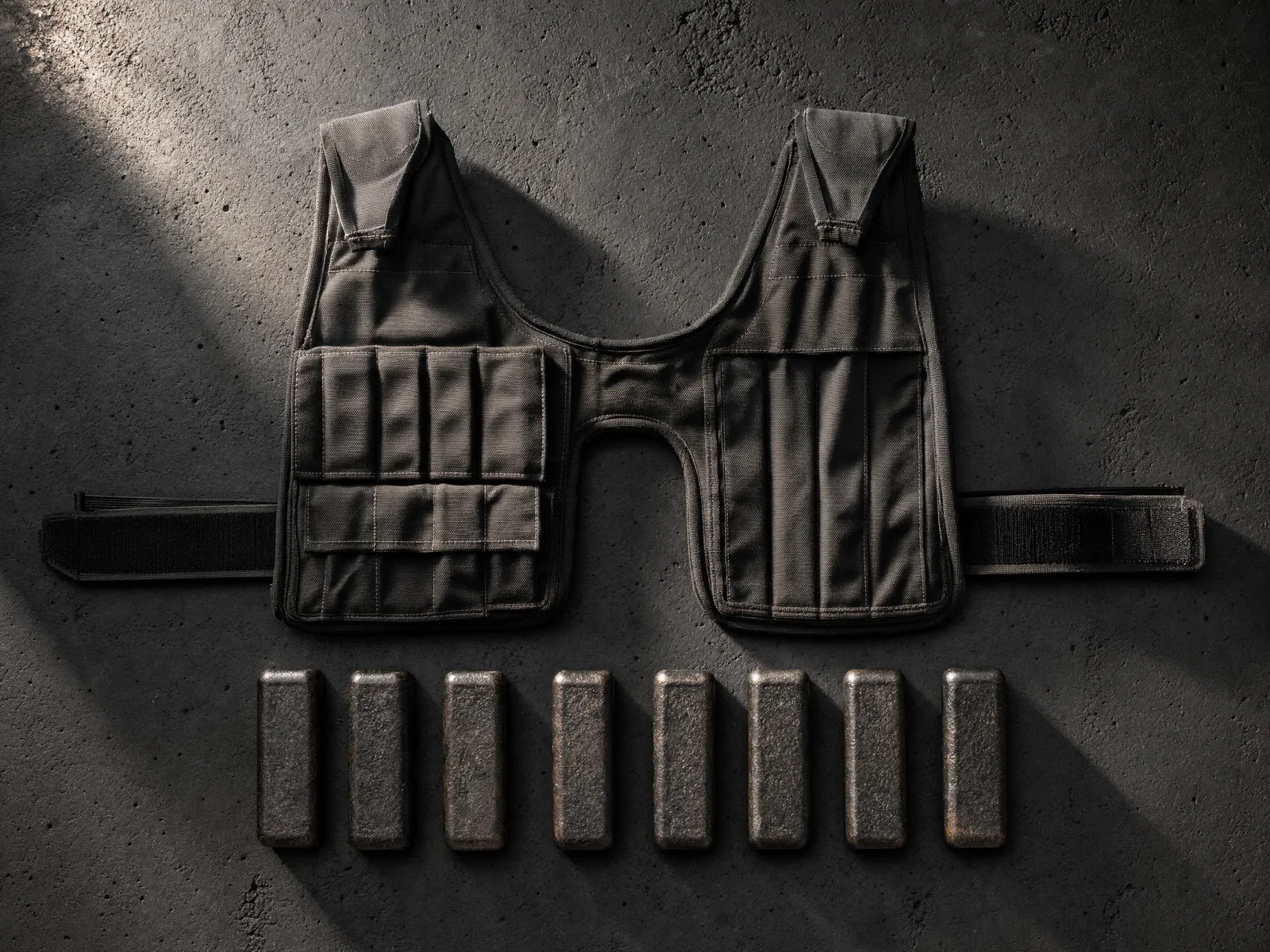
Sixteen removable 2.4 lb iron weights sit across sixteen pockets, eight on the front and eight on the back, for a stated adjustment range of 0 to 40 lb. The shell is 1000D Oxford nylon, which Eric Flag describes as tear- and abrasion-resistant. The vest weighs 1.6 lb empty, which is the only published empty weight in this roundup. There is an adjustable strap for fit, and the maker states the vest suits all body sizes and both men and women. It is hand wash only, and ships with the weights, adjustable straps and a user manual.
// What We Like
Sixteen pockets in 2.4 lb steps is the most granular system here, and granularity is what lets you add load in the small amounts the published progression guidance actually describes. The eight-front, eight-back layout is the arrangement the load-carriage literature associates with a vest rather than a pack, and a published 1.6 lb empty weight means the number on the label is close to the number on your body.

The cheap way to own a known 20 lb load
Neoprene rubber fabric with double stitching, filled with iron sand.
Price as of
Neoprene rubber fabric with double stitching, filled with iron sand. The 20 lb is a fixed weight and cannot be adjusted; ZELUS sells 6, 8, 12, 16, 20, 25 and 30 lb versions as separate purchases. There are detachable front zipper pockets plus a rear elastic-mesh pocket, adjustable buckle straps, and cushioned shoulder straps. ZELUS states it fits chest sizes between 31.5 and 45 inches, which is the only published chest range in this roundup, and describes the fabric as non-chafing.
// What We Like
A published chest range of 31.5 to 45 inches is worth more than most spec sheets here, because fit is the variable that decides whether a vest gets worn. Twenty pounds is also the load with the most usable research attached to it, since the 2021 Ergonomics study of CrossFit vests tested exactly 20 lb on men and 14 lb on women. If you already know the weight you want, you are not paying for adjustment you will not use.
The lowest-cost way to find out if you like weighted walking
Fine iron sand in breathable neoprene, at a fixed 10 lb that cannot be adjusted.
Price as of
Fine iron sand in breathable neoprene, at a fixed 10 lb that cannot be adjusted. BAGAIL sells the line across a 5 to 30 lb range as separate weights, and this listing is the 10 lb. There is a detachable phone pouch that the maker says fits most phones up to 7 inches, plus a rear mesh pocket, and reflective strips front and back. It is wipe clean with a damp cloth and not machine washable.
// What We Like
At $14.99 as of September 2026, down from a $24.99 list price, this is the cheapest answer to the only question that matters early on, which is whether you will keep doing this. Ten pounds is close to the 5 percent of body weight starting point in ACSM's weighted-vest guidance for a 200-pound adult, and above it for a lighter one, and the phone pouch and reflective strips are the two features a walker actually uses.

Two dense plates instead of sixteen small pockets
A plate-carrier design: the load is carried as two curved 3D plates rather than many small pockets.
Price as of
A plate-carrier design: the load is carried as two curved 3D plates rather than many small pockets. North Gym sells it in 14 lb, 20 lb, 30 lb and 42.5 lb plate configurations, and states that the curved plates keep the load close to the body without excess pressure on the torso. The listing publishes unusually little beyond that, with no fabric denier, no dimensions and no empty vest weight, so what follows is a judgment about the format rather than about verified construction.
// What We Like
Curved plates are the format most people mean when they say the vest should feel like part of them rather than like cargo. Two dense masses held flat against the chest and back should move less than sixteen small pockets do, though we have not tested it, and that is the property that matters for running and for anything overhead. A 42.5 lb configuration is also the highest ceiling in this roundup.
Our top three, ranked
The Leaderboard
The adjustable vest we would buy first
APEXUP sells this vest in 20 lb, 30 lb and 40 lb versions and adjusts the load with removable 2.
Check PricePrice as of
The finest weight increments in the roundup
Sixteen removable 2.
Check PricePrice as of
The cheap way to own a known 20 lb load
Neoprene rubber fabric with double stitching, filled with iron sand.
Check PricePrice as of
What to know before you buy
Field Notes
Is a weighted vest good for rucking?
It works, but it is not a rucksack with different straps. In a 2024 paper in Medicine and Science in Sports and Exercise, David Looney and colleagues built a separate metabolic model term for vests precisely because vest-borne load carriage "differs in energetic costs to backpacking and other forms of load carriage." In practice that means the same number on the label buys a different session: closer to your centre of mass, quieter, and far easier to run in. It also means no hip belt, no water carriage, and no way to shift weight off your shoulders when a walk runs long.
What weight vest should a beginner start with?
Published guidance clusters low. Writing for ACSM in February 2026, Len Kravitz describes starting at roughly 5 percent of body weight and building toward a 10 to 20 percent range depending on fitness level and activity; what suits any individual is a question for a doctor or coach. The ACE-commissioned study Kravitz ran with James McCormick at the University of New Mexico tested 13 untrained women walking at 2.5 mph and found that on flat ground a vest at 10 percent of body mass produced no significant increase in energy cost, while 15 percent was needed for about a 12 percent rise. On a 5 to 10 percent grade, the 10 percent vest was worth about 13 percent more calories.
Are adjustable weighted vests worth it?
In our view yes, for most people, and the reason is arithmetic rather than enthusiasm. The published progression advice is written in percentages of body weight, and percentages move in small numbers: 5 percent of a 160-pound adult is 8 pounds. A vest that loads in 2.4 or 2.5 lb increments can follow that curve. A fixed 20 lb vest gives you one point on it, and when that point gets easy the only route forward is another purchase. The exception is the reader who already knows the load they want and would rather spend the difference on shoes.
Can you use a weighted vest instead of a rucksack?
For shorter, harder sessions, yes. For distance, the pack keeps two advantages a vest cannot copy: a hip belt that moves load off your shoulders, and somewhere to put water. There is also a breathing cost to wrapping mass around the ribcage. The 2022 Physiological Reports review by Faghy and colleagues relays work by Armstrong and colleagues in which torso-borne loads rising from 12 to 47 kg produced reductions of 8 to 15 percent in forced vital capacity. Those are far heavier loads than a training vest, so read the direction rather than the number.
Who put in the work
The Coach
Your Coach
Darlene Schmitt
I am a fitness instructor and promoter who truly enjoys helping others become the best they can be! My mission is to help people find the love of fitness and to help them develop a lifelong habit of exercise. I am a firm believer that fitness should be fun, and I make it my mission to ensure that my classes are always enjoyable. I am also a certified nutritionist and personal trainer, so I am able to offer my students comprehensive and well-rounded support.