How much weight should you ruck with?

Contains affiliate links. Our policy.
Ten to twenty pounds. That is where GORUCK tells new ruckers to start, and for most adults it works out to roughly 5 to 10 percent of bodyweight. The ceiling matters more than the starting point: keep the load at or below about 30 percent of what you weigh, and treat anything heavier as a deliberate, specific choice rather than a default.
Everything after that paragraph is about why the honest answer carries a range. Published guidance disagrees — not wildly, but enough that a 180-pound beginner can find recommendations anywhere between 9 and 25 pounds depending on which page they land on. Below we show where those numbers come from, what the military load-carriage literature says about where risk climbs, and how to choose a number for your own first month. If rucking itself is new, our guide to rucking for beginners covers the rest of the setup; this article is only about the load. One caveat, and we mean it: if you are pregnant, managing a health condition, or returning from an injury, the weight in your pack is a conversation for a doctor or a qualified coach before it is a conversation for an article.
The short answer: 10 to 20 pounds, or 5 to 10 percent of bodyweight
Three sources that answer the question of how much weight you should ruck with, three slightly different numbers.
GORUCK's beginner page is the bluntest: "When in doubt, start with 10-20 pounds." HyperWear's rucking weight guide is more cautious, opening with "many beginners should start rucking with 5–10 lb or about 5–10% of body weight," and telling people entirely new to exercise to begin with an empty backpack and then 5 pounds. Ruck Authority lands between them: "Most beginners should start rucking with 10-15 lbs, or roughly 5-10% of body weight, for the first two weeks."
Notice what the two that talk in percentages share. HyperWear and Ruck Authority both put the starting load at 5 to 10 percent of bodyweight, even though they quote different pound figures; GORUCK gives pounds only and saves its percentage rule for the ceiling. The disagreement is not really about the rule — it is about which body the rule is being applied to.
Our editorial position, flagged as ours: start at the bottom of the published range, not the middle. The limiting factor in month one is almost never your legs. It is your shoulders, your feet and how long you hold decent posture — and a light pack does not slow any of that down.
Rucking weight by bodyweight: a starting-load table
The percentages in this table come from HyperWear's tiers — 5 percent as a conservative start, 10 percent for an active beginner, 15 percent for intermediate and 20 percent for advanced. The final column is not from HyperWear: it is the oft-cited 30 percent safety threshold relayed by the load-carriage review discussed in the next section, included so you can see how far the working numbers sit below it.
| Bodyweight | Conservative start (5%) | Active beginner (10%) | Intermediate (15%) | Advanced (20%) | Cited safety ceiling (30%) | | --- | --- | --- | --- | --- | --- | | 130 lb | 7 lb | 13 lb | 20 lb | 26 lb | 39 lb | | 150 lb | 8 lb | 15 lb | 23 lb | 30 lb | 45 lb | | 170 lb | 9 lb | 17 lb | 26 lb | 34 lb | 51 lb | | 190 lb | 10 lb | 19 lb | 29 lb | 38 lb | 57 lb | | 210 lb | 11 lb | 21 lb | 32 lb | 42 lb | 63 lb | | 230 lb | 12 lb | 23 lb | 35 lb | 46 lb | 69 lb |
Two things to read off it. First, the "20 pounds" quoted as universal beginner advice is 15 percent of bodyweight for a 130-pound person and under 9 percent for a 230-pound person — same pack, different stimulus, different risk. Second, the ceiling column sits a long way from the working columns, which is the point. Almost nobody rucking for general fitness has a reason to go near it.
Why the sources disagree, and what that tells you
Rucking guidance is written by two constituencies. One is military-adjacent and thinks in terms of standards to be met. The other is consumer fitness and thinks in terms of the safest possible on-ramp. Both are giving honest advice to different readers.
That is why the ruck weight percentage of bodyweight question produces a spread rather than a point. The useful move is not to pick a winner — it is to notice that every source we found that states a percentage puts the beginner range between 5 and 10 percent of bodyweight. A range that tight across independent sources is about as close to consensus as free fitness advice gets.
The sources diverge at the top end instead. GORUCK's limit is "a good rule of thumb is to not carry more than one third of your bodyweight." Ruck Authority observes that "most recreational ruckers top out at 45 to 60 lbs." The peer-reviewed line is lower than either. When numbers disagree like this, our habit is to plan from the most conservative one and treat the rest as headroom that exists but does not need to be used.
What the load-carriage research says about the ceiling
This is the part of the topic with actual literature behind it, because armies have been studying it for decades.
A 2020 review in the Journal of Orthopedics and Orthopedic Surgery relays what it calls an oft-cited study suggesting that "any type of load carriage should remain at or below 30% of the bearer's body weight for the sake of safety" — while noting that people for whom load carriage is a job requirement may find that threshold hard to hold to. On gait, the same review is careful: in the studies where stride length shortened under load "the borne loads were 20%BM or higher, while the magnitude of the loads that did not affect stride length were 30%BM or lower," which the authors read as evidence of a threshold somewhere in that window where normal walking mechanics have to change. It also reports that 34 percent of 338 surveyed soldiers reported a load-carriage injury at some point in their career, and that road marching accounted for around 15 percent of injury encounters in one dataset — second only to physical training itself.
A narrative review in the Journal of Military and Veterans' Health catalogues the injuries load carriage actually produces: "blisters, lower back injuries and knee and foot pain, to stress fractures, and brachial plexus palsy." That last one is the injury ruckers know as rucksack palsy — nerve compression at the shoulder from straps carrying too much for too long.
One honest caveat: these are military populations carrying military loads over military distances, not people walking three miles round the neighbourhood with a 20-pound plate. The doctrinal loads are heavy. FM 21-18, the Army's foot marches manual, states that "the fighting load should not exceed 48 pounds" and that "the approach march load (which includes the fighting load) should be less than 72 pounds, based upon individual abilities." The same manual frames the problem in a line worth borrowing: "the primary consideration is not how much a soldier can carry, but how much he can carry without impaired combat effectiveness." Swap in your own version of effectiveness and the test still works.
Rucking weight for beginners: your first four weeks
Here the sourcing thins out and editorial judgment takes over, so we will mark the line clearly. Everything in this section is our recommendation, built on the published starting ranges above rather than on a study of beginners.
- Week 1. Bottom of the range — 5 percent of bodyweight, or 10 pounds, whichever is lower. Two sessions, 20 to 30 minutes each, flat ground. The goal is to find out where the pack rubs.
- Week 2. Same weight, more time. Push each session to 40 minutes. If your shoulders and feet are quiet afterwards, you have a green light.
- Week 3. Same weight again, add a third session or add hills — not both.
- Week 4. Now add load. Five pounds, or up to 10 percent of bodyweight, and drop the duration back to where week 2 sat.
That is slower than most plans you will find, and the reason is that in our experience the tissue which complains first in rucking is not muscle. It tends to be skin, connective tissue and the small stabilisers around the shoulder, and none of those give much warning. We will publish a beginner rucking training plan that lays this out week by week; until then, the four bullets above are the whole idea.
How fast should you add weight?
The published progression rules are consistent, which is reassuring. GORUCK: work up "in increments of 5 pounds each week, or as you see fit." HyperWear: add weight only once "your current ruck feels controlled for multiple sessions," and — citing Cleveland Clinic guidance — increase one component at a time by about 10 percent per week. Ruck Authority states the constraint most directly: "Add five lbs OR add one mile per week. Never both in the same week."
Frequency has a research-backed anchor too. The Journal of Military and Veterans' Health review concludes that "an effective load carriage conditioning program will include specific load carriage training conducted between two and four times per month," and cites work by Knapik and colleagues from 1990 in which soldiers who trained with load twice or more per month were 11 percent faster over 20 kilometres. That is a military benchmark on military distances, but the direction is clear enough: load carriage responds to modest, regular exposure rather than to volume.
Weight, distance and pace: change one at a time
A ruck has three dials and most people turn all three at once, then wonder which one hurt them.
Pace is the underrated one. GORUCK's beginner benchmark is 17 to 20 minutes per mile, with 15 minutes per mile noted as the Army minimum standard to work toward over time. That five-minute gap is a substantial change in demand at a fixed load, and it costs you nothing in the pack.
Our ordering, offered as judgment and not as a finding: time first, then distance, then terrain, then pace, and weight last. Weight has the highest cost when you get it wrong, so it should be the dial you turn least often. If you want a session to feel harder this week, walk the same load up a hill.
What carries the load changes what the load feels like
Twenty pounds sitting high and tight against your spine is a different experience from twenty pounds swinging in the bottom of a school backpack. Load placement, strap width and pack fit are not accessories to the weight question — they change what a given number does to your shoulders and lower back. Rucksack palsy appears to be as much a strap-and-fit problem as a weight problem — the case literature points to the size of the load, how long the straps are under pressure, and whether the pack has a frame or hip belt to take any of the weight off the shoulders.
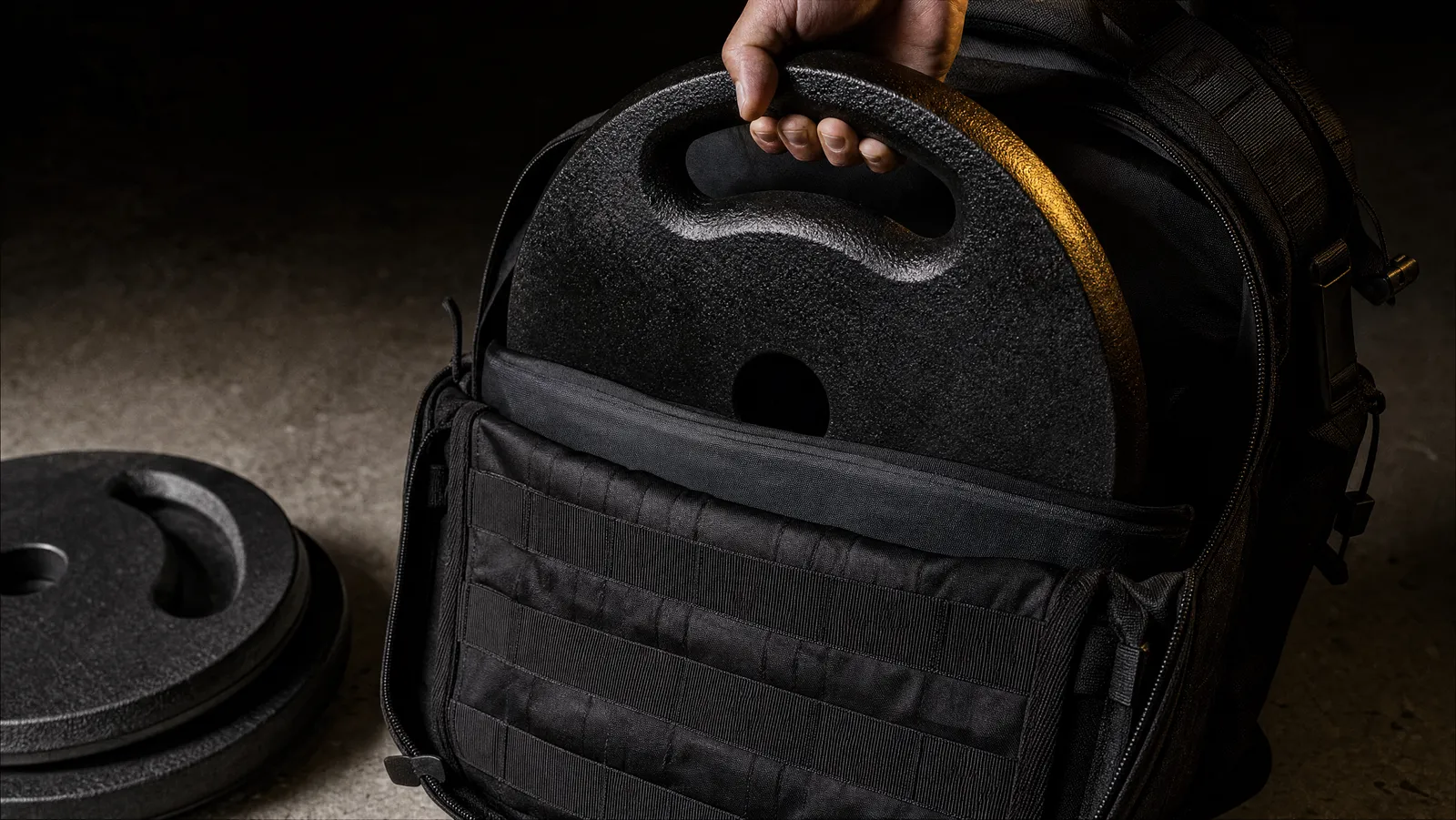
We cover fit and construction separately in our roundup of the best rucking backpacks for beginners. For what goes inside, plates designed for rucking sit flat and high; bricks wrapped in a towel do not, and books shift with every step. If you already own adjustable dumbbells or bumper plates, some will work, and the same logic behind our Hyrox home gym equipment picks applies here — the object has to sit still against your back.
There is also a real alternative worth weighing: a vest instead of a pack. That trade-off, rucking vs a weighted vest, deserves its own treatment and we will give it one.
Does a heavier ruck build more bone?
Worth a mention, because load-carrying and bone health have been linked hard in fitness media lately and the strongest recent trial is less flattering than the headlines.
In a 2025 randomised clinical trial published in JAMA Network Open, 150 older adults with obesity were randomised across a 12-month weight-loss programme, with 133 completing. One group wore a weighted vest daily, adjusted weekly to match the weight they had lost, up to 10 percent of baseline bodyweight. Total hip trabecular bone mineral density fell in every group, between 1.2 and 1.9 percent at 12 months, with no difference between the vest group and weight loss alone. The authors conclude that the vest "was not able to mitigate WL-associated bone loss at the hip in older adults living with obesity."
That is one trial, in one population, under weight loss. It does not say carrying load is pointless. It does say that choosing a heavier pack specifically to protect your hips is not a well-supported reason to add weight.
Signs the weight is wrong
Not medical advice, and not a diagnostic list — these are the practical signals we would act on:
- Your posture collapses forward in the last third of the walk and you cannot hold it back up.
- Numbness, tingling or pins and needles in your hands or forearms during or after a ruck.
- Hot spots or blisters appearing on routes you used to finish clean.
- Your pace at a given distance has dropped for two or three sessions running.
- You are dreading the session rather than the distance.
- Anything sharp, one-sided, or still there the next morning — that one is a stop-and-ask-someone signal, not a lighten-the-pack signal.
The fix for the first five is unglamorous: take five pounds out, walk the same route, put it back in a fortnight.
The honest answer
If you want one number: start at 10 pounds, or 5 percent of your bodyweight if that is lower, and give it three weeks before you touch it. The honest version is that the published beginner range runs 5 to 10 percent of bodyweight, the sensible working range for most people settles between 10 and 20 percent, and the most-cited safety ceiling in the load-carriage literature sits at 30 percent — a line most recreational ruckers have no reason to approach.
The number in your pack matters far less than the fact that you carried it three times this week and will carry it three times next week. Load is the easiest variable to change and the one that punishes impatience hardest. Everything else — time on feet, hills, pace, how well the pack fits — will improve your rucking more than another five pounds will.
For the setup, the technique and the rest of the on-ramp, our complete rucking guide is the place to start. Then pick your number off the table above, and pick the low one.
What to know before you buy
Field Notes
How much weight should a beginner ruck with?
Ten to twenty pounds is the most commonly published starting range. GORUCK's own beginner page says "when in doubt, start with 10-20 pounds." HyperWear's beginner chart is more conservative, putting new ruckers at 5 to 10 pounds, or about 5 to 10 percent of bodyweight. Ruck Authority splits the difference at 10 to 15 pounds for the first two weeks. In our view the low end is the better place to start, because the first month is about your feet, shoulders and posture rather than about load.
Is 30 pounds too heavy for rucking?
It depends almost entirely on what you weigh and how long you have been rucking. A 2020 review in the Journal of Orthopedics and Orthopedic Surgery relays the oft-cited safety guidance that load carriage "should remain at or below 30% of the bearer's body weight for the sake of safety." Thirty pounds is about 15 percent of bodyweight for a 200-pound adult and roughly 25 percent for a 120-pound adult. Same pack, very different demand — which is why absolute numbers travel badly between people.
Should ruck weight be a percentage of bodyweight?
Percentages scale better than fixed pounds, which is why most published charts use them. HyperWear's tiers run 5 percent for a conservative start, 10 percent for an active beginner, 15 percent for intermediate and 20 percent for advanced. GORUCK frames the upper limit the same way, advising you not to carry more than one third of your bodyweight. The percentage is a planning tool, not a target to chase — plenty of experienced ruckers stay near 15 percent indefinitely and get what they came for.
How often should you add weight to your ruck?
Slower than most people want to. GORUCK suggests working up "in increments of 5 pounds each week, or as you see fit." Ruck Authority states the constraint that matters more than the increment: "Add five lbs OR add one mile per week. Never both in the same week." HyperWear makes the same point as a rule, advising you to increase one component at a time by about 10 percent per week and to add load only once your current ruck feels controlled across multiple sessions.
Who put in the work
The Coach
Your Coach
Darlene Schmitt
I am a fitness instructor and promoter who truly enjoys helping others become the best they can be! My mission is to help people find the love of fitness and to help them develop a lifelong habit of exercise. I am a firm believer that fitness should be fun, and I make it my mission to ensure that my classes are always enjoyable. I am also a certified nutritionist and personal trainer, so I am able to offer my students comprehensive and well-rounded support.