Rucking for beginners: how to start walking with weight


Contains affiliate links. Our policy.
Ten to twenty pounds in a backpack, two or three walks a week, forty-five minutes at a pace where you can still hold a conversation. That is rucking for beginners in one line, and it is close to what GORUCK tells first-timers: start with 10 to 20 pounds, ruck once or twice a week if you are new to training, and never carry more than a third of your bodyweight.
The more useful answer is that the weight is the easy variable, and it is the only one most beginners think about. What decides how your first month goes is time under load and how fast you add to it. Almost everything that goes wrong in the first eight weeks is a ramp problem rather than a poundage problem.
This is the hub page for the whole topic. Below we cover the load, the pack, what the weight actually changes compared with a normal walk, the honest state of the research on benefits and injury, the calorie question, and an eight-week on-ramp you can start this weekend. Each section answers the question at a practical level and hands the deeper version off to a dedicated article. If you already train in a garage or a spare room, our guide to training at home covers the equipment side of the house; this one needs a backpack and a sidewalk. One caveat before any of it: if you are managing a health condition, are pregnant, or are returning from an injury, take the plan to a doctor or a qualified coach before you load a pack.
What rucking actually is
Rucking is walking with weight carried on your back. That is the whole definition. The word comes from military rucksack marching, which is also where the research comes from: the US Defense Department's Defense Centers for Public Health maintains an entire injury-prevention topic on foot marching and load carriage, because armies have been measuring what happens to loaded humans for a century.
That military lineage explains both the appeal and the limits of the evidence. The appeal is that rucking has essentially no skill barrier. There is no movement to learn, no class to book and no equipment beyond a bag with something heavy in it. The limit is that most of the good data was collected on young soldiers carrying 20 to 45 kilograms for hours, which is not what you are about to do on a Tuesday evening with 15 pounds and a 40-minute loop.
We flag that gap now because it recurs in every section below. When we cite load-carriage science, we are borrowing from a population carrying far more weight than you will. That is useful for understanding direction and mechanism. It is not useful for predicting your outcome, and any article that treats a soldier study as a promise about your knees or your waistline is overreaching.
The honest framing is that rucking is a low-skill, moderate-intensity aerobic activity with an added mechanical load, and it is exceptionally easy to keep doing. That last part is the case for it.
How much weight should you actually carry?
Start at 10 to 20 pounds. GORUCK's beginner guidance is unusually direct on this: "when in doubt, start with 10-20 pounds," with the ceiling set at no more than one third of your bodyweight. Writing for ACE in May 2023, Pete McCall relays a more conservative entry point from trainer Robert Linkul: 8 to 10 pounds for adults under 150 pounds, and up to 20 pounds for people who weigh more.
Those two sources bracket the sensible range. Here is how we would translate them, with the important column on the right:
| Your bodyweight | A first load we would use | The sourced ceiling | | --- | --- | --- | | Under 150 lb (68 kg) | 8-10 lb | One third of bodyweight | | 150-200 lb (68-91 kg) | 10-15 lb | One third of bodyweight | | Over 200 lb (91 kg) | 15-20 lb | One third of bodyweight |
The starting-load column is our editorial judgment built on the two sources above. The ceiling column is GORUCK's, and the word ceiling is doing real work there. One third of bodyweight is the maximum a well-conditioned rucker should approach, not a target for month one. For a 180-pound adult that is 60 pounds, which is nearly twice the 15 kg (33 lb) load at which knee joint forces have been measured to rise meaningfully in a lab.
Two practical notes. First, weigh what is actually in the bag. A "20-pound" pack with water, a jacket and a phone is not a 20-pound pack. Second, your first three sessions should feel underloaded. If you finish thinking you could have carried more, the ramp is working. That is the same patience we argue for in run training, where the build rate rather than the top-end effort is what decides whether the block survives. We go through the arithmetic properly, including plate sizing and how to weigh a loaded pack, in our dedicated piece on how much weight to ruck with.
Choosing your first rucksack
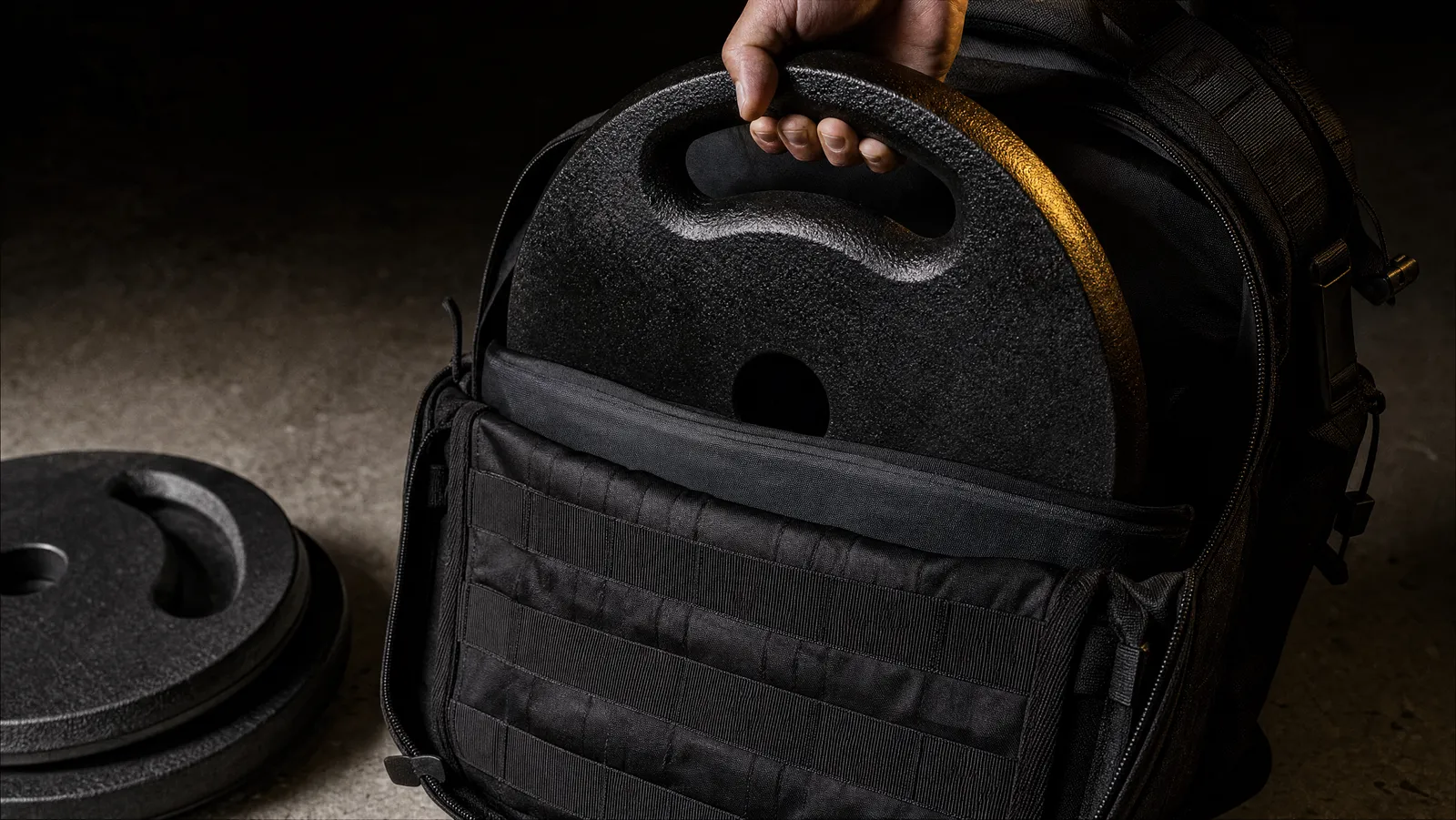
Almost any backpack works for the first month, and we would rather you started with the one in your closet than waited two weeks for a delivery. The bag becomes a real variable somewhere around the 20-pound mark, when three things start to matter: whether the load sits high against your upper back or sags toward your hips, whether the shoulder straps are wide enough to spread pressure, and whether the pack stays still when you walk.
Load position is the one that catches people out. A weight that slumps to the bottom of a loose daypack pulls you backward and forces a compensatory forward lean, which is exactly the posture that the Defense Centers for Public Health associates with the back complaints common to foot marching. Keeping the load high and snug against the spine is the single cheapest fix available to a beginner, and it costs nothing: fill the dead space under the weight with a rolled towel so the plate or dumbbell cannot travel.
For the first eight weeks, in our view the checklist is short:
- A weight that sits between your shoulder blades and does not shift when you jog three steps.
- Shoulder straps at least two inches wide, padded, with no exposed stitching where the strap meets the body.
- A sternum strap. It is the difference between straps that stay put and straps that slowly slide outward and numb your hands.
- Nothing hard pressing directly into your lower back.
Skip the hip belt debate for now. Hip belts transfer load off the shoulders, which is excellent for hiking 25 pounds for six hours and largely irrelevant for 15 pounds for 45 minutes. When you are ready to buy something purpose-built, our roundup of the best rucking backpacks for beginners compares the options that actually hold plates securely. If you already own a plate carrier or adjustable dumbbells from a home setup, our home gym equipment guide covers what doubles as ruck weight and what does not.
Rucking vs walking: what the load changes
The load roughly doubles the metabolic cost and it adds a mechanical stress that walking does not have. Those are two different changes, and conflating them is why people either under-rate rucking or over-rate it.
On the metabolic side, ACE cites Compendium of Physical Activities values of 7.0 METs for backpacking and 7.3 METs for climbing hills with a 10 to 20 pound load. The Compendium puts an ordinary moderate walk (2.8 to 3.4 mph, level, firm surface) at 3.8 METs, so the loaded figures are roughly double. A loaded walk sits in the same energy-cost neighbourhood as a slow jog, at a fraction of the impact. That is the entire commercial pitch for rucking, and it is basically fair.
On the mechanical side, the load is not free. In a 2018 study in PLOS ONE, Lenton and colleagues reported that carrying 15 kg and 30 kg produced 10.1 percent and 19.9 percent increases in peak medial knee joint contact force compared with unloaded walking. A 2023 paper in the Journal of Applied Biomechanics by Jones, Willson, DeVita and Wedge found the same direction using relative loads: across 24 healthy young adults walking with no load, 15 percent and 30 percent of added bodyweight, total, medial and lateral tibiofemoral first-peak contact forces and impulses all rose significantly as load rose.
Read together, those two findings say something simple and useful. The extra work you feel is real, and so is the extra joint loading, and both scale with the weight rather than with how hard the session felt. That is why we treat rucking as a training stimulus with a dose, not as a walk with a bag on.
The practical consequence for a beginner is that rucking substitutes well for easy aerobic work and badly for a rest day. If you are also running, count your rucks in your weekly load rather than adding them on top of it, a point we make at more length in our run training guide. We break down the full comparison, including step rate, pace and heart-rate differences, in our piece on rucking compared to plain walking.
Rucksack or weighted vest?
The difference is where the load sits, and everything else follows from it. A rucksack carries the weight behind your centre of mass, so your torso leans forward to counterbalance it. A vest wraps the load around your trunk, closer to your centre of mass, so the counterbalancing lean is smaller.
We should be plain about the evidence here: we did not find a good head-to-head trial comparing rucksacks and weighted vests for injury or fitness outcomes in recreational ruckers. Everything in the table below is our editorial judgment, built from the load-position mechanics above and from what beginners tell us breaks first.
| | Rucksack | Weighted vest | | --- | --- | --- | | Where the load sits | Behind you, high on the back | Wrapped around the trunk | | What tends to complain first | Shoulders, trapezius, low back | Ribs, breathing at higher intensity | | Scaling past 30 lb | Straightforward | Gets bulky and hot | | Doubles as | Carrying gear, water, a jacket | Bodyweight work, hill repeats, intervals | | Getting it on and off mid-session | Easy | Fiddly | | Our default for a first eight weeks | Yes | Only if straps are intolerable |
Our default recommendation is the pack, for two unglamorous reasons. You can take a pack off at a bus stop, and you can carry water in it. Neither is a physiological argument, and we are not going to dress them up as one.
The case for a vest is stronger than it looks, though, and it is not only about comfort. It matters most if you plan to mix loaded walking with anything more dynamic than walking, because a vest stays put. Our full treatment of rucking vs a weighted vest gets into the intensity and fit trade-offs in detail.
What rucking does to your body
The defensible claims are aerobic and muscular. ACE describes rucking as combining "low- to moderate-intensity cardiorespiratory activity from walking along with muscular strength training," with the potential to improve aerobic capacity and increase strength in the lower-body and core muscles. That is a modest, mechanistically sensible claim from a certifying body, and it is roughly where we would leave it.
The claim that has driven this topic's popularity is bone density, and here the evidence is weaker than the internet suggests. The best-controlled trial we found is not encouraging. In JAMA Network Open in June 2025, Beavers and colleagues reported the INVEST in Bone Health trial: 150 older adults with obesity, mean age 66.4 years, randomised for 12 months to weight loss alone, weight loss plus daily weighted vest use, or weight loss plus resistance training. Vest wearers averaged 7.1 hours a day. Total hip trabecular volumetric bone mineral density fell between 1.2 and 1.9 percent in every group, with no difference between the vest group and weight loss alone.
Two qualifications, both important. That trial tested all-day passive vest wear during intentional weight loss, which is not rucking. And a null result in one population does not settle a question. But it is the strongest randomised evidence in the vicinity of the bone-density claim, it ran for a full year, and it did not find the effect that is currently being sold. We would ruck for aerobic fitness and for the simple fact that you will keep doing it, and we would treat bone claims as unproven for now.
There is a third benefit nobody studies and everybody reports: adherence. A 45-minute ruck is a walk you were partly going to take anyway. In our experience that is why it survives busy weeks when structured sessions do not, and consistency is the variable that beats every programming argument. It is the same case we make for training at home: the session you actually complete outperforms the better one you keep rescheduling. We go through the research on the benefits of rucking, including what is claimed versus what is measured, in a separate article.
Is it safe for your knees and back?
For most healthy adults starting at a modest load, nothing we found in the research argues against it, and the ramp is the thing that actually matters. But the injury literature deserves respect rather than reassurance, and none of what follows is medical advice.
The Defense Centers for Public Health identifies the lower extremities and the back as the body regions most frequently affected by foot marching and load carriage, with injuries running from blisters through strains, sprains and stress fractures to nerve compression. Those are the complaints of people carrying heavy loads for long distances repeatedly. Blisters and shoulder-strap nerve irritation are the two that show up at beginner loads.
The joint-loading numbers from the previous section apply here too. Lenton and colleagues concluded in PLOS ONE that soldiers carrying loads over 15 kg for prolonged periods could be at greater risk of knee musculoskeletal injury than those with less exposure. Fifteen kilograms is 33 pounds. That is well above a sensible beginner load and well below the one-third-of-bodyweight ceiling, which is a useful thing to know before you chase the ceiling.
Everything from here is our editorial position, because no study we found tested a beginner protocol. The rules we would follow:
- Change one variable per week. Distance or weight, never both.
- Treat hot spots on the feet as a stop signal, not a toughness test. Blisters end more beginner ruck streaks than joints do.
- If your hands go numb or tingle, the straps are too narrow or too tight. Loosen, widen, or shorten the session.
- Low-back soreness that persists into the next day means the load is sitting too low in the pack or is simply too heavy.
- Build the walking habit before you build the load. Three unloaded 45-minute walks a week is a legitimate week zero, and it plays the same role as the base phase in our beginner training plan.
And the caveat that matters most: if you have existing knee, hip or back problems, are pregnant, or are coming back from an injury, this is a conversation to have with a doctor or a qualified coach before you add weight, not after something hurts. We are not going to give you a rehab protocol here. Our deeper look at whether rucking is bad for your knees and back walks through what the load-carriage literature does and does not support.
The calorie math
Use ACE's worked example as your anchor: a 165-pound person rucking for 45 minutes with a 20-pound load burns roughly 9.6 calories per minute, or about 432 calories. That is a defensible number from a named source with its assumptions stated, which is more than most rucking calculators offer.
Many of those calculators are built on the Pandolf equation, developed at the US Army Research Institute of Environmental Medicine and published in 1977, which predicts the metabolic cost of loaded walking from bodyweight, load, speed, grade and a terrain factor. It is a genuinely good piece of applied physiology and it is also nearly fifty years old. In a 2017 paper in the Journal of Science and Medicine in Sport, Drain and colleagues found the equation systematically under-predicted metabolic rate across ten speed-load combinations, with prediction error ranging from 12 to 33 percent, and the smallest errors (12 to 17 percent) at moderate walking speeds of 4.5 to 5.5 km per hour.
Note the direction of that error. The equation under-predicted, meaning real energy cost was higher than the model said, at least in that contemporary military load-carriage setting. So the honest read is not that rucking calculators inflate the number. It is that they carry an error band of tens of percent in either direction once you leave moderate walking speeds.
What we would do with that: use a calculator to compare sessions against each other, not to reconcile against food. A 5-mile ruck with 20 pounds is meaningfully harder than a 3-mile ruck with 20 pounds, and the calculator will tell you that correctly. Whether it was 400 or 550 calories is a question no wearable or equation can currently answer to the precision people want. The same caution applies to the pace-based estimates we discuss in our run training guide. Our full breakdown of how many calories rucking burns compares the common calculators and shows where they diverge.
If a vest suits you better
Some people simply cannot get on with shoulder straps, and forcing it is how a promising habit dies in week three. A vest is a reasonable primary choice rather than a consolation prize if any of the following is true.
You have a shoulder or neck issue that makes strap pressure unpleasant. You want the load to stay locked down while you do more than walk, such as hill repeats, step-ups or bodyweight circuits mid-route. You want to wear the load for long stretches at low intensity, which the INVEST trial at least established is tolerable: participants averaged 7.1 hours a day of vest wear across 12 months, which is a real-world adherence signal even though the trial's bone findings were null.
The trade-offs, in our experience, are heat and breathing. A vest is warmer than a pack in summer, and a heavy vest that rides high can make deep breathing feel restricted once your effort climbs. Fit fixes most of this. Loads that sit lower on the trunk and are cinched properly at the sides behave much better than a loose vest slapping with each step.
One practical note for people who already own equipment: a plate carrier is not automatically a training vest. Carrier plates are often heavier than you want for a first eight weeks, and the fit is designed for protection rather than for two hours of walking. Our home gym equipment guide covers what crosses over. When you are ready to choose, our roundup of the best weighted vests for rucking sets out the fit and load-increment differences that actually matter.
Your first eight weeks
Here is an eight-week on-ramp. It is built on two published constraints from GORUCK's workout plans, which cap progression at five extra pounds per week and 10 percent more distance than the previous week, and on GORUCK's frequency guidance of 1 to 2 rucks per week for people new to training and 3 to 4 for people already training. The arrangement of those constraints into weeks is our editorial judgment, not a published protocol.
| Week | Rucks | Distance each | Load | What you are training | | --- | --- | --- | --- | --- | | 1-2 | 2 | 1.5-2 miles | Starting load | Tolerance. Shoulders and feet, not fitness | | 3-4 | 2-3 | 2-2.5 miles | Same | Frequency and the habit | | 5-6 | 3 | 2.5-3 miles | Plus 5 lb | The first real load increase | | 7-8 | 3 | 3-4 miles, one longer | Same | Time under load |
Pace matters less than people expect early on. GORUCK suggests aiming for 17 to 20 minutes per mile when starting out, with the Army minimum standard of 15 minutes per mile as a longer-term goal. Week one should be conversational throughout. If you cannot speak in full sentences, you are either too heavy or too fast, and it is usually too heavy.
Three rules we would hold to across all eight weeks:
- Never add weight and distance in the same week. This is the single most common way a beginner ruck block ends early.
- Repeat a week rather than skip forward. If week 5 felt rough, do week 5 again. Nothing is lost.
- Protect one longer session. By week 7, one ruck should be noticeably longer than the others. Time under load is the adaptation you are actually chasing.
Eight weeks is enough to establish the habit and to know whether you like it. It is not enough to transform anything, and we would be lying if we implied otherwise. For a sense of how longer training blocks are structured and why twelve weeks keeps recurring in published programmes, our piece on how long training blocks actually take is a useful companion, and our beginner training plan shows what a phased build looks like written out. The week-by-week version of this, with every session and the deload logic spelled out, is what we set out in a beginner rucking training plan.
Mistakes we see in the first month
None of these are sourced. They are the patterns we see most often from readers who write to us after a rough start.
Starting at the ceiling. Someone reads "one third of bodyweight," calculates 55 pounds and starts there. That is a maximum for trained ruckers, and it sits well above the 15 kg exposure level flagged in the knee-loading literature.
Buying before walking. A 200-dollar pack does not make week one easier. A closet backpack with a towel-wrapped dumbbell tells you within three sessions whether you will keep doing this.
Treating it as extra. Rucking is training. If you added three rucks on top of an existing running or gym week without removing anything, you added training load, and something will eventually object.
Ignoring the feet. Foot blisters are among the most commonly reported load-carriage complaints in the military literature and they are largely preventable with fitted shoes, proper socks and stopping at the hot-spot stage.
Going too fast, too early. Speed multiplies the metabolic cost of a load rather than adding to it. Slow down and add minutes instead; our notes on training at home make the same argument about intensity creep in a different context.
Where to start this week
Put 10 to 15 pounds in a backpack you already own, wrap it in a towel so it sits high and cannot move, and walk for 40 minutes at a pace where you could hold a conversation. Do that twice this week and once more next week. That is the entire entry requirement, and it is deliberately unimpressive.
The interesting part of rucking is not any single session. It is that in eight weeks you will be carrying a load you would have refused today, and that the habit will have cost you almost nothing in willpower. The load is the least important decision you will make. The ramp is the whole game.
Start light enough that your first ruck feels slightly pointless. That is the correct feeling.
Explore the full series
- How much weight should you ruck with? — What the research and the coaching guidance actually say about your starting load.
- Best rucking backpacks for beginners — Why a beginner does not need a purpose-built ruck, and the packs and plates we would buy instead.
What to know before you buy
Field Notes
How much weight should a beginner ruck with?
Ten to twenty pounds is the published starting range. GORUCK tells new ruckers to "start with 10-20 pounds" and adds a ceiling: "a good rule of thumb is to not carry more than one third of your bodyweight." Writing for ACE in May 2023, Pete McCall reports a more conservative entry point from trainer Robert Linkul, who suggests 8 to 10 pounds for adults under 150 pounds and up to 20 pounds for heavier individuals. Both agree the first load should feel almost too easy.
How many calories does rucking burn?
More than walking, less than most calculators promise. ACE puts loaded walking at 7.0 to 7.3 METs, citing the Compendium of Physical Activities, and works a specific example: a 165-pound person rucking for 45 minutes with a 20-pound load burns roughly 9.6 calories per minute, or about 432 calories. Many online rucking calculators are built on the Pandolf equation, published in 1977 by the US Army Research Institute of Environmental Medicine, so treat their outputs as estimates rather than measurements.
Is rucking bad for your knees?
Load raises knee joint forces in a measurable, dose-dependent way. In a 2018 PLOS ONE study, Lenton and colleagues found that carrying 15 kg and 30 kg produced 10.1 percent and 19.9 percent increases in peak medial knee joint contact force compared with walking unloaded, and concluded that soldiers carrying loads over 15 kg for prolonged periods could be at greater risk of knee injury. That is an argument for modest loads and slow progression, not for avoiding rucking.
How often should you ruck as a beginner?
One or two sessions a week to start. GORUCK advises 1 to 2 rucks per week for people new to working out and 3 to 4 for those already training, at a pace of 17 to 20 minutes per mile, with the Army minimum standard of 15 minutes per mile as a longer-term goal. Its published workout plans cap progression at five extra pounds per week and 10 percent more distance than the previous week. Adding both at once is the common beginner mistake.
Who put in the work
The Coach
Your Coach
Darlene Schmitt
I am a fitness instructor and promoter who truly enjoys helping others become the best they can be! My mission is to help people find the love of fitness and to help them develop a lifelong habit of exercise. I am a firm believer that fitness should be fun, and I make it my mission to ensure that my classes are always enjoyable. I am also a certified nutritionist and personal trainer, so I am able to offer my students comprehensive and well-rounded support.