Best adjustable kettlebells: one handle, many weights

Contains affiliate links. Our policy.
The best adjustable kettlebell is a good buy if your list is swings, squats, rows and carries, and a bad buy if it runs on to cleans, presses, snatches and get-ups. One handle replacing four or five bells solves a real money and floor-space problem. What you trade is shape, and shape is what decides whether a bell can sit on the back of your forearm. We earn a commission on purchases made through links on this page, at no cost to you.
An adjustable kettlebell solves an arithmetic problem and introduces a mechanical one, and which side wins depends entirely on which lifts you intend to do.
Two disclosures. We have not tested, lifted, measured or owned any of these, so every spec below is the maker's or a named reviewer's, attributed either way. And we quote no star ratings or review counts, because our product data source returns no rating values. If kettlebells are not yet a settled direction, our beginner kettlebell guide is a better place to start than any buying page.
Who an adjustable kettlebell is actually for
The case for one is arithmetic, and it is strongest for the lifter who has outgrown a single bell but cannot justify four.
Fixed bells step coarsely. The 2019 scoping review by Meigh and colleagues in BMC Sports Science, Medicine and Rehabilitation records that sport kettlebells are "most commonly available from 8 kg to 32 kg in 2-4 kg increments", with the wider market running "from 2 kg to 92 kg". A 4 kg step off a 16 kg (35 lb) bell is a 25 percent jump in load.
Set that against the progression rule. The ACSM position stand Progression Models in Resistance Training for Healthy Adults recommends "that 2-10% increase in load be applied when the individual can perform the current workload for one to two repetitions over the desired number". Twenty-five percent is two and a half times the top of that band.
That mismatch is why one bell stops working in a predictable order rather than all at once. As we argue in is one kettlebell enough, the press stalls first and the squat gets too easy long before it, because no single load is both a hard press and a hard squat. An adjustable bell answers that specific problem: one purchase that is 12 lb for a press and 35 lb for a swing.
The replacement ratios are the selling point, and they are the makers' claims rather than ours: Bowflex says the SelectTech 840 replaces up to six kettlebells, REP says five settings replace five bells, and Titan lists 12 kg to 32 kg from one shell.
Who it is not for: anyone whose list leads with the snatch or the get-up, and anyone who has not yet picked a first weight at all. If that is you, what size kettlebell to start with is the earlier decision.
Where adjustable bells fall down: the handle and the wrist
First the honest disclaimer. We have found no peer-reviewed research comparing adjustable and fixed kettlebell mechanics, so this section is reasoning about geometry and published case material, not a finding from a trial.
Start with what a fixed bell is. Meigh and colleagues describe traditional bells as "typically made from cast iron, with dimensions increasing with weight", against competition bells of "standardised dimensions made of steel". Either way it is a continuous ball under a handle. An adjustable bell is a shell around plates, or a handle carrying plates. That changes three things.
Shape, meaning where the bell lands on you. For a swing almost none of this matters: the bell hangs below your hands and never touches your arm. For the clean, the press, the snatch and the get-up it matters a great deal, because the bell rests on the back of the forearm, where a square edge, a protruding pin or a wider body lands differently from a cast ball.
That is not a hypothetical wrist. A 2013 case report by Karthik and colleagues in BMC Sports Science, Medicine and Rehabilitation describes a 39-year-old man with three months of radial-sided wrist pain, attributed to the handle striking his wrist because he tended to hold it off-centre; ultrasound showed a split extensor pollicis brevis tendon. The authors write that such injuries happen "due to direct impact over the wrist or due to off-center handling", note that they are especially common in beginners, and conclude that users should be taught about off-centre handle holding. One patient is a mechanism, not a rate — but it is the mechanism an unfamiliar bell shape makes more likely.
Centre of mass, which moves as you load it. Dicus and colleagues in the International Journal of Exercise Science put the fixed case precisely: in an overhead press "the center of mass of a dumbbell is in line with the glenohumeral joint", while "the center of mass of the kettlebell is posterior to the glenohumeral joint", and they expect that "Posterior displacement of the kettlebell center of mass may result in less stability during the pressing motion". Our reasoning rather than their finding: on a plate-loaded handle you move that centre of mass every time you change the weight, so the bell you learned the hinge with is not the bell you press at the top setting.
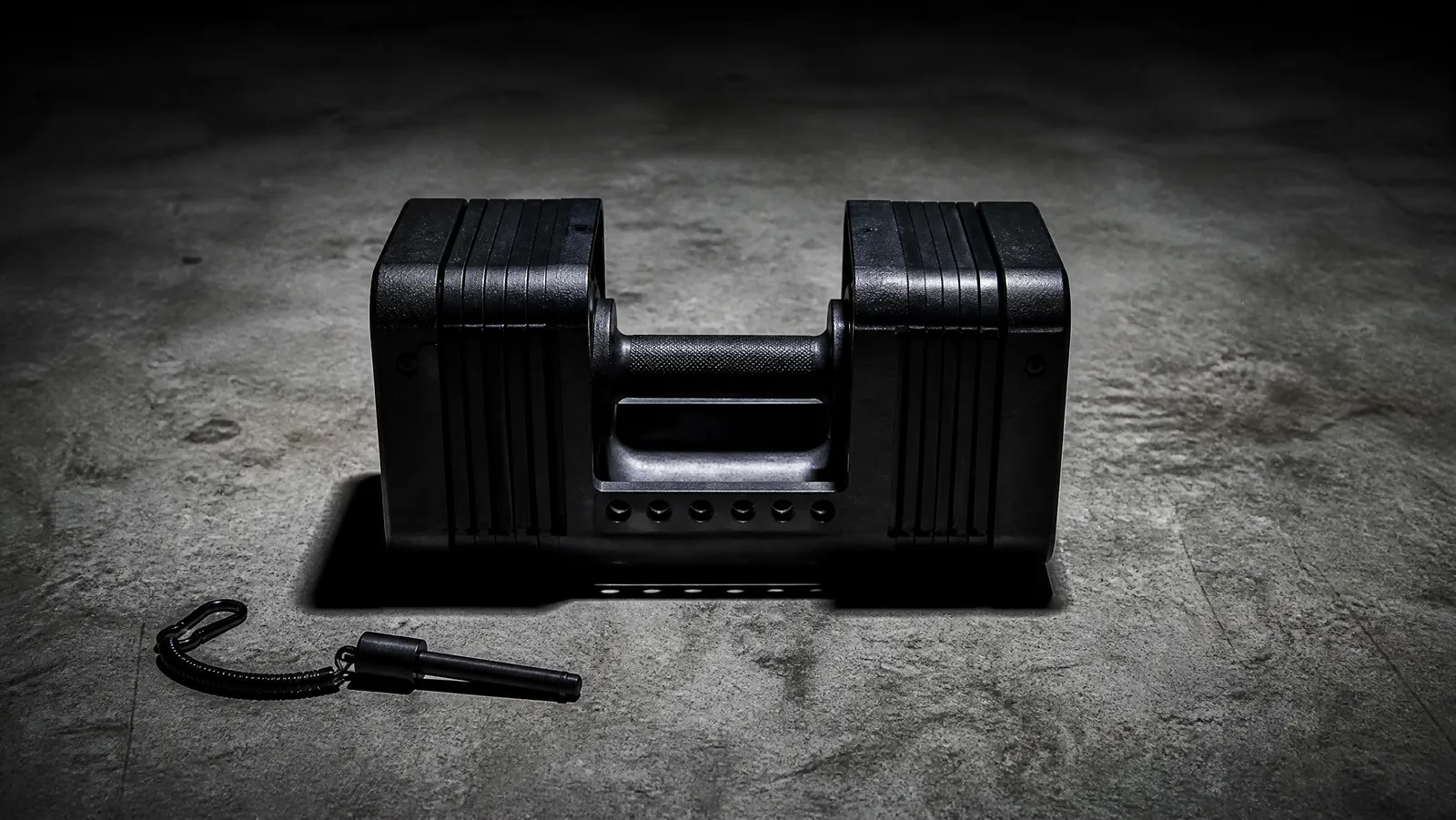
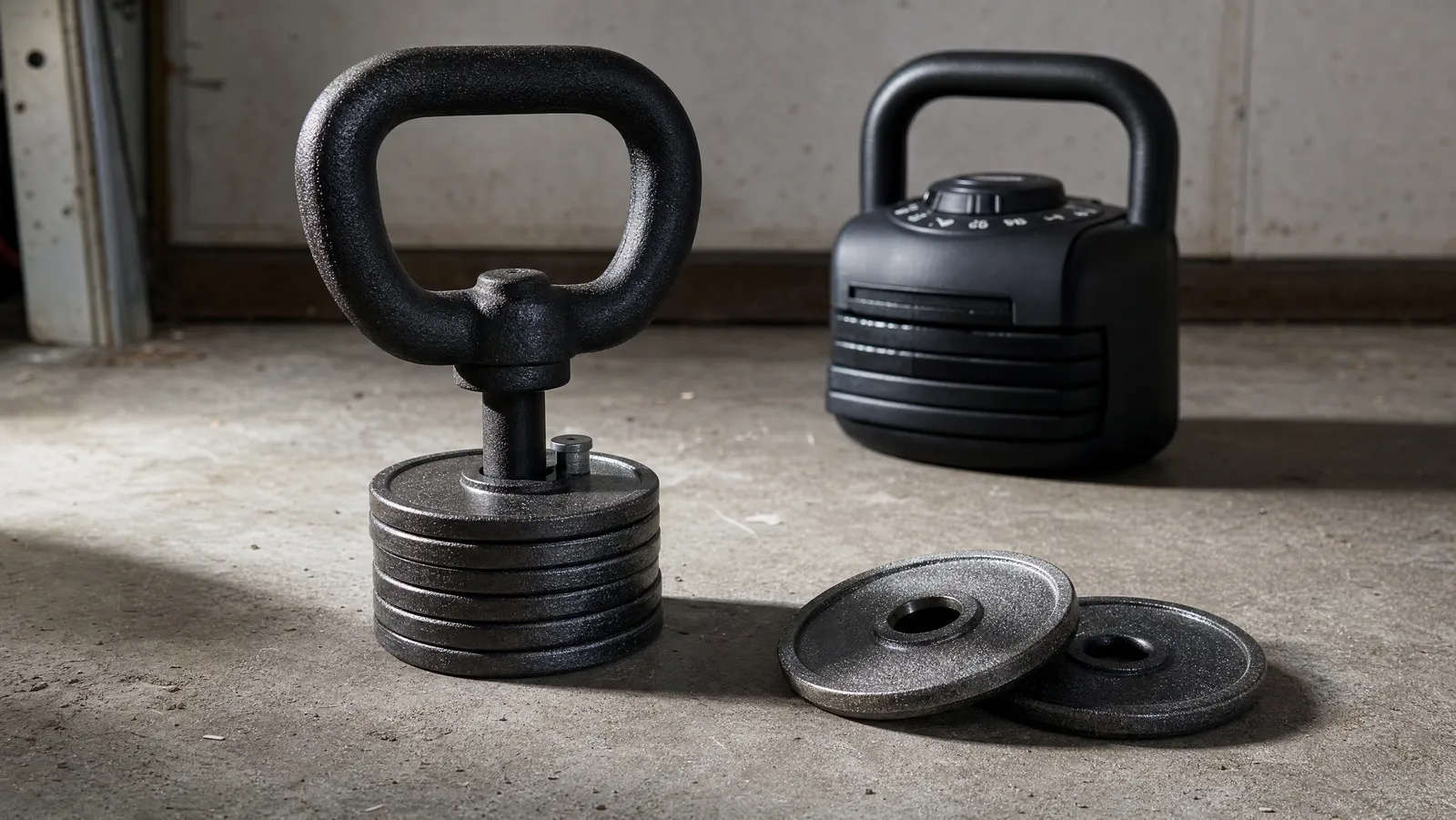
Something has to hold the plates in. Each maker documents a different answer. Bowflex uses a dial. REP uses push-and-twist selection with internal nylon thermoplastic retainers, each plate on its own fasteners. Titan uses a screw you remove with the included hex key and wrench. Apex uses a centre locking pin. EAST MOUNT describes an internal locking system. Kettle Gryp is a hinged handle with a latching closure. We have not stress-tested any of them. What we will say plainly is that on a bell you intend to accelerate overhead and then catch, that mechanism is a point of failure a solid casting does not have. Check it before every session, and get coaching before you put any bell over your head.
Third-party testers see the same split. Garage Gym Reviews found the SelectTech 840 shell "is comfortable in the front rack position during presses" and still listed it as "Not ideal for overhead or comp-style lifts", putting its handle at 28 mm against about 35 mm on standard bells.
Adjustment speed decides whether you use the feature at all. A dial is seconds. Garage Gym Reviews rated both the Bowflex and the REP five out of five for adjustment speed, while saying Titan's bell is not the fastest to change and listing "Requires an Allen key to adjust the weights" as a con. A bell that needs two tools is one you set for a training block, not one you change between sets.
The six we would consider
Ranked for a general home-gym buyer. Every pick carries a named limitation, because every one of them has a real one.
BowFlex SelectTech 840: our pick, if the list is swings, squats and rows
Who it is for: the reader who wants one object, changed in seconds, whose heaviest ambition is a 40 lb swing.
The BowFlex SelectTech 840 is $149 as of October 2026. Bowflex says a turn of the dial moves it from 8 to 40 lb, replacing up to six kettlebells at 8, 12, 20, 25, 35 and 40 lb, lists the range as 3.5-18 kg, and markets it for swings, rows, squats and twists.
The honest limitation: two of them. The top end is 40 lb, a working swing weight rather than a heavy one, where Titan's bell reaches 71 lb. And the shape is a compromise that Garage Gym Reviews summarises as "Bulky at lighter weights". At $149 for 40 lb of top-end load that is about $3.73 per pound.
Apex 20 lb kettlebell handle: the plate-loaded budget pick, with a hard condition
Who it is for: people who already own standard 1-inch weight plates.
The Apex 20 lb kettlebell handle set is $47.99 as of October 2026, against a $59.99 list price. Apex lists a 15 lb cast iron handle, a 5 lb base, four removable spacer disks and a centre locking pin for a 20 lb starting weight, in cast iron with a powder-coated finish and a wide classic handle for one or both hands. Swap the spacers for standard 2.5, 5 or 10 lb plates and it loads to 50 lb.
Read the constraint before anything else. It takes standard 1-inch plates only, not 2-inch Olympic plates. Those are different systems: Wikipedia's summary of weight plate standards puts the standard bore at about 25 mm against the 50 mm sleeves an Olympic plate is made for. If your plates came with an Olympic bar they do not fit, and we would not trust an adapter on something you swing.
The honest limitation: plates are sold separately, so $47.99 is not the price of a 50 lb bell. The loaded stack also shifts the balance as you add weight, and in our reading a centre pin is the most exposed retention mechanism on this page.
REP Fitness 16 kg adjustable: the one that still feels like a kettlebell
Who it is for: someone who wants to change weight mid-session without thinking about it.
The REP Fitness adjustable kettlebell is $149.99 as of October 2026, a 16 kg (35 lb) bell with five weight settings selected by pushing down and twisting. REP claims it adjusts more quickly than any other on the market, which is their claim rather than a measurement we can verify, though Garage Gym Reviews rated it five out of five for adjustment speed and wrote that "If you closed your eyes, you wouldn't know it was adjustable". REP describes the matte powdercoat as less slippery than glossy competitors, and internal nylon thermoplastic retainers with each plate on its own fasteners.
The honest limitation: price per pound. At $149.99 for a 35 lb top setting that is about $4.25 per pound, the dearest load here, and it buys less range than Titan's bell at $50 more. Garage Gym Reviews flags the weak point too: "the plastic gearing in the adjustment mechanism may wear down over time".
Titan Fitness 12-32 kg: the only one that reaches a heavy swing
Who it is for: a lifter who already swings 16 kg and wants somewhere to go.
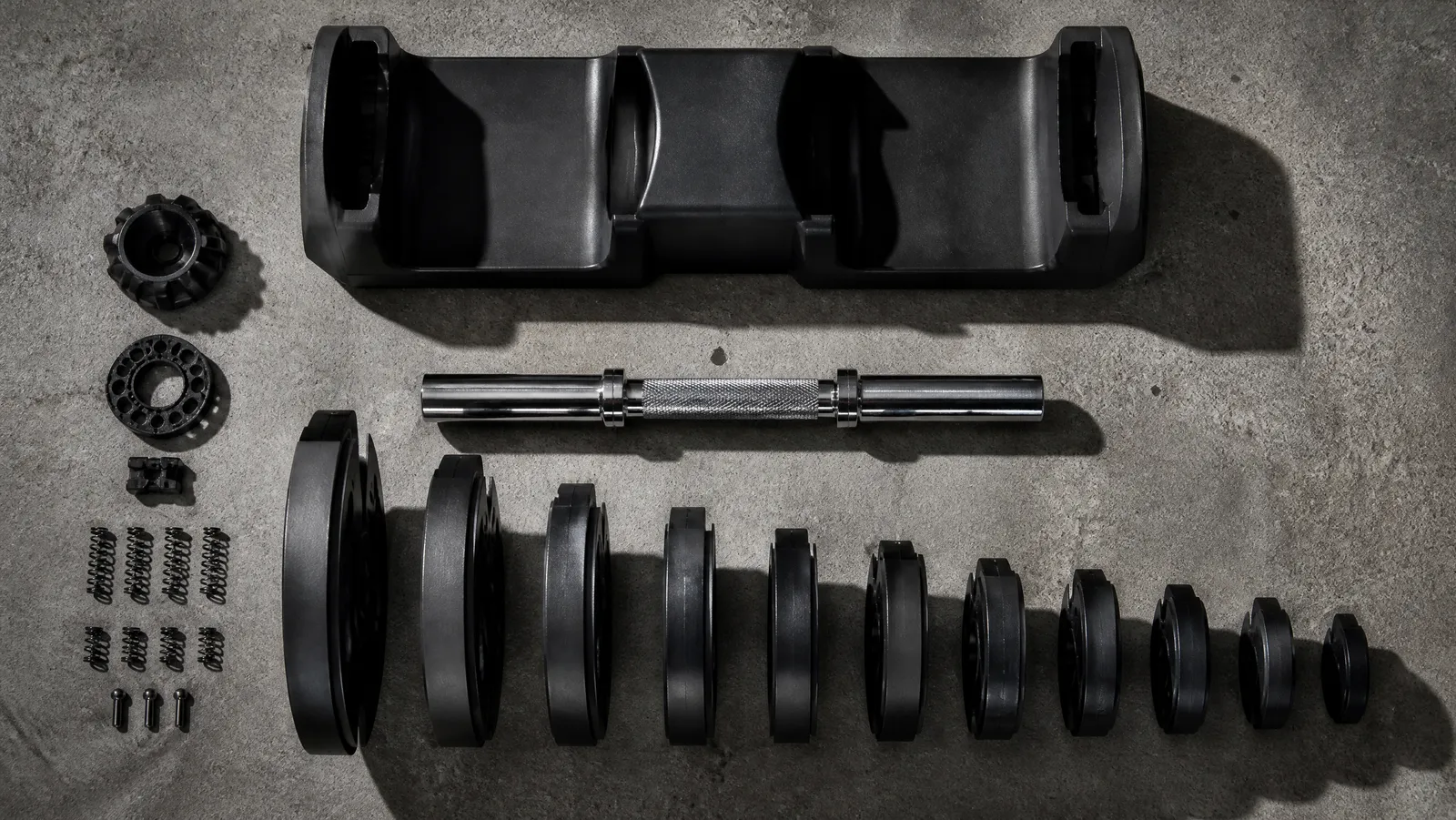
The Titan Fitness adjustable kettlebell is $199.99 as of October 2026. Titan lists a 12 kg shell plus six cast iron plates of 2, 2, 3, 3, 4 and 6 kg, setting from 12 kg (26 lb) to 32 kg (71 lb) and almost every weight in between, with an ergonomic non-slip handle and a flat base for pushups, dips and planks. Garage Gym Reviews credits it with "Consistent feel at all weights" and "Even balance for snatches and cleans", which is the property most adjustable designs give up.
The honest limitation: you change it by loosening and removing a screw with a hex key and a wrench, which is minutes rather than seconds, so this is a bell you set for a block of training. The same reviewers list "Powder coat showing premature corrosion" and "Not ideal for total beginners" among its cons. It is the dearest pick here, though $2.84 per pound at the top setting is better arithmetic than either of the quick-adjusting bells above.
EAST MOUNT 15 lb 3-in-1: the deliberately light start
Who it is for: a deconditioned or returning start, or a pressing and get-up bell alongside something heavier.
The EAST MOUNT 15 lb adjustable set is $38.79 as of October 2026, against a $40.84 list price, with three settings — 5, 9 and 15 lb — changed through an internal locking system on a wider triangle-shaped handle. EAST MOUNT says the structure keeps load away from the wrist during overhead presses and snatches, which is the right thing to design for and a claim we cannot test.
The honest limitation: the ceiling. Fifteen pounds is a warm-up swing weight for most adults, so this is a second bell rather than a first one. EAST MOUNT also claims most adjustable kettlebells stop at 12 lb; the other five picks on this page all handle 35 lb or more, so read that one as marketing.
Kettle Gryp: not a kettlebell, and the cheapest fix if you own dumbbells
Who it is for: someone with a dumbbell rack and no intention of buying iron.
The Kettle Gryp is $36.65 as of October 2026 and adds no load of its own. It is a hinged handle with a latching closure that clamps around a dumbbell you already own, made from impact-resistant ABS plastic, urethane foam and stainless steel, made in USA, weighing under a pound. The fit rules decide whether it works for you: a 55 lb maximum dumbbell, a 1.5 inch maximum handle diameter, a 4.5 inch minimum handle length, and no fit on most vinyl or neoprene handles.
The honest limitation: it is a grip, not a bell, and the shape shows. Garage Gym Reviews found swings and goblet squats mostly fine but described rotational work as "very awkward when I tried to do movements involving rotation of the kettlebell, like a kettlebell snatch or clean", noticed handle flex above the recommended weight, and reported that the plastic handle "ended up feeling slick compared to traditional kettlebells".
Adjustable vs fixed: the actual cost comparison
An adjustable bell wins against powder-coated iron and loses against cheap vinyl, and that is most of the adjustable kettlebell vs fixed argument.
Our own best kettlebells for beginners roundup priced a Titan 16 kg (35 lb) cast iron bell at $74.99 in October 2026, about $2.14 per pound, and a CAP 15 lb vinyl-coated bell at $18.39, about $1.23 per pound. Treat both as snapshots; kettlebell prices move.
Now the arithmetic. The Bowflex covers 8 to 40 lb for $149 as of October 2026. Nobody buys every rung of a ladder, but three bells roughly spanning that range — say 12, 25 and 40 lb, 77 lb of iron — would run about $165 at $2.14 per pound and about $95 at $1.23. So against the construction we actually prefer, the dialled bell is modestly cheaper and occupies one footprint instead of three. Against the cheapest honest vinyl, it costs roughly 55 percent more.
The Apex is the other shape of the same problem. At $47.99 as of October 2026 it is the cheapest route to 50 lb here, but only if the plates are already in your garage. Buy the plates too and it stops being the budget option at all.
Floor space is the tiebreaker the spreadsheet misses. A six-bell ladder is a row along a wall; a dialled bell is one object. In a bedroom corner, price per pound is not the deciding number.
Are adjustable kettlebells worth it?
Split the question by what you intend to lift, because the answer flips.
If your training is swings, goblet squats, rows, carries and floor work: yes, comfortably. None of those lifts rest the bell on your forearm, so the mechanical objection mostly evaporates, and you get load steps no fixed ladder can match.
If your training is the full hardstyle list, clean and press and snatch and get-up: no, or not as your only bell. Buy two fixed bells instead. Shape does real work in those lifts, and the case material above is a reminder that a handle landing off-centre on a wrist has put at least one lifter in a clinic. If you want one adjustable and one fixed, the fixed one should be the one you press.
If you are not sure you will still be training in March: no. Spend less. A 15 lb bell tells you more about your own behaviour than a $149 purchase does. And if adjustability is the appeal but the lifts are overhead, Titan's design is the compromise worth considering, for the even balance its reviewers credit it with, at the cost of a hex key.
What we would actually buy
The Bowflex at $149 as of October 2026 if the list is swings, squats and rows. Two fixed bells if the list is longer than that. The Apex at $47.99 if there are already 1-inch plates on a shelf.
What none of these fixes is the thing that actually limits a home kettlebell programme, and it is not the increments. A bell with six settings you use badly is worse than one bell you use well, and no mechanism inside a shell will out-perform a competent hip hinge. Check the retention mechanism before each session, keep the overhead lifts under a coach's eye while you learn them, and start with kettlebell training for beginners.
Gear we'd put on our own floor
The Picks

The one to buy if swings, squats and rows are the whole list
Bowflex says a turn of the dial moves this from 8 to 40 lb, replacing up to six kettlebells at 8, 12, 20, 25, 35 and 40 lb, and lists the range as 3.
Price as of
Bowflex says a turn of the dial moves this from 8 to 40 lb, replacing up to six kettlebells at 8, 12, 20, 25, 35 and 40 lb, and lists the range as 3.5-18 kg. It is a single space-saving unit marketed for swings, rows, squats and twists, with a two-month JRNY All-Access membership trial included. At $149 as of October 2026 that is about $3.73 per pound of top-end load. The limitation is the top end itself: 40 lb is a working swing weight rather than a heavy one, and Garage Gym Reviews lists the bell as not ideal for overhead or comp-style lifts.

One handle instead of a shelf, if you already own 1-inch plates
Apex lists a 20 lb system: a 15 lb cast iron handle, a 5 lb base, four removable spacer disks and a centre locking pin, in cast iron with a powder-coated finish and a wide classic handle for one or both hands.
Price as of
Apex lists a 20 lb system: a 15 lb cast iron handle, a 5 lb base, four removable spacer disks and a centre locking pin, in cast iron with a powder-coated finish and a wide classic handle for one or both hands. Swap the spacers for standard 2.5, 5 or 10 lb plates and it loads to 50 lb. Read the constraint first, because it decides the purchase: standard 1-inch plates only, not 2-inch Olympic, and plates are sold separately. At $47.99 as of October 2026 it is the cheapest route to 50 lb here, and the only pick that needs a second shopping trip.

The one that still feels like a kettlebell when you change it
REP's mechanism is push down and twist to select one of five weight settings, replacing five kettlebells, and REP claims it adjusts more quickly than any other on the market.
Price as of
REP's mechanism is push down and twist to select one of five weight settings, replacing five kettlebells, and REP claims it adjusts more quickly than any other on the market. The surface is a matte powdercoat REP describes as less slippery than glossy competitors, the internal plates sit in nylon thermoplastic retainers secured by their own fasteners, and there is a rubber bottom for your flooring. At $149.99 as of October 2026 for a 16 kg (35 lb) bell that is roughly $4.25 per pound, the dearest load on this page, and the adjustment gearing is plastic.

The only pick here that reaches a genuinely heavy swing
Titan lists a 12 kg shell plus six cast iron plates of 2, 2, 3, 3, 4 and 6 kg, setting from 12 kg (26 lb) to 32 kg (71 lb) and almost every weight in between, with an ergonomic non-slip handle and a flat base for pushups, dips and planks.
Price as of
Titan lists a 12 kg shell plus six cast iron plates of 2, 2, 3, 3, 4 and 6 kg, setting from 12 kg (26 lb) to 32 kg (71 lb) and almost every weight in between, with an ergonomic non-slip handle and a flat base for pushups, dips and planks. It is the heaviest and the dearest pick here at $199.99 as of October 2026, about $2.84 per pound at the top setting. The limitation is the tooling: you loosen and remove a screw with the included hex key and wrench, so this is a bell you set for a block of training rather than change between sets.

A three-setting bell for a deliberately light start
Three settings, 5, 9 and 15 lb, changed through an internal locking system, on a wider triangle-shaped handle for one or two hands.
Price as of
Three settings, 5, 9 and 15 lb, changed through an internal locking system, on a wider triangle-shaped handle for one or two hands. EAST MOUNT says the structure keeps load away from the wrist during overhead presses and snatches, and claims most adjustable kettlebells stop at 12 lb, which the other five picks on this page do not support. At $38.79 as of October 2026 it is the cheapest way here to own an adjustable bell. The limitation is plain: 15 lb is a warm-up swing weight for most adults, so treat it as a pressing and get-up bell rather than your only one.

Not a kettlebell, and the cheapest answer if you own dumbbells
A hinged handle with a latching closure that clamps around a dumbbell you already own, made from impact-resistant ABS plastic, urethane foam and stainless steel, made in USA, weighing under a pound and packing in a gym bag.
Price as of
A hinged handle with a latching closure that clamps around a dumbbell you already own, made from impact-resistant ABS plastic, urethane foam and stainless steel, made in USA, weighing under a pound and packing in a gym bag. The fit rules matter more than the price: 55 lb maximum dumbbell, 1.5 inch maximum handle diameter, 4.5 inch minimum handle length, and it does not fit most vinyl or neoprene coated handles. Garage Gym Reviews found swings workable and snatches and cleans awkward. At $36.65 as of October 2026 it adds no load of its own.
Our top three, ranked
The Leaderboard
The one to buy if swings, squats and rows are the whole list
Bowflex says a turn of the dial moves this from 8 to 40 lb, replacing up to six kettlebells at 8, 12, 20, 25, 35 and 40 lb, and lists the range as 3.
Check PricePrice as of
One handle instead of a shelf, if you already own 1-inch plates
Apex lists a 20 lb system: a 15 lb cast iron handle, a 5 lb base, four removable spacer disks and a centre locking pin, in cast iron with a powder-coated finish and a wide classic handle for one or both hands.
Check PricePrice as of
The one that still feels like a kettlebell when you change it
REP's mechanism is push down and twist to select one of five weight settings, replacing five kettlebells, and REP claims it adjusts more quickly than any other on the market.
Check PricePrice as of
What to know before you buy
Field Notes
Are adjustable kettlebells worth it?
Worth it for swings, squats, rows and carries; not worth it as your only bell if you intend to clean, press or snatch. The money case is real: one BowFlex SelectTech 840 at $149 as of October 2026 covers 8 to 40 lb, where three fixed bells spanning roughly the same range would run about $165 at the $2.14 per pound our own beginner roundup recorded for powder-coated iron in October 2026. The increment case is real too, because fixed bells step coarsely: [Meigh and colleagues in BMC Sports Science, Medicine and Rehabilitation](https://pmc.ncbi.nlm.nih.gov/articles/PMC6719359/) record sport bells as "most commonly available from 8 kg to 32 kg in 2-4 kg increments", while the ACSM position stand on [progression models in resistance training](https://sfu.ca/~ryand/kin343/ACSMresistance.pdf) recommends "that 2-10% increase in load be applied when the individual can perform the current workload for one to two repetitions over the desired number". What you pay for both is shape. We have found no peer-reviewed comparison of adjustable and fixed kettlebell mechanics, so that objection is our reasoning rather than a measured result.
Are adjustable kettlebells safe for swings?
For the two-handed swing the geometry is mostly in your favour, because the bell hangs below your hands and never touches your arm, so a boxier body matters far less than it does overhead. The part we cannot vouch for is the mechanism. Every pick here holds its plates with something — a dial, a push-and-twist selector, a screw and hex key, a centre pin, a latch — and we have not stress-tested any of them, nor found published fatigue data on any adjustable kettlebell. Treat an inspection before each session as part of the warm-up. On swings generally, the 2019 scoping review by [Meigh and colleagues](https://pmc.ncbi.nlm.nih.gov/articles/PMC6719359/) reports that there have been no adverse events reported during clinical trials and that no clear or quantifiable risk of harm from kettlebell training has been identified, while cautioning that it is unclear whether that clean record reflects reality or incomplete reporting. If you have a history of back or shoulder trouble, get cleared by a clinician before you swing anything.
Can you do cleans and presses with an adjustable kettlebell?
You can, but this is the lift family where the design costs you something. In a clean, a press, a snatch or a get-up the bell rests on the back of the forearm, so an edge, a protruding pin or a wider body lands where a cast ball would not. A 2013 case report by [Karthik and colleagues in BMC Sports Science, Medicine and Rehabilitation](https://pmc.ncbi.nlm.nih.gov/articles/PMC3680204/) describes a 39-year-old man whose three months of radial-sided wrist pain was attributed to the handle striking his wrist during triceps work because he tended to hold it off-centre, with imaging showing a split extensor pollicis brevis tendon. The authors write that wrist injuries happen "due to direct impact over the wrist or due to off-center handling", especially in beginners, and that users should be taught about off-centre handle holding. One case is a mechanism, not a rate. Among our picks, Garage Gym Reviews credits Titan's design with even balance for snatches and cleans and lists the Bowflex as not ideal for overhead or comp-style lifts. Our judgement: learn these lifts on a fixed bell with a coach, then decide.
Who put in the work
The Coach
Your Coach
Darlene Schmitt
I am a fitness instructor and promoter who truly enjoys helping others become the best they can be! My mission is to help people find the love of fitness and to help them develop a lifelong habit of exercise. I am a firm believer that fitness should be fun, and I make it my mission to ensure that my classes are always enjoyable. I am also a certified nutritionist and personal trainer, so I am able to offer my students comprehensive and well-rounded support.