Massage gun vs foam roller: which one should you buy first?

Contains affiliate links. Our policy.
Buy the foam roller first. As of September 2026 a high-density roller costs about $12 to $14 against $40 to $130 for a massage gun, and the published evidence behind the two is much closer than that price gap suggests. Exercise Legend is reader-supported: if you buy through the links below we may earn a commission, which never changes what we recommend.
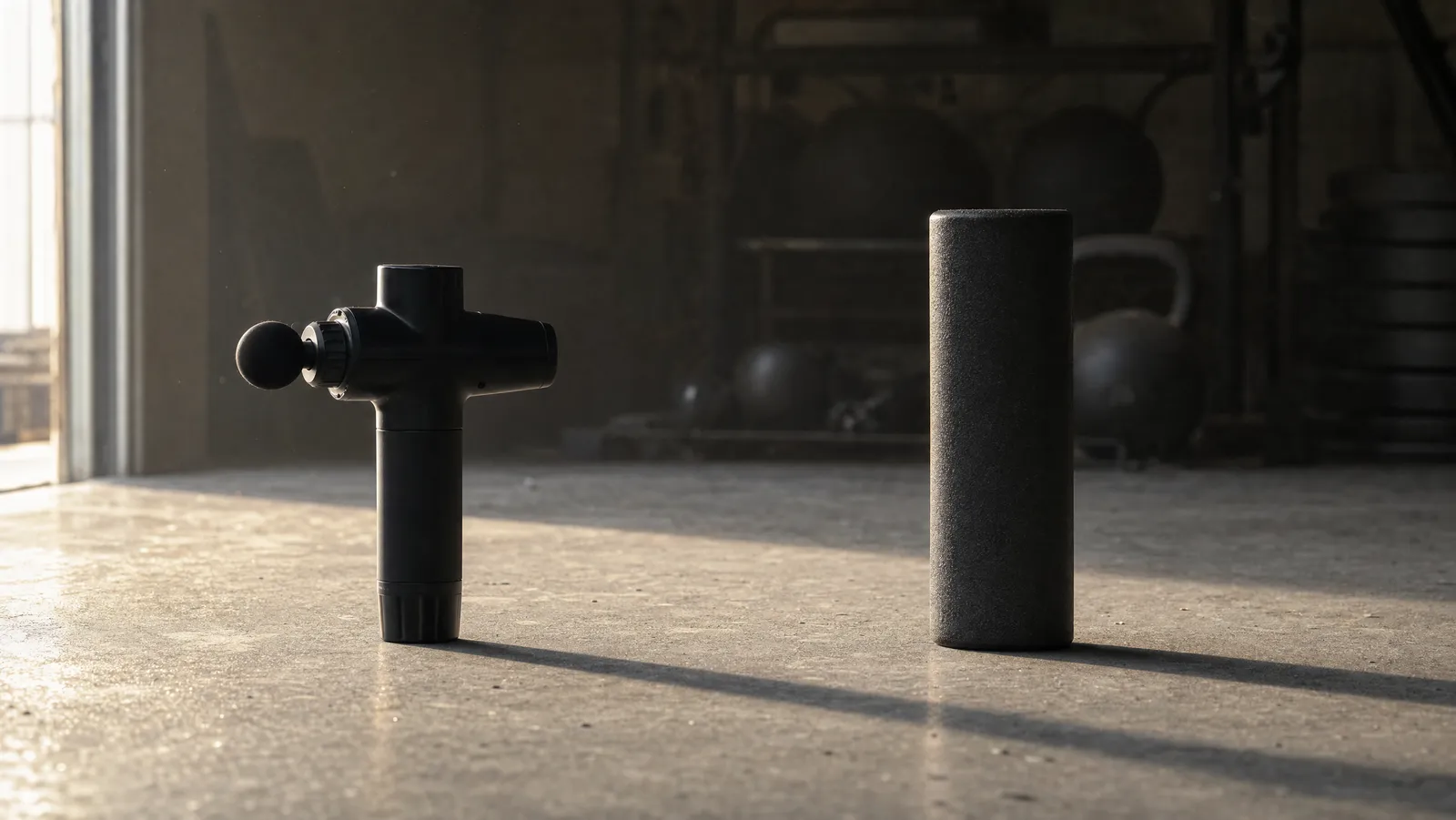
That is not a budget compromise, it is where the research lands. The massage gun vs foam roller question has a short list of genuine exceptions — calves, forearms, a spot you cannot reach without getting on the floor, a knee or wrist that will not take your bodyweight — and outside that list the roller does the same job for a tenth of the money. Below is what each tool actually does to tissue, a measure-by-measure comparison, and where each one honestly wins. If you want the whole category ranked rather than this head-to-head, that is our guide to the best muscle recovery tools.
The 30-second answer: foam roller or massage gun
Buy the foam roller first if you train at home, have floor space, and can get down to the floor and back up without difficulty. That is most readers, and it is a $12 decision.
Buy the massage gun first if any of these is true: you cannot kneel or put weight through a wrist or a knee; the areas that bother you are calves, forearms or feet; you travel and want something that works in a hotel room with no floor space; or you want to treat one spot in 60 seconds rather than run a 10-minute floor routine.
Buy both if you already own a roller and keep skipping your calves. That is the exact gap percussion fills best, and a $40 mini device fills it.
What percussion and myofascial release actually do to your tissue
Both tools are sold on the idea of releasing fascia. That claim deserves examining, because the researchers who study it do not believe it.
According to Behm and Wilke's 2019 narrative review in Sports Medicine, there is "insufficient evidence to support that the primary mechanisms underlying rolling and other similar devices are the release of myofascial restrictions and thus the term 'self-myofascial release' devices is misleading." Their alternative explanation is neural rather than structural: rolling activates skin and fascial mechanoreceptors and interstitial type III and IV afferents that modulate sympathetic and parasympathetic activity.
They do not say nothing happens. The same review allows that "myofascial tone can be modulated with rollers by changes in thixotropic properties, blood flow, and fascial hydration affecting tissue stiffness." Something real is going on. It is just not the thing printed on the box, and that matters here because both tools are sold on the same mechanism story. If the story is wrong for one, it is wrong for both — which removes the most common argument for paying ten times more.
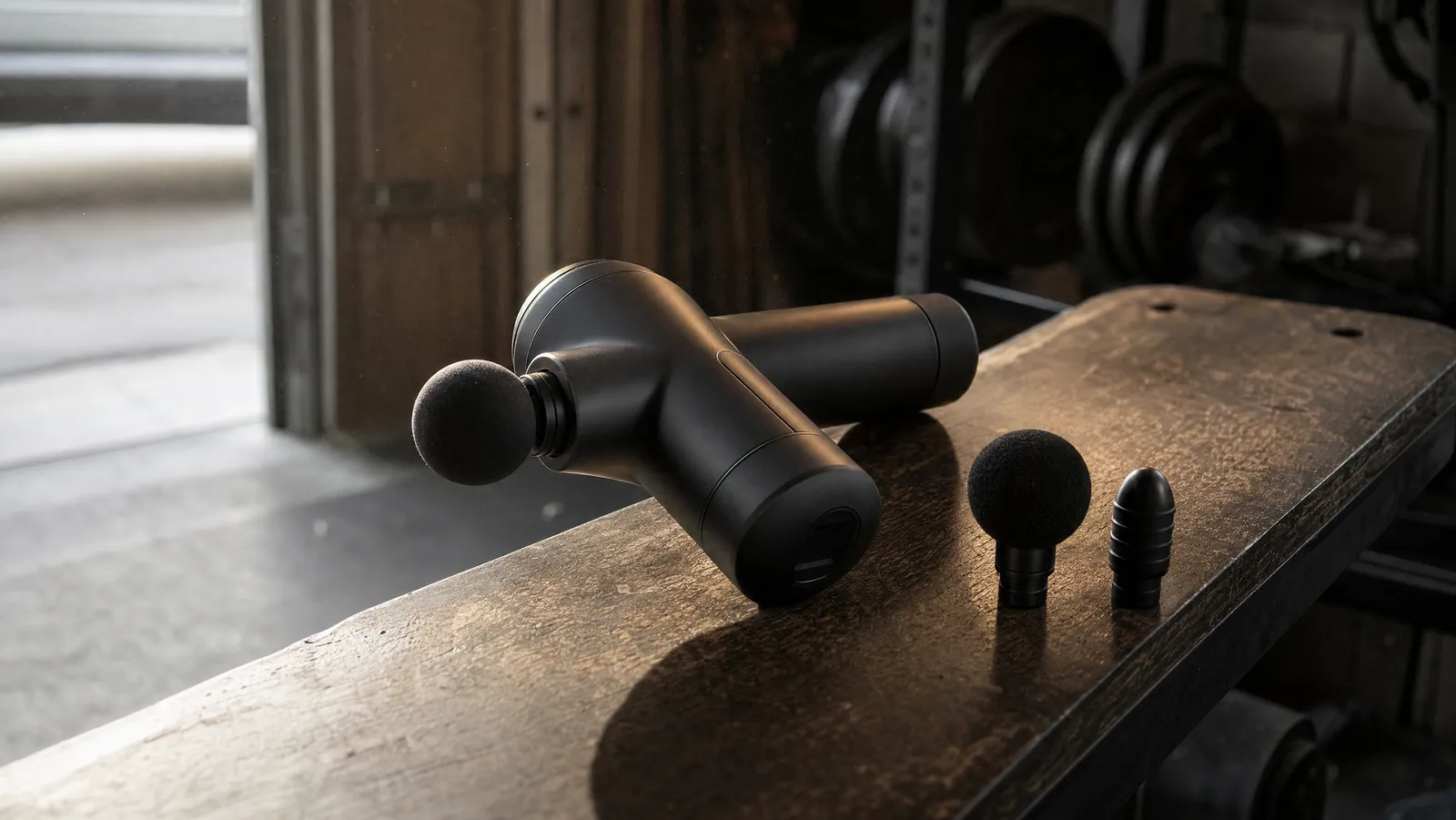
The mechanical difference is easier to describe. A roller presses a broad contact patch into you using a fraction of your bodyweight while you move across it. A gun delivers a small, fast, repeated impact at one point. The manufacturer of the BOB AND BRAD X6 Pro Max lists 55 lb of stall force and 10.5 mm of amplitude at 2,000 to 3,200 RPM — maker's numbers rather than independent measurement, a caveat that applies to every spec in this article. A roller has no equivalent figure, because the load is whatever share of your bodyweight you put through it.
Massage gun vs foam rolling, measure by measure
| Measure | Foam roller | Massage gun | |---|---|---| | Price, September 2026 | $11.99 to $13.99 | $39.99 mini, $129.98 full-size | | Range-of-motion evidence | Moderate effect, but only from 4-plus weeks of training | Consistent acute gains from a single application | | Soreness evidence | No better than passive rest for pain | No better than passive rest for pain | | What it reaches | Big surfaces: quads, hamstrings, lats, mid-back | Anywhere your hand reaches, including calves and forearms | | Effort | You move your bodyweight over it | You hold a 0.72 to 1.9 lb device still | | Time per session | About 10 minutes | 30 to 60 seconds per spot | | Noise | Silent | Under 40 dB mini, under 55 dB full-size, per the manufacturers | | Portability | 12 by 6 inches, needs floor space | 0.72 lb, fits a backpack pocket | | Failure mode | Foam slowly compresses | Battery, motor, charger, warranty window | | Who it fails | Anyone who cannot get to the floor | Anyone treating a whole back |
Two rows do most of the work. The evidence rows are nearly identical, which is the finding that should drive the purchase. Reach and effort are where the tools genuinely diverge, and that is a question about your body and your living room rather than about muscle physiology.
Where the massage gun genuinely wins
Calves. This is the strongest case, and it is not close. The 2022 Sports Medicine systematic review and meta-analysis of foam-rolling training pooled 11 studies and 290 participants and found a moderate overall effect on range of motion, effect size 0.823. Broken down by muscle, hamstrings came in at 0.645 and quadriceps at 0.425, but the triceps surae — the calves — landed at minus 0.024. The authors state plainly that "responses are muscle or joint specific." If your calves are the problem, and they often are once running volume climbs the way it does in run training for Hyrox, the roller is not the tool the evidence supports.
Getting a result today. A 2025 crossover pilot study in PeerJ put 18 physically active men through eight minutes of percussion, eight minutes of foam rolling, or nothing, with 4 to 5 day washouts. Percussive massage significantly improved hamstring flexibility compared with both foam rolling and no treatment. It is 18 men and the authors call it a pilot, so treat it as a signal rather than a settled finding — and note that the same study found no condition improved reactive strength, leg press power or muscular endurance.
Bodies that cannot load the floor. Rolling a quad means kneeling and pushing through your wrists. If a knee, wrist or shoulder will not tolerate that — a common situation for anyone managing the kind of joint complaints we cover in is rucking bad for your knees and back — the gun is not a luxury version of the roller. It is the only one of the two you can use.
Effort. You sit in a chair holding something under two pounds. After a hard session that is the difference between doing it and not.
Where the foam roller genuinely wins
Price, obviously. But also durability. A block of high-density foam has no battery to degrade, no motor to burn out and no charging port to fail. The manufacturer of the ProsourceFit roller rates it to 300 lb and describes it as water-resistant. The likeliest end state is that the foam slowly compresses over years.
Long-term range of motion. The meta-analysis above found that interventions longer than four weeks produced significant gains, while four weeks or less did not. That is a training effect rather than a one-off, and it is the strongest claim either tool has to changing anything durable about you. We have not seen an equivalent multi-week meta-analysis for percussion, which is a gap in the evidence rather than a point against the gun.
Post-soreness tissue properties. In the 2025 randomized trial in the Journal of Functional Morphology and Kinesiology, 60 volunteers aged 30 to 40 were assigned to foam rolling, percussive massage or passive rest after inducing delayed-onset muscle soreness. Foam rolling significantly reduced the onset and duration of raised muscle tone and stiffness, and improved elasticity. Percussive massage showed no significant effect on those measures in the same trial. One study does not settle a question, but it runs directly against the assumption that the pricier tool is the stronger one.
Coverage. Nothing treats a whole upper back, both lats and both quads in ten minutes the way a roller does. A gun is a scalpel; a roller is a broom.
Feeling better is not the same as recovering faster
This distinction is the backbone of everything we write about recovery tools, and here it is in one sentence from the researchers. The authors of that 60-person trial conclude that foam rolling and percussive massage "accelerate recovery of muscle tone, stiffness, and elasticity after DOMS as compared to passive rest but offer no added benefit for pain relief." All three groups, including the one that did nothing, got sorer by day two and felt better by day four.
So: measurable changes in how the muscle behaves, no measurable change in how much it hurts relative to sitting still. And on performance, the IJSPT systematic review of percussive therapy — 13 studies, 255 participants — did report acute increases in muscle strength, explosive muscle strength and flexibility from a single application, though it also notes that "all studies had limitations in methodological quality or reporting of findings", and that static stretching was as effective as percussion for flexibility gains. It found that multiple treatments reduced experiences of musculoskeletal pain, in the two protocols that tested them: five times a week for three weeks, and three times a week for two weeks.
What none of this evidence shows is either tool making you recover faster in the sense of being able to train harder tomorrow — the acute gains above are measured minutes after treatment, not the next day. Both may make the next 20 minutes more pleasant, and one of them costs $12.
The safety paragraph worth reading twice
Percussion is the tool with a documented harm case. In Physical Therapy in 2021, Chen and colleagues reported rhabdomyolysis in a 25-year-old woman with untreated mild iron deficiency anemia, after roughly 10 minutes of percussion gun treatment to both thighs following two consecutive days of cycling. Her creatine kinase measured 32,290 U/L against a normal range of 24 to 195, and she recovered after intravenous fluids and urine alkalinization. The authors note that "the medical literature contains no clinical-/evidence-based reports regarding the benefits, indications, contraindications, and side effects of these devices." One case report is not a pattern. It is a reason to keep sessions short and stop if something hurts in a way that is not the usual hurt.
Rolling has softer limits. Cleveland Clinic's guidance, quoting exercise specialist Ben Kuharik, is one to two minutes per muscle group and no more than about 10 minutes in total, and it warns against rolling directly over joints like ankles, knees or elbows because you can hyperextend them. The same page advises talking to a provider first if you have a broken bone, a torn muscle, or if you are pregnant.
The plain version: if you are pregnant, managing a circulatory or clotting condition, living with neuropathy, or working around an acute injury, ask a clinician whether either tool is appropriate for you before you buy one. That is not a question an article can answer.
What to buy, and what it costs
For the roller, we would buy the Day 1 Fitness High Density Foam Roller at $13.99 as of September 2026, or the ProsourceFit at $11.99 as of September 2026 if you want the cheapest credible option. Both are 12 by 6 inches in high-density EPP. One point worth knowing before you click: 12 inches is a limb-length roller. If you want to lie lengthways along it for the thoracic spine, ProsourceFit also sells 18, 24 and 36-inch versions, and that is the one we would pick for back work. That is our editorial judgement about fit rather than a published finding.
For percussion, the SBUBU Mini at $39.99 as of September 2026 is the one that changes the arithmetic of this comparison. The manufacturer lists 0.72 lb, 32 lb of stall force, 7 mm of amplitude, 3,200 RPM, under 40 dB, and a 10-minute auto-shutoff. Given the case report above, we regard a hard shutoff as a sensible design feature rather than a limitation, though that is our reading rather than the manufacturer's stated rationale.
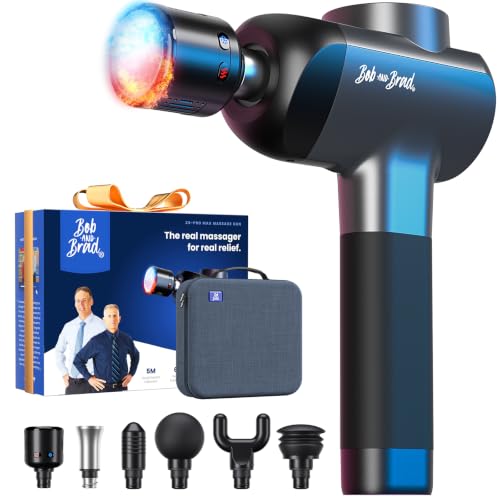
The BOB AND BRAD X6 Pro Max at $129.98 as of September 2026 is where percussion stops being a cheap add-on. The manufacturer lists 55 lb of stall force, 10.5 mm of amplitude, a head that switches between 113F heat and 50F cold in about three seconds, 1.9 lbs, a two-year warranty and FSA/HSA eligibility. Whether the extra $90 is defensible is a longer argument, and we make it in full in our piece on whether massage guns are worth the money.
And if the $40 is genuinely discretionary, we would rather see it spent on resistance bands for a full-body workout than on a second recovery device. Training tools change more than recovery tools do.
Can you skip both?
Largely, yes, and we would rather you heard that from us than worked it out after spending $130.
Sleep is the intervention with the best return. A 2023 systematic review in Sports Medicine - Open by Cunha and colleagues, covering 25 studies on sleep interventions and athletic performance, recommends extending sleep by 46 to 113 minutes over 3 to 49 nights for athletes habitually sleeping around seven hours. The authors are candid about the quality problem: "none of the included studies presented a low risk of bias." That is still a better-evidenced lever than any handheld device.
Food is the second. The International Society of Sports Nutrition position stand on protein and exercise puts daily intake of 1.4 to 2.0 g of protein per kg of bodyweight as "sufficient for most exercising individuals" for building and maintaining muscle, spread across servings of roughly 20 to 40 g every three to four hours.
Third is easy movement on the day after a hard session — a walk, a slow bike, nothing that requires a decision. That is our habit rather than a published protocol. If your week is structured the way our Hyrox training plan for beginners is, the easy day is already built in.
Which is better, a foam roller or a massage gun? Our verdict
Buy the roller. Spend $12 to $14, use it for ten minutes at a time, and give it more than four weeks before you judge it, because that is where the range-of-motion evidence turns significant. The technique matters more than the hardware, and how to foam roll well is its own subject — doing it imperfectly for ten minutes beats owning the right device and never using it.
Then buy the mini gun, at $40 as of September 2026, if and when you hit one of the specific walls: calves that do not respond, a joint that will not take the floor, or a travel week with no floor space. That sequence costs about $54 in total and covers essentially everything either tool is good for. The $130 full-size gun is a real upgrade in force and adds heat and cold, but it is a want, not a first purchase.
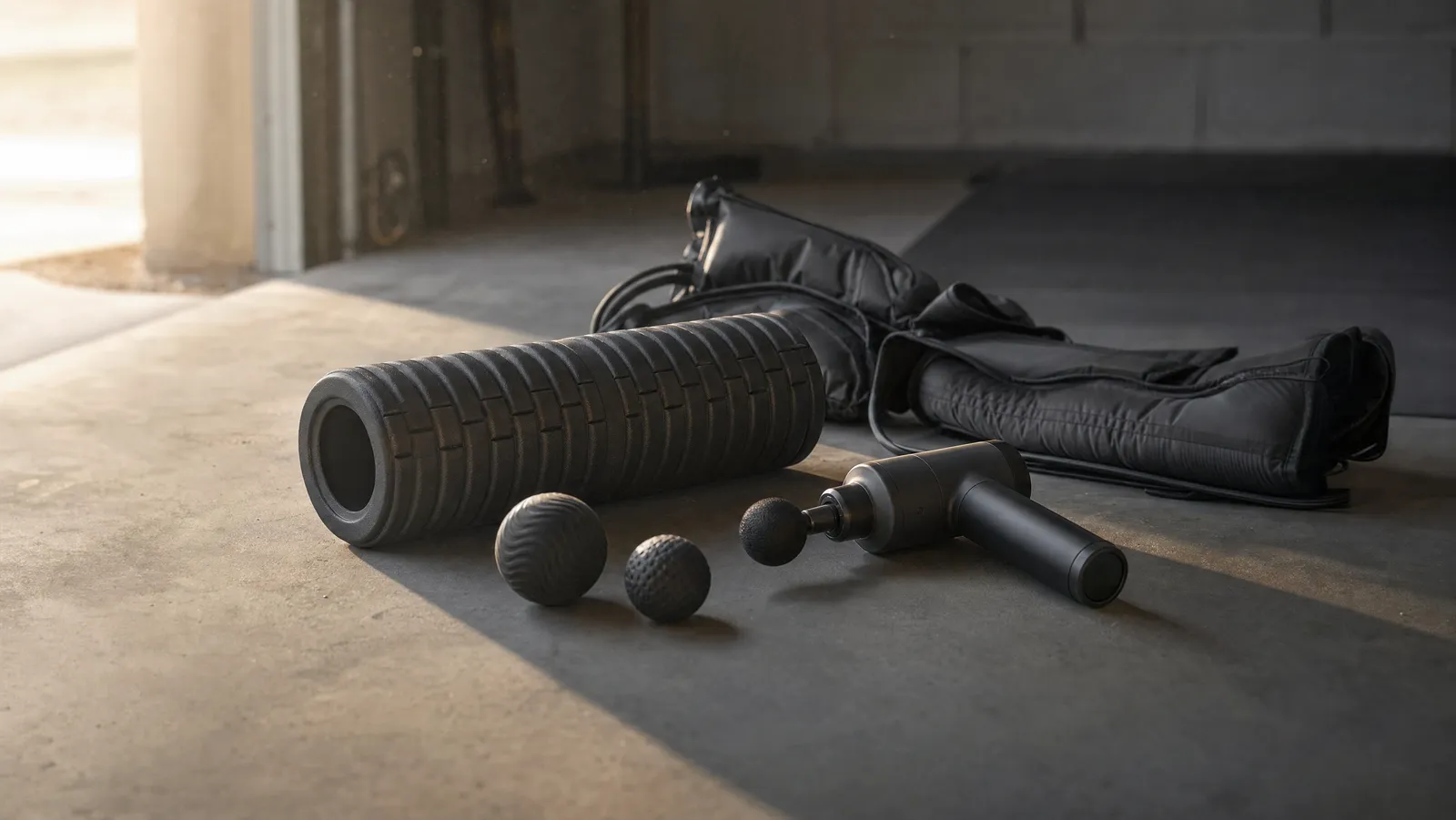
For where both tools sit against compression boots, massage balls and everything else in the category, see our full guide to recovery tools.
Gear we'd put on our own floor
The Picks
Full-size percussion, heat and cold
55 lb stall force and a dual-temperature head.
Price as of
55 lb stall force and a dual-temperature head. This is the shape of the argument for spending real money on percussion.

0.72 lb and under 40dB, with enough stall force to be more than a novelty.

High-density, 12 inch
The whole case for rollers in one object: no battery, no motor, and it costs about a tenth of the gun above.
Price as of
The whole case for rollers in one object: no battery, no motor, and it costs about a tenth of the gun above.

The cheapest credible option
Same high-density EPP construction, rated to 300 lb, and sold in four lengths if 12 inches is the wrong call for you.
Price as of
Same high-density EPP construction, rated to 300 lb, and sold in four lengths if 12 inches is the wrong call for you.
Our top three, ranked
The Leaderboard
Full-size percussion, heat and cold
55 lb stall force and a dual-temperature head.
Check PricePrice as of
High-density, 12 inch
The whole case for rollers in one object: no battery, no motor, and it costs about a tenth of the gun above.
Check PricePrice as of
What to know before you buy
Field Notes
How long should you use a massage gun on one muscle?
Shorter than most people assume. The [2023 systematic review in the International Journal of Sports Physical Therapy](https://ijspt.scholasticahq.com/article/73795-the-effect-of-percussive-therapy-on-musculoskeletal-performance-and-experiences-of-pain-a-systematic-literature-review) by Sams, Langdown, Simons and Vseteckova found single applications across its 13 studies ran anywhere from 30 seconds to 30 minutes, which tells you the literature has not settled on a dose. For context on the upper end, the [Physical Therapy case report by Chen and colleagues](https://academic.oup.com/ptj/article/101/1/pzaa199/5958507) describes roughly 10 minutes of percussion across both thighs preceding a case of rhabdomyolysis. We stay at 30 to 60 seconds per spot. That is our editorial judgement rather than a published protocol.
Does foam rolling actually reduce soreness?
It changes how your muscle behaves more than how much it hurts. In a 2025 randomized trial in the Journal of Functional Morphology and Kinesiology, [60 volunteers were split between foam rolling, percussive massage and passive rest](https://pmc.ncbi.nlm.nih.gov/articles/PMC12286022/) after exercise-induced soreness. Foam rolling significantly reduced the onset and duration of raised muscle tone and stiffness. But all three groups, including the one that did nothing, showed the same pattern of pain rising by day two and easing by day four, with no significant differences between them. The authors conclude both tools "offer no added benefit for pain relief."
Can a massage gun replace stretching?
Not on the current evidence, and the review that is most positive about massage guns says so itself. The [IJSPT systematic review of percussive therapy](https://ijspt.scholasticahq.com/article/73795-the-effect-of-percussive-therapy-on-musculoskeletal-performance-and-experiences-of-pain-a-systematic-literature-review) found consistent acute flexibility improvements after single applications, but also reported that static stretching was equally effective for those flexibility gains. So a gun is a substitute for stretching in the sense that it gets you a similar short-term range-of-motion bump with less discomfort, not in the sense that it does something stretching cannot.
Why does foam rolling not seem to work on my calves?
Because the meta-analysis says it largely does not. The [2022 Sports Medicine systematic review and meta-analysis of foam-rolling training](https://pmc.ncbi.nlm.nih.gov/articles/PMC9474417/) pooled 11 studies and 290 participants and broke the range-of-motion results down by muscle. Hamstrings responded, with an effect size of 0.645, and quadriceps responded, at 0.425. The triceps surae, meaning your calves, came out at an effect size of minus 0.024, which is no effect at all. The authors note that "responses are muscle or joint specific." Calves are the single clearest case for reaching for a massage gun instead.
Who put in the work
The Coach
Your Coach
Darlene Schmitt
I am a fitness instructor and promoter who truly enjoys helping others become the best they can be! My mission is to help people find the love of fitness and to help them develop a lifelong habit of exercise. I am a firm believer that fitness should be fun, and I make it my mission to ensure that my classes are always enjoyable. I am also a certified nutritionist and personal trainer, so I am able to offer my students comprehensive and well-rounded support.