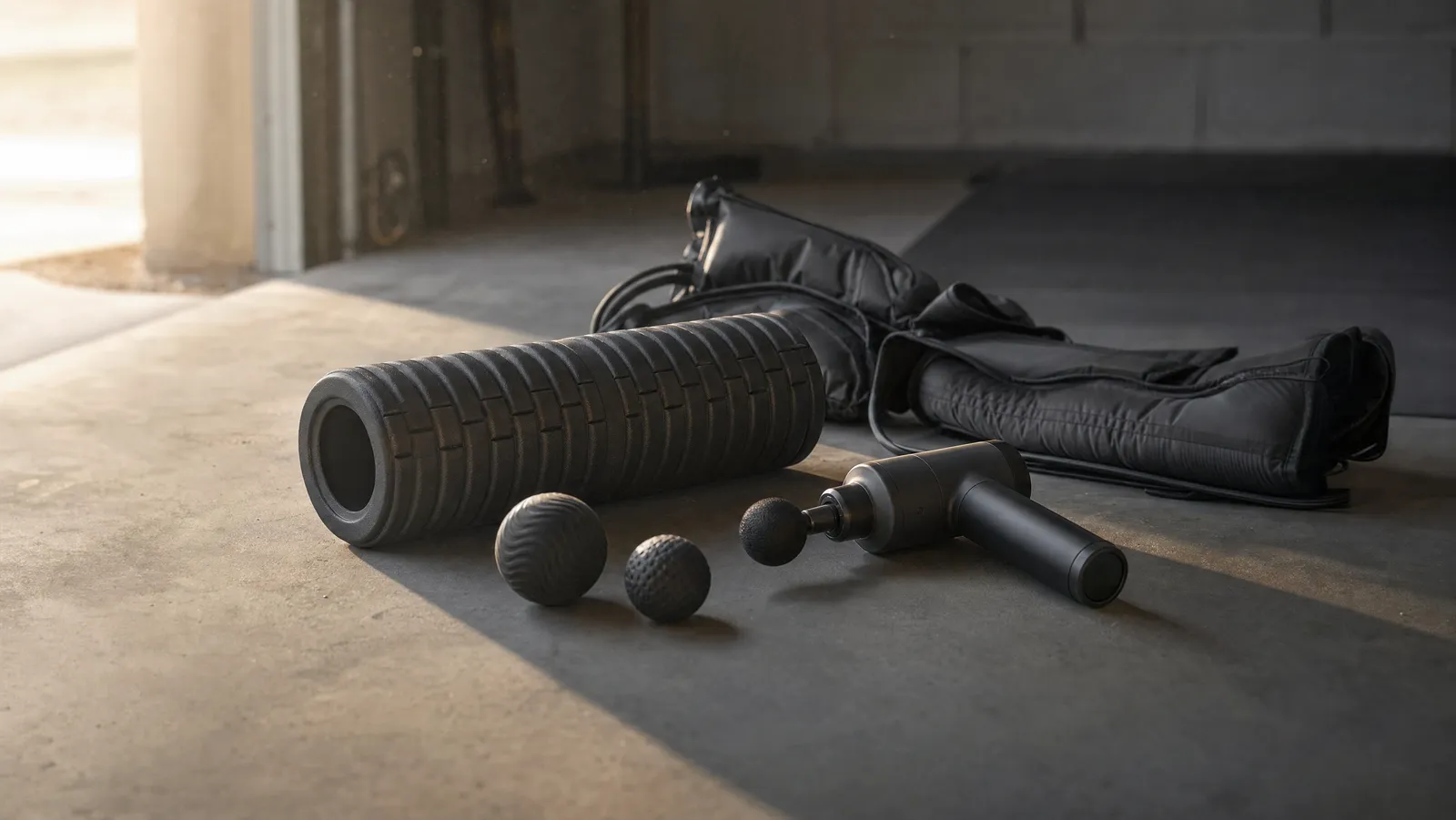
Are massage guns worth it? What the evidence actually shows

Contains affiliate links. Our policy.
A massage gun is worth buying if you want a sore quad to feel better tonight and a stiff hip to move through more range in the next twenty minutes. It is not worth buying if you want to recover faster and train harder tomorrow. Exercise Legend is reader-supported: if you buy through the links below we may earn a commission, which never changes what we recommend.
That gap — feels better versus recovers faster — runs through this entire category, and it is the organizing idea behind our guide to muscle recovery tools that actually work. Marketing copy slides from the first claim into the second inside a single sentence. The trials do not.
Are massage guns worth it for you specifically? That turns on which of those two things you thought you were buying. Below: what the hardware does, what the evidence supports, what it plainly does not, and how much of the spec sheet is worth paying for.
What a massage gun actually does, in three numbers
According to Mayo Clinic Store's explainer, massage guns "work by delivering rapid, concentrated pulses of pressure—often up to 40 percussions per second—into the muscle tissue", stimulating mechanoreceptors and proprioceptors in a way that "may help reduce the perception of pain and enhance mobility." Note the verbs. Perception and mobility, not repair.
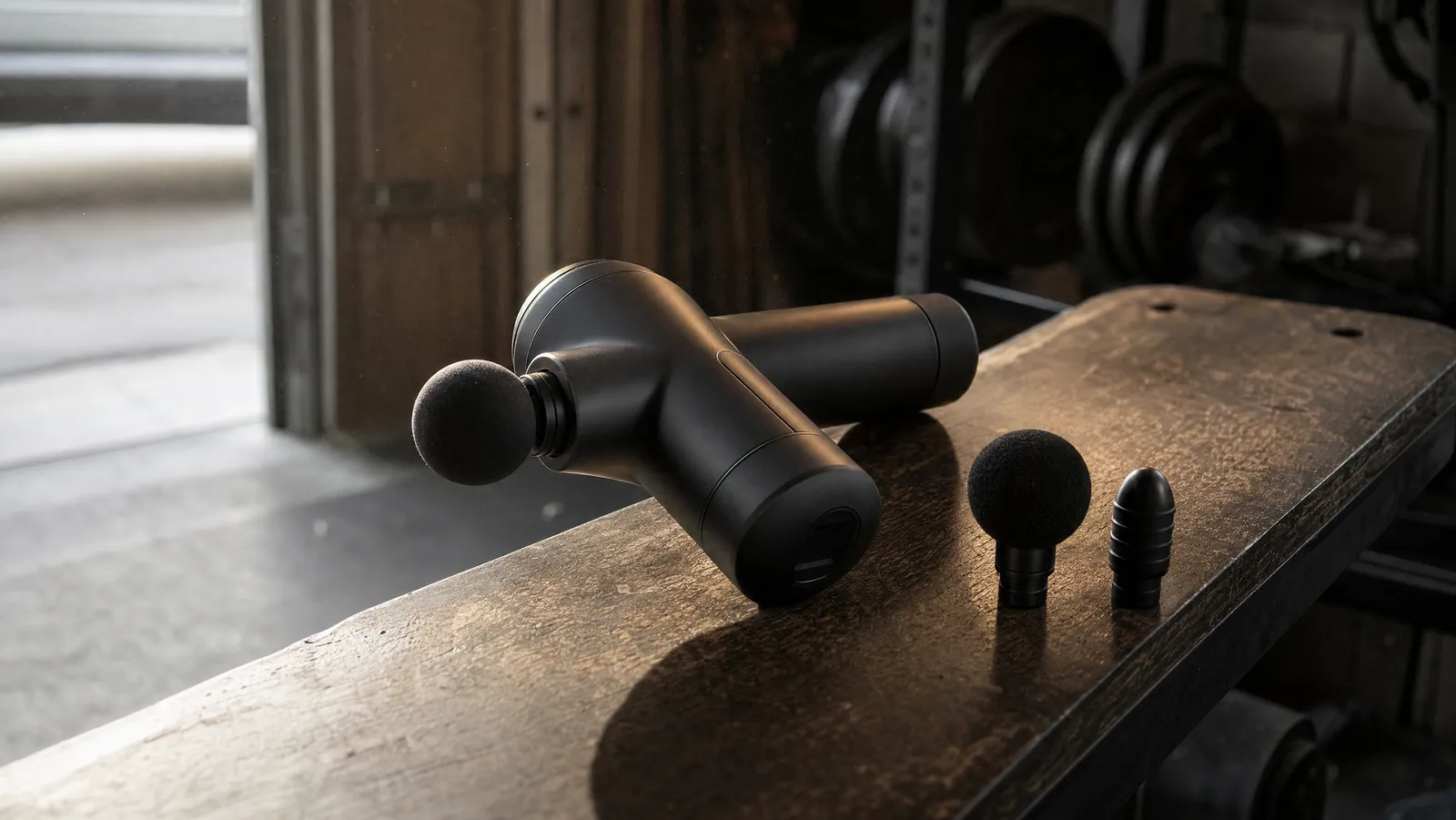
Three specs decide how a device feels in the hand.
- Amplitude is how far the head travels on each stroke. A retailer explainer from LifeStar Pro defines it as "the physical distance the massage head travels forward and backward during a single cycle" and argues that "amplitude is the single most important factor in determining whether a device provides actual deep-tissue percussive therapy or just superficial vibration." That is a seller's framing rather than a measured finding, and we flag it as such — but the mechanics are not in dispute. A 7mm stroke and a 12mm stroke are different tools doing different jobs.
- Stall force is how hard you can lean on the head before the motor gives up. The same explainer calls it "the maximum amount of pressure that can be applied to the massage head before the internal motor bogs down and stops completely." Low stall force is why a cheap gun goes quiet the moment you press it into a thick muscle belly.
- Speed, quoted as RPM or percussions per minute, is the number printed largest on the box and the least informative of the three. A device that runs at 3,200 RPM but stalls under light pressure is a vibrator with ambitions.
One thing we want to state once, plainly: every spec in this article comes from the manufacturer's own listing. We are not aware of anyone independently auditing stall force or amplitude claims in this market, so read them as marketing copy with numbers in it.
What the research supports: range of motion, and soreness you can feel
Range of motion is the best-supported outcome, and it is not close. A 2023 systematic review by Sams, Langdown, Simons and Vseteckova in the International Journal of Sports Physical Therapy pooled 13 studies covering 255 adults and reported that "overall, results indicated an improvement in flexibility in all anatomical locations after PT." Their conclusion is that percussive therapy "delivered by massage guns can help improve acute muscle strength, explosive muscle strength and flexibility, and reduce experiences of musculoskeletal pain."
Read the word acute carefully. These are effects measured minutes after treatment, in mostly small studies, and the same review notes the literature's methodological inconsistency.
The soreness evidence is thinner but real in places. A 2025 randomized controlled trial by Li and colleagues in Frontiers in Public Health put 30 physically active male college students through a squat protocol to induce delayed onset muscle soreness, then split them into three groups of ten: static stretching, 25 minutes of percussion massage, or 40 minutes of percussion massage, delivered immediately afterwards and again 24 hours later with a device running at 53 Hz and 6mm amplitude. At the 48-hour mark the long-duration percussion group reported significantly lower pain scores than the stretching group (p = 0.003) and significantly greater knee range of motion (p = 0.012). The authors conclude that "PMT was more effective than static stretching for DOMS recovery" and that "two 40-min PMT sessions provided greater benefits than two 25-min sessions."
Two caveats that the headline version of that study usually drops. The comparator was static stretching, not rest — so this is percussion beating a weak control, not percussion beating nothing. And 40 minutes is a long time to spend holding a vibrating device against your legs, twice.
What the research does not support: recovering faster
Here is where we part company with the marketing.
The most useful recent evidence is a 2026 systematic review and meta-analysis by Zhu and colleagues in Chiropractic and Manual Therapies, pooling 12 randomized controlled trials and 393 participants. Its four results tell the whole story:
- Countermovement jump recovery improved versus control, with a moderate effect (g = 0.78, p < 0.01) — but rated low certainty.
- Creatine kinase, a blood marker of muscle damage, fell (g = -0.87, p = 0.02) — rated very low certainty.
- Maximum voluntary contraction did not recover any faster (g = 0.12, p = 0.28), and this one is rated moderate certainty, the strongest grade in the paper.
- Soreness was not reduced (g = 0.14, p = 0.40), rated very low certainty.
The authors state it themselves: "PT may promote CMJ recovery and may reduce CK levels, but current evidence does not show clear benefits for MVC recovery or DOMS relief." Note the certainty ratings. The one finding graded moderate certainty is the negative one.
There is also a plausible case for restraint before hard efforts. In a 2023 crossover study in the Turkish Journal of Sports Medicine, Canbulut and colleagues applied a Hypervolt at 30 Hz to the dominant quadriceps of 24 young adults for eight minutes. Hip flexion range improved (p = 0.02). Vertical jump and agility were unchanged. Wingate anaerobic peak power fell (p = 0.006), as did average power (p = 0.039). One small study is not a prohibition, but if you are about to run intervals as part of run training for Hyrox, we would keep the pre-session work short and off the prime movers. That is our editorial judgement rather than a published protocol.
The honest summary: a massage gun reliably changes how far your legs move, and may change how they feel. It does not reliably change how strong they are tomorrow.
Massage gun versus foam roller: the comparison that should worry you
A 2025 randomized trial by Szajkowski, Pasek and Cieslar in the Journal of Functional Morphology and Kinesiology, published via PubMed Central, ran 60 healthy volunteers aged 30 to 40 through four days of DOMS in three groups of 20: foam rolling, percussive massage, or passive rest. Foam rolling significantly reduced the onset and duration of raised muscle tone (p = 0.006) and stiffness (p < 0.001), and was the only intervention to improve elasticity (p < 0.001). Percussive massage did not reach significance on those measures. And on pain, the finding that matters most: "Neither therapy surpassed passive rest in pain relief, though pain was highest in the control group at the end of the observation period." The authors' own overall summary is more even-handed than that sounds — they report that foam rolling and percussive massage both "accelerate recovery of muscle tone, stiffness, and elasticity after DOMS as compared to passive rest but offer no added benefit for pain relief."
A $20 piece of foam still outperformed the device on the onset and duration of raised tone and stiffness, and was the only one of the two to improve elasticity. We work through when each tool earns its place in massage gun versus foam roller, because the honest answer is not the one either product category would like.
So are massage guns worth the money? Split it by who you are
Worth it: you have 20 minutes and something specific hurts. A tight calf after a long loaded walk, a stiff hip flexor the morning after intervals. You want it to feel better and move better now. This is the use case the evidence actually covers, and a massage gun does it without a floor, a wall, or getting into a position your back objects to. If your training looks like an at-home Hyrox plan, with the same few muscle groups getting hammered week after week, a device you can point at one spot on the sofa gets used. A foam roller in the closet does not.
Worth it: you will not stretch, but you will hold a gadget. Adherence is a real variable and we are not going to pretend otherwise. If percussion is the only mobility work you will do, percussion beats nothing.
Not worth it: you are buying tomorrow's performance. The best-graded finding in the 2026 meta-analysis is no faster recovery of maximum strength. If your problem is that you are too sore to train well, the levers are sleep, food and training load, not a motor.
Not worth it: you already foam roll and like it. On the 2025 trial above, you are not obviously trading up.
Not worth it: you are treating pain you have not had looked at. More on this below.
What to spend: three tiers, and what the money buys
The gap between a $40 unit and a $130 unit is not "power". It is amplitude, stall force and features you may not need.
Around $40 — find out whether percussion does anything for you. The SBUBU mini is 0.72 lb, runs at up to 3,200 RPM, and the manufacturer lists 7mm amplitude and 32 lb of stall force, under 40dB, with four heads and a 10-minute auto-shutoff. At $39.99 as of September 2026, it costs less than two sports massages. Seven millimeters is at the vibration end of the range rather than the deep-percussion end, which is exactly the point: you are buying the answer to a question, not a commitment. Check the current price on Amazon.
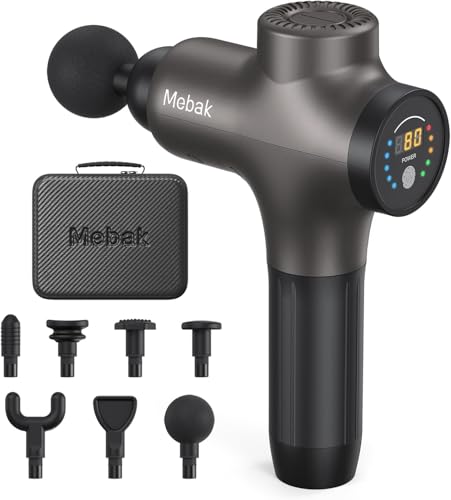
Around $100 — the spec most people actually want. The Mebak 3 lists 12mm amplitude and 53 lb of stall force, five speeds from 950 to 3,000 RPM, seven heads and 39 to 50dB operation, at 1.68 lb. This is the tier where the head still moves when you lean on a quad. Its most interesting feature is an LED pressure sensor that shows how hard you are pressing — a sensible guard against the main way people misuse these devices. At $99.99 as of September 2026, it is the one we would buy if we were only buying one. Check the current price on Amazon.
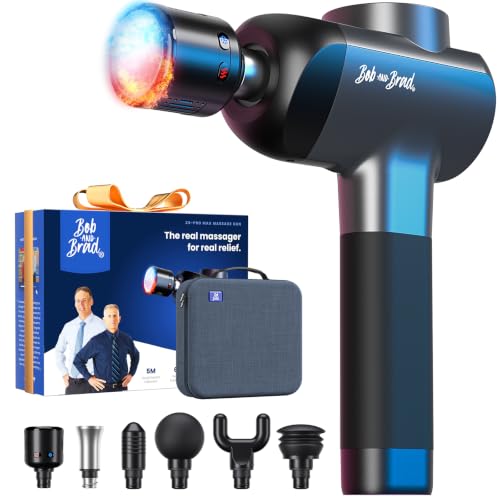
Around $130 — heat and cold in the same device. The BOB AND BRAD X6 Pro Max lists 55 lb of stall force, 10.5mm amplitude, five speeds from 2,000 to 3,200 RPM, and a head that switches between heat up to 113F and cold down to 50F in about three seconds. It is also listed as FSA/HSA eligible with a two-year warranty, at $129.98 as of September 2026. The case for spending up is consolidation, not intensity — note that the amplitude is lower than the mid-range pick's. If the alternative is buying a separate heat pack and ice cup you will use twice, folding them into the device you already reach for is a defensible $30. We have found no trial testing a combined heat-cold percussion head against plain percussion, so treat the combination as convenience rather than a proven upgrade. Check the current price on Amazon.
Skip the $400 tier. Nothing in the evidence above distinguishes device brands, and no trial we found compared premium hardware against budget hardware on any outcome.
Who should not use one, and where not to point it
This is the section that changes the answer for some readers, so we are not burying it.
Percussion is not uniformly benign. In a 2021 case report in Physical Therapy, Chen and colleagues describe a young woman with untreated iron deficiency anemia who developed rhabdomyolysis after cycling and then receiving percussion gun treatment from her coach. She presented with three days of thigh pain, tea-colored urine, muscle tenderness, multiple hematomas and hemoglobinuria, and was hospitalized for intravenous fluid resuscitation and urine alkalinization before recovering. The authors describe it as the first reported case of its kind. One case report is not a base rate, and we are not implying that this is a common outcome. It is a reason to treat "more, harder, longer" as the wrong instinct.
Mayo Clinic Store is direct on placement: massage guns "should not be used over bony areas, open wounds, or areas of acute inflammation." The same page advises that "individuals with certain health conditions, including deep vein thrombosis, advanced diabetes, or nerve disorders, should consult a healthcare provider before using percussive therapy."
If you have a known injury, a circulatory condition or clotting risk, nerve damage or neuropathy, or you are pregnant, ask a clinician whether percussion is appropriate for you before you buy one, not after. That is not boilerplate. It is the specific situation in which a device that feels good can make a real problem worse.
And a distinction worth holding onto: a massage gun manages a symptom. It does not diagnose one. If your knees or lower back hurt under load — the exact question we take up in is rucking bad for your knees and back — the answer is usually a change in load, technique or programming, not more percussion at the sore spot.
The verdict
Buy one if you want a tool that makes sore muscles feel better and stiff joints move further, tonight. The range-of-motion half of that is reasonably well evidenced; the feels-better half is mixed, with the 2023 review finding reduced experiences of pain and the 2026 meta-analysis finding no soreness benefit against control. It costs $40 to test.
Do not buy one expecting faster recovery. The best-graded finding in the most recent meta-analysis is that maximum strength does not come back any sooner. Anyone selling you the opposite is ahead of the data.
Our practical advice: start at $40. If you use it three times a week for a month, the 12mm, 53 lb tier is the upgrade we would make. If it sits in a drawer, you have learned something useful for the price of a takeaway. Get the technique right before you get the hardware right — how to use a massage gun properly matters more than which one you own, and 30 seconds to 2 minutes per muscle group is where to start.
If you are assembling a recovery setup rather than buying a single gadget, work through Exercise Legend's complete recovery tool guide first, then come back and spend. And if you are new to loaded training entirely, the soreness you are trying to solve is usually a programming problem — our guide to rucking for beginners has more on getting the load right the first time.
Gear we'd put on our own floor
The Picks

If you want to find out whether percussion does anything for you
The low-commitment way to test the category.
Price as of
The low-commitment way to test the category. Small, quiet and cheap enough that a disappointing answer is not an expensive one.
The amplitude and stall force most people actually need
12mm amplitude and 53 lb stall force, with a pressure indicator that stops you from grinding too hard into a sore spot.
Price as of
12mm amplitude and 53 lb stall force, with a pressure indicator that stops you from grinding too hard into a sore spot.
Heat and cold in the same device
The reason to spend up is the dual-temperature head, which folds two separate recovery tools into the one you will actually pick up.
Price as of
The reason to spend up is the dual-temperature head, which folds two separate recovery tools into the one you will actually pick up.
How the picks stack up
Head To Head
If you want to find out whether percussion does anything for you
The low-commitment way to test the category.
Check PricePrice as of
The amplitude and stall force most people actually need
12mm amplitude and 53 lb stall force, with a pressure indicator that stops you from grinding too hard into a sore spot.
Check PricePrice as of
Heat and cold in the same device
The reason to spend up is the dual-temperature head, which folds two separate recovery tools into the one you will actually pick up.
Check PricePrice as of
What to know before you buy
Field Notes
How long should you use a massage gun on one muscle?
Start at 30 seconds to 2 minutes per muscle group. That is the window given by [Mayo Clinic Store's explainer](https://store.mayoclinic.com/education/how-a-massage-gun-works-and-its-potential-benefits/), which says that "for best results, experts recommend applying the device to targeted muscle groups for 30 seconds to 2 minutes, depending on the level of soreness or tightness." Longer is not automatically better. The 2026 meta-analysis by Zhu and colleagues in [Chiropractic and Manual Therapies](https://pmc.ncbi.nlm.nih.gov/articles/PMC13488264/) found that while longer treatment favored jump recovery, longer treatment was also associated with higher soreness scores, and the authors warn their dose findings "are preliminary and should not be interpreted as prescriptive thresholds."
Can you use a massage gun before a workout?
Yes, briefly, and not on the muscle you are about to max out. A 2023 crossover study by Canbulut and colleagues in the [Turkish Journal of Sports Medicine](https://journalofsportsmedicine.org/full-text/690/eng) applied a Hypervolt at 30 Hz to the dominant quadriceps of 24 young adults for eight minutes. Hip flexion range improved (p = 0.02), vertical jump and agility were unchanged, but Wingate anaerobic peak power fell (p = 0.006), as did average power (p = 0.039). Our reading is that a long, heavy pre-session blast on a prime mover is a bad trade. That is our judgement, not a published guideline.
Does a massage gun flush out lactic acid?
No source we found supports that framing, and we would not repeat it. [Mayo Clinic Store](https://store.mayoclinic.com/education/how-a-massage-gun-works-and-its-potential-benefits/) describes the mechanism as stimulation of mechanoreceptors and proprioceptors "which may help reduce the perception of pain and enhance mobility", and lists improved blood flow and temporarily reduced muscle tone among possible benefits — not lactate clearance. The nearest blood marker anyone has measured is creatine kinase, and the 2026 meta-analysis in [Chiropractic and Manual Therapies](https://pmc.ncbi.nlm.nih.gov/articles/PMC13488264/) did find percussive therapy lowered it, at very low certainty, while failing to find any soreness benefit at all.
Are massage guns FSA or HSA eligible?
Sometimes, and the paperwork decides. [HSA Store's eligibility list](https://hsastore.com/hsa-eligibility-list/m/massage-gun-for-pain-relief) treats a massage gun bought for general well-being or relaxation as ineligible unless you hold a Letter of Medical Necessity from a healthcare provider showing the device will be used to treat a medical condition, and advises keeping an itemized receipt alongside it. Manufacturers who label a product "FSA/HSA eligible" are describing the product category, not pre-approving your claim. Confirm with your plan administrator before you spend the balance.
Who put in the work
The Coach
Your Coach
Darlene Schmitt
I am a fitness instructor and promoter who truly enjoys helping others become the best they can be! My mission is to help people find the love of fitness and to help them develop a lifelong habit of exercise. I am a firm believer that fitness should be fun, and I make it my mission to ensure that my classes are always enjoyable. I am also a certified nutritionist and personal trainer, so I am able to offer my students comprehensive and well-rounded support.