Best muscle recovery tools: what actually works, and what you can skip

Contains affiliate links. Our policy.
The best muscle recovery tools, ranked by what they cost and what the evidence supports, come down to four: a $13.99 foam roller, a $19.99 pair of massage balls, a massage gun somewhere between $39.99 and $129.98, and — only if you have a specific reason — $169.99 compression boots, all prices as of September 2026. Exercise Legend is reader-supported: if you buy through the links below we may earn a commission, which never changes what we recommend.
Here is the distinction that organizes this entire guide, and that most roundups blur. Almost every tool here has reasonable evidence that it makes you feel better. Very few have good evidence that it makes you recover faster. Those are different products being sold under one name. Feeling better is worth money — it is why people keep training — but it is not the same as arriving at tomorrow's session stronger, and one of these tools may actively cost you adaptation if you time it badly.
So we have graded each class of tool twice. Once for the feeling, once for the physiology.
| Tool class | Makes you feel better | Makes you recover faster | Typical spend | | --- | --- | --- | --- | | Foam roller and massage balls | Yes, modestly | Not demonstrated; better as a warm-up tool | $14 to $20 | | Percussion massage gun | Yes, at long doses | Not demonstrated at short doses | $40 to $130 | | Compression boots | Yes, moderate effect on soreness | Trivial effects on muscle function | $170 | | Cold water immersion | Yes, consistently | Mixed, and a real cost after lifting | $0 to several hundred | | Sleep | Not the point | The largest reported effects we found | Free |
One housekeeping note before the specifics. Every dimension, stall force, pressure range and battery figure in this article comes from the manufacturer's own listing, not from independent measurement by us or anyone else. Treat those numbers as marketing copy that is probably approximately right, and treat the gap between two products' claimed specs as smaller than it looks.
Percussion massage guns: the flagship recovery tool
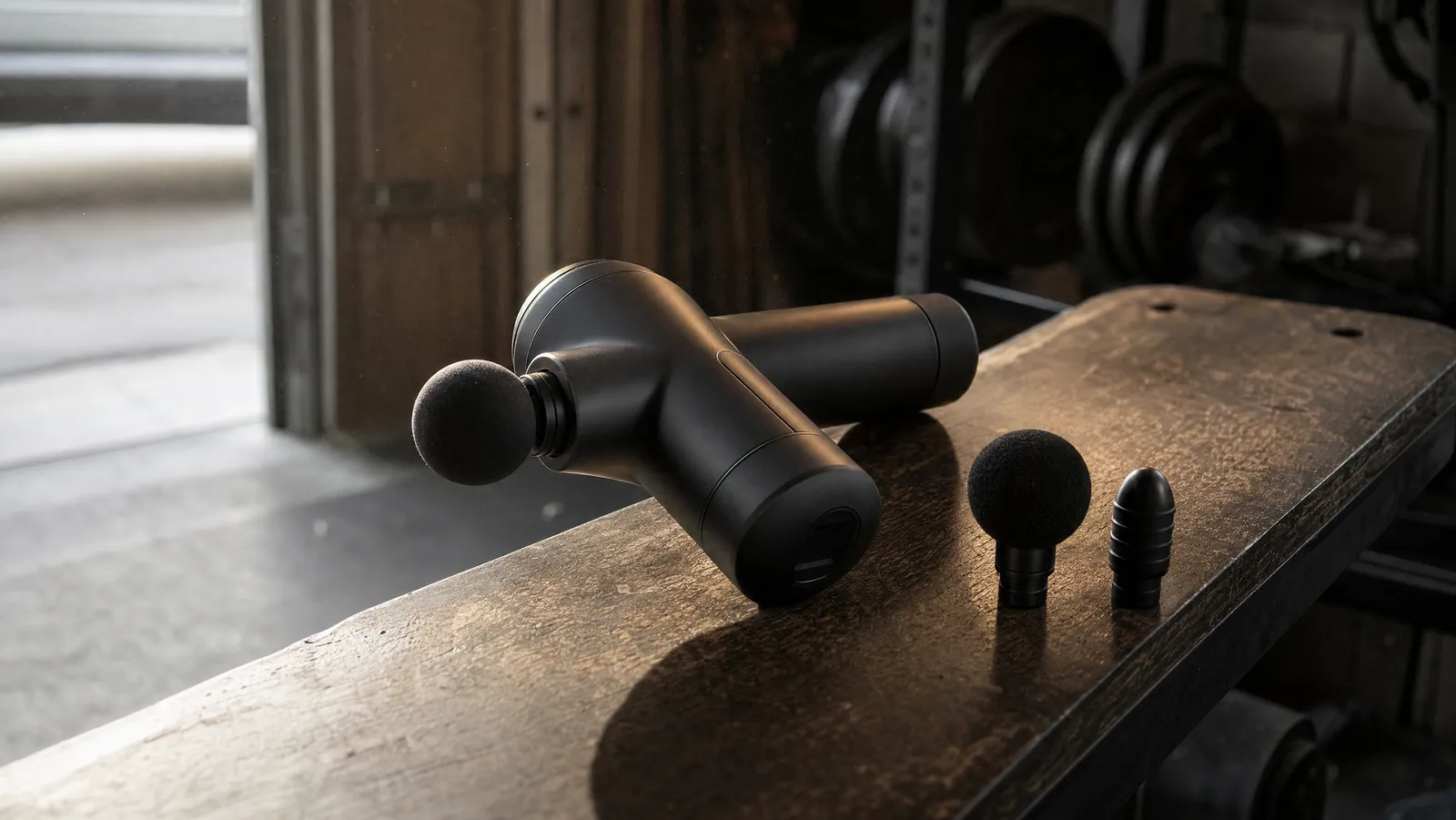
A percussion gun is a small reciprocating hammer. The head travels a fixed distance — the amplitude, usually 6mm to 12mm — at a speed the makers of the guns in this guide list anywhere from 950 to 3,200 strokes per minute, and the stall force is how hard you can press before the motor gives up. That is the whole technology. Everything else is ergonomics and battery.
The case for it starts with hands-on massage, which has the better evidence base. A 2017 systematic review and meta-analysis of 11 studies and 504 participants in Frontiers in Physiology by Guo and colleagues found soreness ratings significantly lower with massage than without at 24 hours (SMD -0.61), 48 hours (SMD -1.51) and 72 hours (SMD -1.46), and concluded that "massage therapy after strenuous exercise could be effective for alleviating DOMS and improving muscle performance". A gun is not a therapist's hands, but it is the closest thing most people will apply to themselves four times a week.
For percussion specifically, the picture depends almost entirely on dose. A 2025 randomized controlled trial in Frontiers in Public Health by Li and colleagues put 30 physically active male college students through a soreness protocol and compared static stretching against two percussion doses — 25 minutes and 40 minutes, applied immediately afterwards and again at 24 hours, across quadriceps, adductors, hamstrings, iliotibial band and glutes. At 48 hours the 40-minute group jumped about 2.4cm higher than the stretching group and reported significantly lower pain scores (p = 0.003). The authors' conclusion: "Two 40-min PMT sessions provided greater benefits than two 25-min sessions for treating DOMS."
Now the counterweight, and it is a heavy one. A 2024 study in the Journal of Athletic Training by Leabeater and colleagues gave 65 active young adults five minutes of percussion on one calf and nothing on the other after strenuous exercise. The result: "No significant group × time interactions were recorded for any of the performance or perceptual measures." Worse for the marketing, the authors reported that "small increases in perceived muscle soreness may occur up to 4 hours after use of massage guns".
Put those two studies side by side and the practical message is unusually clear. Five minutes on one muscle did nothing. Forty minutes across five muscle groups, twice, did something measurable. Percussion appears to be a real but dose-hungry intervention, and the two-minute blast most people actually perform sits at the wrong end of that range.
So the honest answer to whether massage guns are worth the money depends on whether you will genuinely spend 20 to 40 minutes with one. If you will, a capable gun earns its place. The manufacturer lists 55 lb of stall force and 10.5mm of amplitude for the BOB AND BRAD X6 Pro Max at $129.98 as of September 2026, along with heads that switch between heat at up to 113F and cold at down to 50F in about three seconds — the only tool here that covers both the stiff-before and the sore-after case.
If you are not sure you will use it, do not spend that. The SBUBU mini is $39.99 as of September 2026, weighs a listed 0.72 lb, and gives up amplitude (7mm) and stall force (32 lb) rather than speed. It is a test purchase, and testing is the correct first step for a tool whose benefit depends this heavily on whether you keep doing it. In between, the Mebak 3 at $99.99 as of September 2026 lists 12mm of amplitude — more than the flagship — plus an LED pressure indicator, which is a better teaching aid than it sounds if you are the type to lean in hard.
Massage gun or foam roller: which one first?
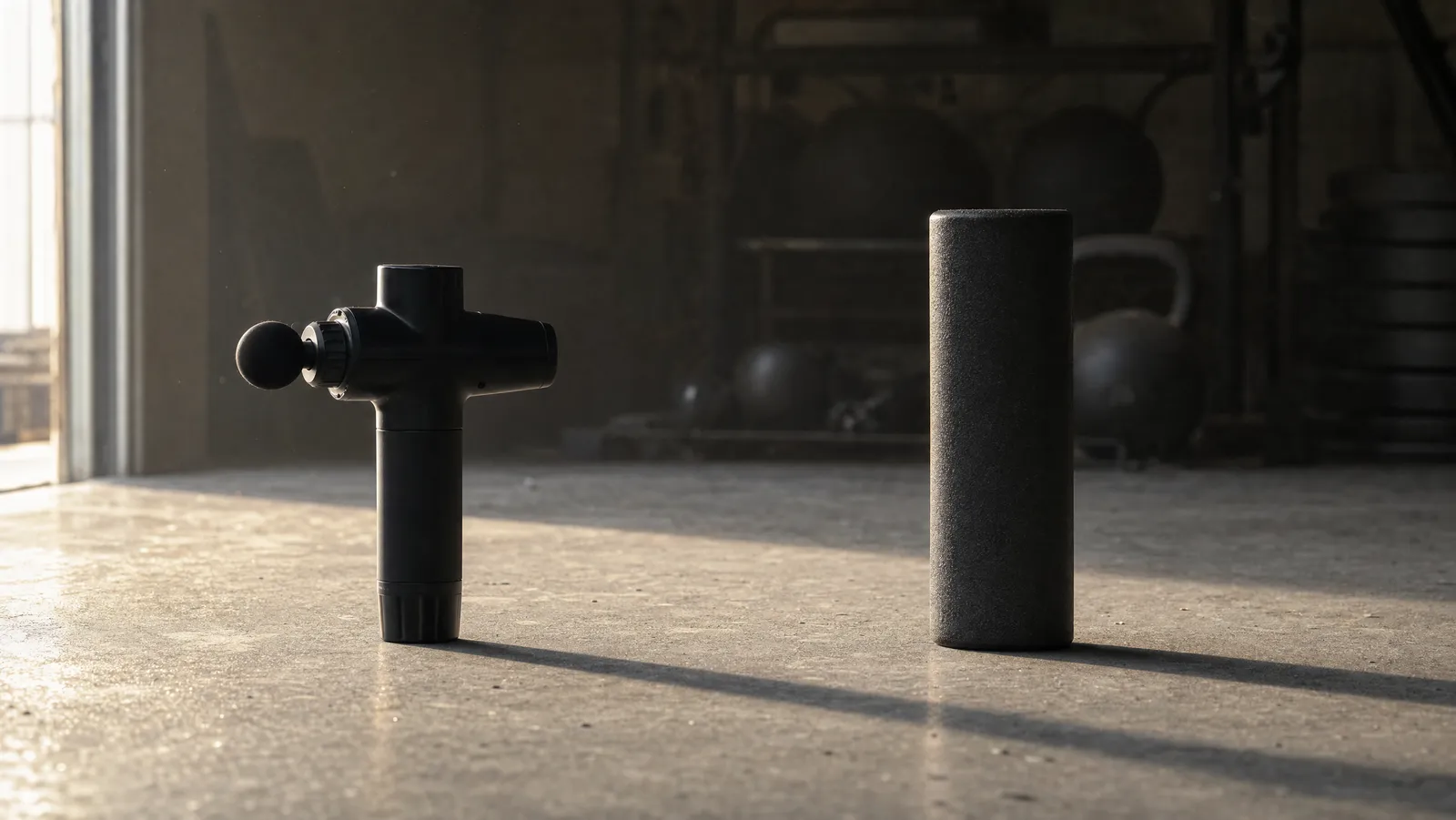
Buy the roller. The massage gun versus foam roller decision is usually framed as a technology upgrade, and it is really a budget-sequencing question: one of these costs $13.99 and the other costs between three and nine times that, and neither has evidence strong enough to justify skipping the cheap one.
They are not identical tools, though, and the differences are practical rather than physiological:
- Coverage. A 12-inch roller treats a whole quad or an upper back in one pass. A gun head treats an area the size of a golf ball.
- Force. With a roller you modulate pressure with your own bodyweight, which self-limits at roughly the point where it hurts too much to hold. With a gun the pressure is whatever your arm decides, which is why the gun has a safety section below and the roller does not.
- Access. A roller requires getting on the floor and loading your wrists and shoulders. If that is the problem — and for a lot of readers over 50 it is exactly the problem — a gun is not a luxury, it is the version of this that you can actually perform.
- Warm-up use. Rolling has the better evidence as a pre-training tool, and it is far easier to roll a quad for 30 seconds before squats than to set up a gun.
Our position: a plain $13.99 roller, price as of September 2026, plus the balls below, covers the great majority of what a home trainee needs. Add the gun when you have run that experiment for a month and found a spot the roller cannot reach, or when floor work is off the table.
Using a massage gun without hurting yourself
Most of how to use a massage gun properly comes down to three numbers and one rule.
The numbers. In the trial that found a benefit, the effective dose worked out to roughly eight minutes per muscle group across five groups, applied twice in 24 hours. In the trial that found nothing, it was five minutes on a single muscle. Somewhere between those is your answer, and it is longer than you think. Start at the lowest speed setting; the difference between 1,800 and 3,200 RPM is not a difference in how serious you are.
The rule. Keep the head moving. Glide it along the belly of the muscle rather than parking it on one spot, stay off bone, joints, the front of the neck and anywhere you can feel a pulse, and stop at discomfort rather than pushing through into pain. Gary Calabrese, DPT, quoted by Cleveland Clinic, puts the core of it plainly: "Be sure to stick to muscles, not bones." The LED pressure readout on some guns exists because people press far harder than they need to.
That matters because the reported harms are not theoretical. A 2021 case report in Physical Therapy by Chen and colleagues describes a 25-year-old woman with untreated iron deficiency anemia who developed rhabdomyolysis after cycling followed by percussion gun treatment on her thighs from her coach. She presented with thigh pain, multiple hematomas and tea-colored urine, with creatine kinase above 30,000 U/L, and recovered after intravenous fluid resuscitation. The authors' own framing is the right register for a single case: it "should alert caregivers, sports professionals, and the public to suspect and recognize the potentially serious adverse effects of percussion guns", and "research is needed to examine the benefits, indications, contraindications, and adverse reactions of percussion guns".
One case does not make a percussion gun dangerous. It does make the case for turning the speed down and not handing the device to a third party who cannot feel what you feel.
A caveat we mean sincerely: if you are pregnant, taking anticoagulants, managing a circulatory condition or a history of blood clots, living with neuropathy or reduced sensation, or recovering from a recent injury or surgery, whether to use percussion, compression or cold on the affected area is a question for your clinician before it is a question for an article. Reduced sensation in particular removes the feedback loop that keeps all of these tools safe.
Foam rollers, balls and the cheap end of the shelf
There is not much to how to foam roll, and the research does not reward complexity. Put the roller under a muscle, load it with as much bodyweight as you can tolerate, and move slowly along the length of the tissue. We use 30 to 60 seconds per area and stop when the sensation dulls — that is our editorial judgement rather than a validated protocol, because the published studies vary their durations too widely to average into a recommendation.
What the evidence does say is more interesting than the technique. The 2019 meta-analysis of 21 studies in Frontiers in Physiology by Wiewelhove and colleagues separated rolling before exercise from rolling after it. Before: "pre-rolling resulted in a small improvement in sprint performance (+0.7%, g = 0.28) and flexibility (+4.0%, g = 0.34)". After: "post-rolling slightly attenuated exercise-induced decreases in sprint (+3.1%, g = 0.34) and strength performance (+3.9%, g = 0.21)", with a somewhat larger effect on muscle pain (+6.0%, g = 0.47). The authors' summary is the line worth keeping: "evidence seems to justify the widespread use of foam rolling as a warm-up activity rather than a recovery tool."
Read that carefully. Every effect above is small. The largest one is the one on how the muscle feels. That is the feel-better column again, and at $13.99 it is the best value on this page.
The Day 1 Fitness roller is our starter pick precisely because it is unremarkable: a 12-inch by 6-inch high-density EPP cylinder, priced at $13.99 as of September 2026, with no grid pattern, no motor and no app. The manufacturer says the foam resists bending or breaking under load. We would rather people spend $14 and find out whether they will use the thing than spend $90 on a vibrating version of a tool they will abandon in March.
Where balls beat a roller
A 6-inch cylinder bridges. Press it into the arch of a foot, the side of a glute, or the groove either side of the spine, and it contacts the bones on both sides of the target and never reaches the target. That is a geometry problem, not a technique problem, and the fix costs $19.99.
Yoga Tune Up therapy balls are 2.5-inch grippy natural-latex balls with a pliable interior, $19.99 as of September 2026 for the pair with a mesh tote. The grip is the point: a lacrosse ball skids out from under you on a hard floor, and these do not. They work singly against a wall for shoulders and glutes, on the floor for feet, or taped together as a peanut to straddle the spine without pressing on it.
For most people, this pair plus the roller is the entire justified recovery kit.
Compression boots and pneumatic recovery
Compression boots inflate a series of chambers around the leg in sequence, usually from the foot upward, then release. They are the most expensive category here that a home trainee plausibly buys, and the evidence is the most mixed relative to the price.
The most current synthesis we found is a 2024 systematic review and meta-analysis in Biology of Sport by Maia and colleagues, covering 17 studies and 319 participants, with 14 pooled. The effects split exactly along the line this article keeps drawing. For pain and soreness, the effect size was 0.486 immediately after use and 0.644 at 48 hours. For muscular function, it was 0.243 immediately and between 0.089 and 0.134 at 24 to 72 hours — trivial, in the language the paper uses. The authors' conclusion: "Lower-limb IPC provides (at best) moderate beneficial effects concerning perceptions of pain and soreness, as well as small, however non-significative effects on the recovery of muscle mechanical functions." On blood markers they note "variable and unclear results".
So whether compression boots actually work depends entirely on what you mean by "work". If you mean your legs feel less battered the day after a long run, there is moderate support. If you mean you will jump higher or run faster tomorrow, the same review says the effect is trivial.
The review also gives you a protocol, which is genuinely useful because the boots ship with a confusing number of modes: approximately 80 mmHg for 20 to 30 minutes, with peristaltic — that is, sequential — compression preferred over uniform squeeze.
Against that, the Musugy sequential boots at $169.99 as of September 2026 read sensibly. The manufacturer lists five chambers inflating foot-to-thigh in a distal-to-proximal sequence, nine pressure levels spanning 40 to 120 mmHg, and 15, 20 and 25-minute timers — so the middle of its pressure range and its middle timer land on the studied protocol rather than beyond it. Listed fit limits are an inseam of 36 inches or more, a thigh up to 31 inches and a calf up to 22 inches, which is worth measuring before you order. The warranty is 12 months.
Our judgement: this is the fifth thing you buy, not the first. A reader running 40 miles a week or racing back-to-back weekends has a defensible case. A reader who lifts three times a week and is sore on Tuesdays does not, and the $170 buys more in the training column than the recovery one.
Cold water immersion: tubs, barrels and the timing problem
This is the one tool on the page where getting the timing wrong does not merely waste money — it can work against the thing you trained for.
The landmark finding is a 2015 study in The Journal of Physiology by Roberts and colleagues. Twenty-one physically active men strength trained twice a week for 12 weeks, with either 10 minutes of cold water immersion at 10.1°C (about 50°F) or active recovery after each session. Quadriceps muscle mass rose by 309g in the active recovery group and 103g in the cold group. Type II fiber cross-sectional area rose 17.1% with active recovery and showed no significant change with cold. The authors state it plainly: "Cold water immersion attenuated long term gains in muscle mass and strength," and "individuals who use strength training... should therefore reconsider whether to use cold water immersion."
That is one study, so the pooled version matters. A 2024 systematic review with meta-analysis in the European Journal of Sport Science by Piñero and colleagues gathered the eight trials that met its criteria and found resistance training alone produced hypertrophy effects of SMD 0.36, against 0.14 for cold immersion plus resistance training, with the comparative effect favoring training alone (cSMD -0.22). The authors' caution is worth repeating rather than burying: "given the overall relatively fair to poor quality of the studies examined, the results of the current study should be interpreted with some caution". The direction is consistent; the certainty is not high.
Now the other half, because the picture genuinely differs by sport. A 2026 meta-analysis of 10 randomized trials in Scandinavian Journal of Medicine and Science in Sports by Veen and colleagues looked at cold immersion after soccer matches — the congested-fixture case, where the next competition is in 72 hours and adaptation is not the immediate goal. It found soreness reduced (SMD -1.04), creatine kinase reduced (SMD -0.77) and maximal voluntary contraction improved (SMD 1.02), while concluding that cold immersion "does not seem to impact sprint performance". Protocols were 8°C to 15°C for 5 to 15 minutes.
The reconciliation is about what you are asking the next 72 hours to do. If the goal is to be less wrecked for a race or a second session, cold has support. If the goal is to grow muscle from the session you just finished, the evidence says cold immediately afterwards works against you. Our practical rule, which is our judgement rather than a published protocol: keep cold away from your lifting sessions by several hours or put it on non-lifting days, and use it freely in race weeks.
On hardware, we have nothing to sell you and that is deliberate. The ice baths versus cold plunge tubs question is a convenience and temperature-control question, not an efficacy one — the studies above used controlled baths, not branded barrels, and a domestic bathtub with enough bagged ice can get into the 46F to 59F band used in that research for the price of the ice, which is our practical judgement rather than something we have measured. Buy the chiller when the daily habit already exists, not to create it.
Soreness is not the scoreboard
Most recovery-tool purchases are triggered by soreness, so it is worth being precise about what soreness is.
The 2024 update in the German Journal of Sports Medicine by Schroeter, Bloch, Hirschmüller and colleagues describes delayed onset muscle soreness as a mechanical overload injury rather than a metabolic one, involving "intracellular edema with endothelial damage, myofibrillar lysis, dilatation and disruption of the T-tubule system as well as focal mitochondrial degeneration", alongside "painful limitations of movement, swelling, reduced strength development". On timing, it reports that "the first clinical manifestations occur between 6 and 12 hours after exercise and reach a peak at between 48 and 72 hours", with recovery typically "within a week without sequelae".
So what DOMS actually tells you is that you did something your muscles were not accustomed to — typically something eccentric, or simply new. It does not tell you the session was productive, and its absence does not tell you the session was wasted. We could find no evidence that soreness tracks training quality, and the same review notes that in a systematic review there was "no uniform conclusion about whether cold or heat therapy has the better pain-relieving effect", which tells you how unsettled even the treatment side is.
Two practical consequences follow.
- Do not use soreness to program. If you only train legs hard enough to be sore, you are chasing novelty rather than progressive overload, and novelty stops producing soreness within a few weeks anyway.
- Do not judge a recovery tool by whether soreness disappears. Soreness resolves on its own inside a week. Any tool applied during that window will appear to work.
How long recovery really takes
There is no single number for how long muscle recovery takes, because at least three clocks run at once and they do not agree.
The soreness clock is the one you feel, and it is the fastest. Per the German Journal of Sports Medicine update above, symptoms appear 6 to 12 hours out, peak at 48 to 72 hours, and clear inside a week.
The building clock runs longer than most people assume. As a 2019 review in Frontiers in Nutrition by Daniel Moore puts it, "a single bout of resistance exercise can increase muscle protein synthesis for up to 24-48 h with the duration for which it is elevated influenced by training history". Trained people appear to turn that response over faster than beginners, which is our reading of why experienced lifters tolerate more frequency; the review itself states only that training history influences how long the response stays elevated.
The sleep clock is the one the tools cannot touch, and it is where the largest reported effects live. A 2023 systematic review of 25 sleep intervention studies in Sports Medicine - Open by Cunha and colleagues found that "increasing sleep duration at night or through napping was the most effective interventions to improve physical and/or cognitive performance", with athletes in the extension studies typically spending 9 to 10 hours in bed to gain 46 to 113 minutes of sleep. The review is candid about "the limited amount of high-quality evidence reviewed", and we are passing that caveat straight through rather than rounding it up.
Set against those three clocks, the honest framing of every device on this page is that they compress how the window feels, not how long it lasts. The one partial exception in our sources is the 40-minute percussion trial above, where the treated group also jumped higher at 48 hours than the stretching group. Beyond that, no study we found shows a roller, a gun or a pair of boots shortening the underlying repair process. That is not a reason to own none of them. It is a reason to buy the cheap ones first and to stop expecting the expensive ones to buy you time.
Recovery for runners, ruckers and Hyrox athletes
The best recovery tools for runners are the same ones everyone else uses, with the emphasis moved down the leg. High-mileage runners accumulate their complaints in calves, Achilles, feet and the lateral hip, and two of those are ball territory rather than roller territory — the arch of the foot especially, where a 6-inch cylinder simply cannot reach. It is also the population with the most defensible case for compression boots, since the Biology of Sport review found its clearest effects on perceived soreness, which is precisely the limiting factor when you are running six days a week.
Ruckers have a different distribution. Load carriage taxes the traps, the upper back and the front of the shoulders where the straps sit, plus the quads and calves on descents. A gun is genuinely easier than a roller for the shoulder and trap region, which is awkward to load with bodyweight. If you are adding weekly volume, the mechanical questions matter more than the recovery ones — we have gone through the joint-loading evidence in is rucking bad for your knees and back, and the sequencing of load and distance in our 8-week rucking training plan for beginners.
Hyrox athletes are the hardest case on this page, because the sport stacks running against strength work in the same session and the same week. That makes the cold-water timing problem real rather than academic: the compromised zone is the hours immediately after strength work, not after the running. Our reading is that a Hyrox block is the wrong place for routine post-lift ice and the right place for rolling, balls and sleep — though that is our judgement rather than a tested protocol, since we could find no trial of recovery modalities in Hyrox specifically. The sessions themselves are laid out in our Hyrox training plan for beginners, the engine work in run training for Hyrox, and the equipment-light version in our Hyrox training at home hub.
One pattern holds across all three groups. The athletes with the highest running volume get the most from compression and the most from sleep; the athletes chasing strength and size get the most from leaving cold alone; and everybody, in every group, gets more from the $14 roller than the price suggests.
The order we would buy them
If you take one thing from this guide, take the sequence rather than the products.
- The $13.99 roller. Best value on the page, best supported as a warm-up tool, and the cheapest way to learn whether you will actually do this.
- The $19.99 pair of balls. Covers the feet, glutes and spinal groove a roller cannot, and completes the kit for under $35 total.
- Sleep, which is free. Larger reported effects than any device here, per the systematic review above.
- A massage gun, once you know you will use it. $39.99 for the mini if you are testing the idea, $99.99 to $129.98 if you have already proven to yourself that you will spend 20 to 40 minutes with it. All prices as of September 2026.
- Compression boots, at $169.99, only with a reason. High running volume or a congested race schedule counts. Tuesday soreness does not.
And a note on the alternative use of that money. If your budget is finite — everyone's is — $170 spent on training you are not currently doing tends to return more than $170 spent on recovering from training you already do. A set of resistance bands for a full-body workout or one of the home gym benches we rate adds sessions to your week. Boots make the sessions you already do feel better afterwards. Both are legitimate purchases. They are not the same purchase, and the first one is the one most home gyms are still missing.
Explore the full series
- Are massage guns worth it? What the evidence actually shows — What the percussion research actually supports, and who should spend the money.
- Massage gun vs foam roller: which one should you buy first? — A head-to-head on cost, evidence, reach and effort — and which to buy first.
Gear we'd put on our own floor
The Picks
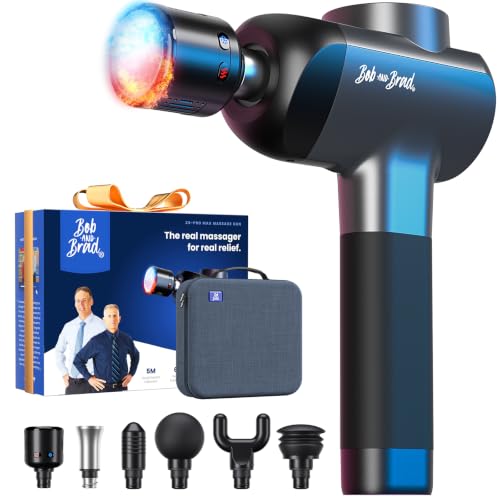
The most capable percussion device in this guide
A full-size percussion gun with the one feature most rivals skip: it can switch between a heated and a chilled head, which covers both the stiffness case and the post-session soreness case with one tool.
Price as of
A full-size percussion gun with the one feature most rivals skip: it can switch between a heated and a chilled head, which covers both the stiffness case and the post-session soreness case with one tool. 55 lb stall force is enough that it does not bog down on a quad.

Under 0.75 lb and quieter than most, with genuinely usable specs for the price. If you are testing whether percussion therapy does anything for you before committing, this is the low-risk way to find out.
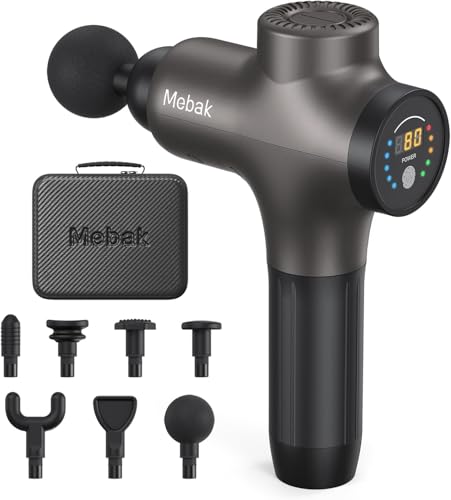
More amplitude than the budget picks, less money than the flagship
12mm of amplitude and 53 lb of stall force put this much closer to the flagship than to the mini, and the LED pressure indicator is a genuinely useful teaching tool for anyone who tends to lean too hard.
Price as of
12mm of amplitude and 53 lb of stall force put this much closer to the flagship than to the mini, and the LED pressure indicator is a genuinely useful teaching tool for anyone who tends to lean too hard.

The cheapest tool here that does real work
A plain high-density EPP cylinder.
Price as of
A plain high-density EPP cylinder. No grid pattern, no vibration, no app. For most people starting out this is the correct first purchase and it costs less than a month of a gym membership.

For the spots a roller cannot reach
Grippy latex balls that stay where you put them, which is the whole point for feet, glutes and the area alongside the spine where a large roller simply bridges over the target.
Price as of
Grippy latex balls that stay where you put them, which is the whole point for feet, glutes and the area alongside the spine where a large roller simply bridges over the target.

The expensive option, for people with a specific reason
Five-chamber sequential compression at a fraction of what the category leader costs.
Price as of
Five-chamber sequential compression at a fraction of what the category leader costs. This is the tool to consider only after the cheap options are already part of your week.
Our top three, ranked
The Leaderboard
The most capable percussion device in this guide
A full-size percussion gun with the one feature most rivals skip: it can switch between a heated and a chilled head, which covers both the stiffness case and the post-session soreness case with one tool.
Check PricePrice as of
The one to buy if you are not sure you will use it
Under 0.
Check PricePrice as of
More amplitude than the budget picks, less money than the flagship
12mm of amplitude and 53 lb of stall force put this much closer to the flagship than to the mini, and the LED pressure indicator is a genuinely useful teaching tool for anyone who tends to lean too hard.
Check PricePrice as of
What to know before you buy
Field Notes
Do massage guns break up lactic acid?
No, and the premise is wrong before the tool is. The 2024 update on delayed onset muscle soreness in the [German Journal of Sports Medicine](https://www.germanjournalsportsmedicine.com/archive/archive-2024/issue-5/update-delayed-onset-muscle-soreness-doms-muscle-biomechanics-pathophysiology-and-therapeutic-approaches/) by Schroeter and colleagues describes DOMS as a mechanical overload injury, with ultrastructural damage including "intracellular edema with endothelial damage, myofibrillar lysis, dilatation and disruption of the T-tubule system as well as focal mitochondrial degeneration". That is structural damage from eccentric loading, not a metabolic by-product sitting in the tissue two days later. A massage gun may make a sore muscle feel better. It is not clearing a substance that is still there.
Should you foam roll before or after training?
Before, on the current evidence. The 2019 meta-analysis of 21 foam-rolling studies in [Frontiers in Physiology](https://pmc.ncbi.nlm.nih.gov/articles/PMC6465761/) by Wiewelhove and colleagues found that "pre-rolling resulted in a small improvement in sprint performance (+0.7%, g = 0.28) and flexibility (+4.0%, g = 0.34)", and concluded that "evidence seems to justify the widespread use of foam rolling as a warm-up activity rather than a recovery tool". Post-rolling effects were smaller and mostly perceptual. Rolling after training is not wasted if you enjoy it, but if you only do it once, do it in the warm-up.
Is heat or cold better for sore muscles?
Nobody has settled it. The same [German Journal of Sports Medicine](https://www.germanjournalsportsmedicine.com/archive/archive-2024/issue-5/update-delayed-onset-muscle-soreness-doms-muscle-biomechanics-pathophysiology-and-therapeutic-approaches/) update reports that "both heat and cold therapy can mitigate the effects of DOMS", while noting that in a systematic review there was "no uniform conclusion about whether cold or heat therapy has the better pain-relieving effect". Our reading is that this is a preference question rather than a protocol question, with one exception worth respecting: cold applied straight after lifting has its own downside for strength and size adaptation. If you like heat before a session and cold after a long easy run, the evidence does not argue with you. That last sentence is our editorial judgement rather than a published recommendation.
How cold and how long does a cold plunge need to be?
One protocol often quoted comes from the 2015 strength-training study in [The Journal of Physiology](https://pmc.ncbi.nlm.nih.gov/articles/PMC4594298/) by Roberts and colleagues, which used 10 minutes at 10.1°C (about 50°F). The 2026 meta-analysis of post-match recovery in [Scandinavian Journal of Medicine and Science in Sports](https://pmc.ncbi.nlm.nih.gov/articles/PMC12767754/) by Veen and colleagues describes the protocols in its 10 trials as 8°C to 15°C for 5 to 15 minutes. So the working range is roughly 46°F to 59°F for 5 to 15 minutes. Note that the first of those studies used that dose to demonstrate a problem, not a benefit.
Does sleep do more for recovery than any tool on this page?
Probably, and it is free. A 2023 systematic review of 25 sleep intervention studies in [Sports Medicine - Open](https://pmc.ncbi.nlm.nih.gov/articles/PMC10354314/) by Cunha and colleagues concluded that "sleep extension and naps were the most representative and most effective strategies to improve sleep and performance", with athletes in the extension studies spending 9 to 10 hours in bed to add 46 to 113 minutes of sleep. The authors are explicit about "the limited amount of high-quality evidence reviewed". Even discounted for that, it is a larger reported effect than anything we found for a device.
Who put in the work
The Coach
Your Coach
Darlene Schmitt
I am a fitness instructor and promoter who truly enjoys helping others become the best they can be! My mission is to help people find the love of fitness and to help them develop a lifelong habit of exercise. I am a firm believer that fitness should be fun, and I make it my mission to ensure that my classes are always enjoyable. I am also a certified nutritionist and personal trainer, so I am able to offer my students comprehensive and well-rounded support.