Do compression boots work? What the recovery evidence actually shows

Contains affiliate links. Our policy.
Compression boots appear to make tired legs feel better, usually for an hour or two. They do not reliably make those legs jump higher or produce more force the next day, and placebo-controlled trials keep finding the first while missing the second. At $85 to $399 as of September 2026, that is the trade.
Exercise Legend is reader-supported: if you buy through the links below we may earn a commission, which never changes what we recommend.
So do compression boots work? They work at something. The honest question is whether that something is what you thought you were paying for. This is the most expensive category in our guide to recovery tools that earn their floor space, and it is also the category where the gap between the clinical evidence and the athletic evidence is widest.
What compression boots actually do
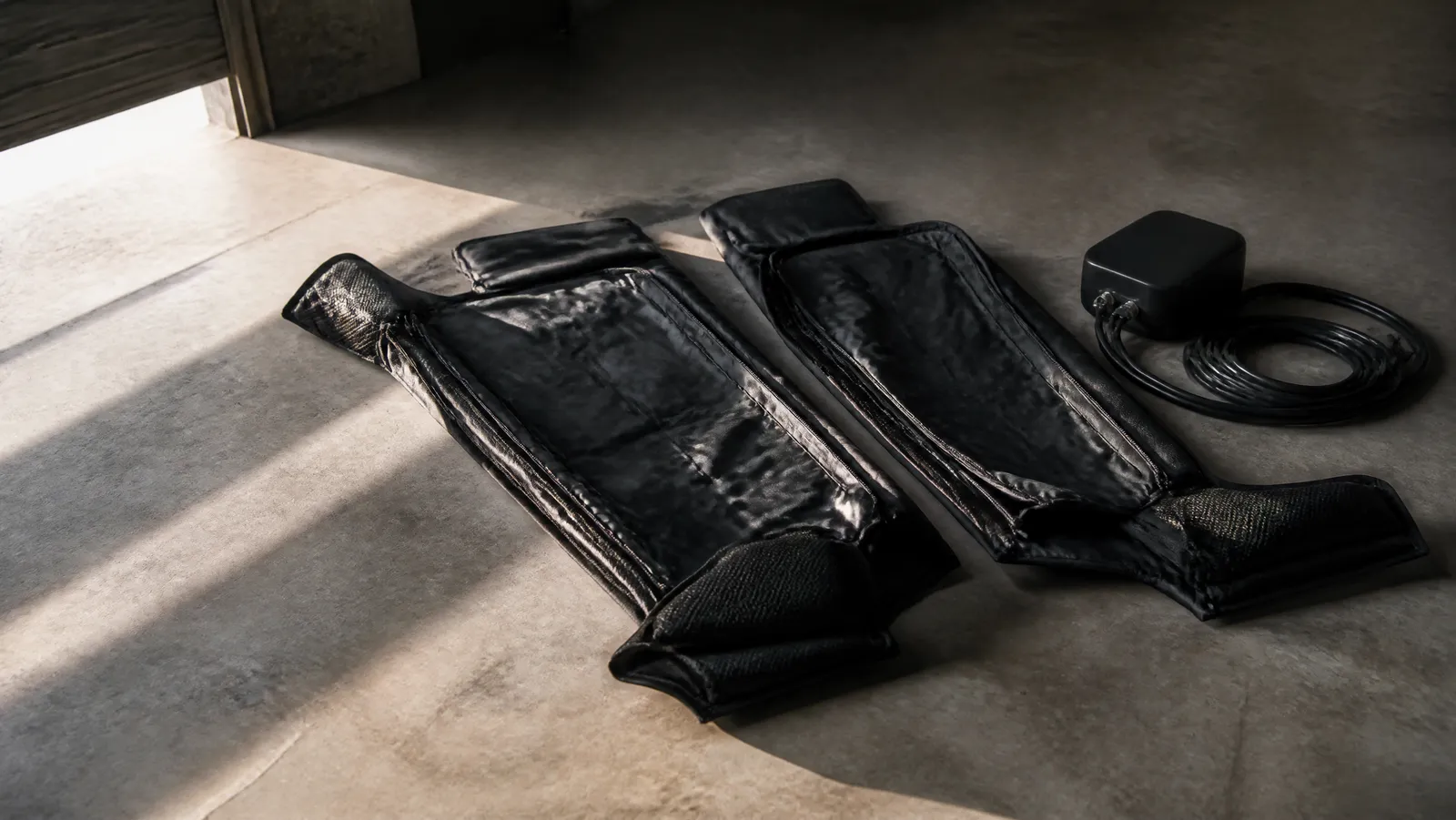
Cleveland Clinic describes intermittent pneumatic compression devices as "inflatable sleeves that prevent blood clots", with sleeves that inflate around the legs every 20 to 60 seconds and then deflate. The University of Rochester Medical Center's health encyclopedia puts the mechanics plainly: "The cuff fills with air and squeezes the leg, much like a blood pressure cuff. Then the cuff deflates and relaxes."
Consumer recovery boots are that idea in a gym bag. Three variables separate them.
- Coverage. How far up the leg the sleeve reaches — foot and calf only, or foot all the way to the thigh. This is the single biggest driver of price.
- Sequence. Whether the chambers inflate in order from the foot upward, which is what "sequential" on a box means, or squeeze as one unit.
- Pressure, quoted in millimeters of mercury (mmHg), the same unit a blood pressure cuff uses.
We will say this once, plainly: every spec in this article comes from the manufacturer's own product listing. We have found no independent testing of what pressure these consumer devices actually deliver, so read the numbers as marketing copy that happens to contain digits.
Where the evidence is strong: the hospital version of this device
Intermittent pneumatic compression is not fringe technology. It is standard equipment on surgical wards, and the trial base is large.
A 2024 systematic review and meta-analysis by Kim, Ryu and Kim in PLOS ONE pooled 16 randomized controlled trials covering 2,828 surgical patients. Against no prophylaxis at all, compression cut the odds of deep vein thrombosis to roughly four in ten (OR 0.41, 95 percent CI 0.26 to 0.65), and the authors conclude that "IPC intervention effectively prevented DVT, PE, and bleeding in surgical patients." The University of Rochester describes the same clinical picture: the technique "is used most often for people who have just had surgery" and "may also be used after a stroke or to help treat lymphedema."
Here is the line that matters: none of that evidence is about recovery. It is about keeping blood moving in people who cannot move themselves, and about swelling in people whose lymphatic drainage is damaged. You, on the sofa after a long run, are neither. The recovery-boot industry borrows the credibility of the clinical literature to sell a different product. Two questions, two bodies of research, and the second is far thinner than the first.
Where the evidence gets thin: recovery after training
The best current synthesis for athletes is a 2024 systematic review and meta-analysis by Maia, Nakamura, Sarmento, Marcelino and Ribeiro in Biology of Sport, covering 17 studies and 319 participants, with 14 studies pooled statistically. Their summary of their own results is not an endorsement: lower-limb compression "provides (at best) moderate beneficial effects concerning perceptions of pain and soreness, as well as small, however non-significative effects on the recovery of muscle mechanical functions."
On performance, the numbers are flat at every time point measured: small and non-significant within two hours of treatment (SMD 0.243, p = 0.096), then trivial at 24 hours (p = 0.498), 48 hours (p = 0.672) and 72 hours (p = 0.642). Creatine kinase, the blood marker of muscle damage, was non-significant at 24, 48 and 72 hours. Blood lactate was not pooled at all: four studies measured clearance, two reporting an advantage and two a neutral effect, and the reviewers conclude only that lower-limb compression "seems not to affect BLa clearance."
Two recent placebo-controlled trials make the same point with tighter controls. In a 2025 randomized trial in the International Journal of Sports Physiology and Performance, Maia and colleagues put 33 active male university students through an all-out flywheel squat protocol, then gave them either 30 minutes of compression at 200 mmHg or a sham microcurrent treatment. Their conclusion: "a 30-minute IPC application immediately following exercise-induced muscle damage does not appear to improve the recovery kinetics of jumping and maximal voluntary contraction performance; however, the potential reduction in perceived soreness suggests a need for further investigation." That second clause is the pattern in miniature — nothing on the objective tests, a signal on how the legs felt.
The same group then tested it on people paid to recover. In a 2026 randomized placebo-controlled trial in BMC Sports Science, Medicine and Rehabilitation, 23 international-level under-19 soccer players received 30 minutes of 200 mmHg compression or a placebo cream after competitive matches. "No significant time x group interactions were found for any of the variables under analysis (p = 0.089 to 0.834)" across jump height, fatigue, creatine kinase and soreness. What did predict recovery, in their exploratory analysis, was training load and total sleep time.
That is the honest state of play: the machine does not appear to restore your legs faster than not using the machine.
Soreness keeps showing up — and it is the hardest thing to measure
The soreness findings are more interesting, and more fragile.
In the Biology of Sport meta-analysis, perceived pain and soreness improved significantly in the first two hours after treatment (SMD 0.486, p = 0.010) and again at 96 hours (SMD 0.368, p = 0.026), while the 24-hour and 48-hour effects missed significance (p = 0.085 and p = 0.055). A 2025 randomized controlled trial by Gu and colleagues in PM&R put 20 untrained male college students through lower-limb plyometrics and treated half for 15 minutes immediately after and again at 24, 48 and 72 hours. Soreness scores and two tensiomyography measures were significantly better in the treated group at 48 and 72 hours (all p under 0.05). The authors conclude that compression "may mitigate exercise-induced DOMS following plyometric exercise."
Twenty people, though. And the blinding problem runs through this whole literature: the Biology of Sport reviewers report that only about a third of the included studies blinded participants, none blinded their assessors, and only 6 of 17 used a placebo control. Soreness is self-reported, and a machine that hugs your legs for 20 minutes is an extremely unblindable intervention.
It is also worth remembering what soreness is and is not telling you, which we take up in what DOMS actually tells you. Feeling less sore is not evidence that tissue repaired faster. A 2016 randomized controlled trial in the Journal of Orthopaedic and Sports Physical Therapy tested both in the same runners: Hoffman and colleagues randomized 72 finishers of a 161-km ultramarathon to 20 minutes of massage, sequential pneumatic compression, or supine rest. Compression lowered overall muscular fatigue scores immediately after treatment (p under 0.01), but there were "no significant differences between groups in any outcome 1 to 7 days after the race", and no group difference in 400-meter run time. Single sessions "provide some immediate subjective benefit", the authors write, with "no evidence, however, that such treatments provide extended subjective or functional benefits of clinical importance."
That is the whole category in one study. Feels better now. Not faster later.
The mmHg problem, and why we will not report those numbers as facts
Three product pages in this category tell three different stories about pressure. Our mid-range pick's manufacturer lists eight intensity settings spanning 50 to 120 mmHg. Our premium pick's manufacturer lists 200 mmHg. Our budget pick's manufacturer does not publish a figure at all. Those are not small differences in a number describing how hard a machine squeezes a limb, and none of them has been independently verified. We are reporting what each manufacturer claims, not what any device delivers.
For context, the Biology of Sport review identified 20 to 30 minutes at approximately 80 mmHg as the configuration most commonly used in the trials it pooled — comfortably inside the mid-range pick's stated range. And 200 mmHg is precisely the pressure used in both placebo-controlled trials above, the two that found nothing on any objective measure. More pressure is not a proxy for more benefit, and treating the biggest number on the shelf as the best product is the wrong inference. That is our editorial judgement, not something any of these papers states directly.
Are compression boots worth it? Sort yourself into one of these groups
Worth considering: you already lie down for 30 minutes and want that time to feel better. This is the use case the evidence covers. If a device gets you horizontal with your legs up after a hard session rather than standing in the kitchen, the behavior change may be worth more than the air pressure.
Worth considering: your training volume is high and monotonous. Multiple sessions a week on the same muscle groups, whether that is run training for Hyrox or back-to-back loaded walks. The daily-use handball trial in Biology of Sport found that five weeks of daily compression "slightly mitigates the fatigue-induced effects of training" in 17 players. A small, hedged result, presented as one.
Not worth it: you are buying tomorrow's performance. Every pooled performance outcome above was non-significant. If you are too fatigued to train well, the levers with evidence behind them are load, sleep and food, which is what the soccer trial's exploratory analysis pointed at.
Not worth it: you have not tried the cheap options yet. The price gap here is enormous: the entry point to this category is $84.99 and the top of our list is $399.00, both as of September 2026. A percussion device covering broadly similar ground starts around $40, and we have written at length on whether massage guns are worth the money, where the answer is also heavily qualified. A high-density foam roller is $12 to $14 as of September 2026, and in at least one head-to-head it beat percussion on muscle tone and stiffness — see massage gun versus foam roller. Spending $399 before spending $13 is a sequencing error.
Not worth it: you are treating a problem you have not had looked at. Persistent leg swelling, one calf larger than the other, numbness, pain that does not track with training. None of those are recovery problems.
Who should not use compression boots
This section changes the answer for some readers, so it is not at the bottom.
The most careful source we found is the 2020 international consensus statement on compression therapy by Rabe and colleagues in Phlebology. The contraindications it lists for sustained compression include severe peripheral arterial occlusive disease defined by low ABPI, ankle, toe and transcutaneous oxygen pressures, "Suspected compression of an existing epifascial arterial bypass", "Severe cardiac insufficiency (NYHA IV)" and "Confirmed allergy to compression material". The same list also includes "Severe diabetic neuropathy with sensory loss or microangiopathy with the risk of skin necrosis" — the statement does not sort its contraindications into absolute and relative tiers, and the only exception it notes for that last item is inelastic compression at low sustained pressure, which is not what a pneumatic boot does. Their first recommendation is unambiguous: "Every patient receiving compression therapy should be screened for conditions that increase the risk of complications, and every compression device should be checked for appropriate fit and application."
Cleveland Clinic lists skin irritation and skin breakdown among the complications, noting that "rarely, nerve damage or a pressure injury" can occur. The University of Rochester is blunter about who is at higher risk: "people with leg ulcers, burns, or peripheral vascular disease have a higher risk for problems," and "older adults may be more at risk for skin breakdown."
One nuance we will not smooth over. A suspected blood clot is widely repeated online as an absolute bar on compression, but the consensus statement treats compression in venous thromboembolism as a supervised clinical decision rather than a blanket prohibition. That is about monitored medical care. It is not permission to self-treat at home.
If you have peripheral arterial disease, heart failure, diabetic neuropathy or reduced sensation in your legs, open wounds or a skin infection, an active or suspected clot, or you are pregnant, ask a clinician whether these devices are appropriate for you before you buy one. A device that feels pleasant can still make a real problem worse, and no source above substitutes for someone examining your legs.
If you are buying: what $85, $300 and $399 actually get you
The ladder is steep, and what climbs it is coverage and convenience, not proven effect. All three prices below are as of September 2026.
$84.99 — calf and foot only, and the limitation is the point. The Comfytemp unit covers calf, ankle, heel and arch, with three independent airbags running sequential inflate and deflate cycles, four adjustable straps, and a 17-inch device height fitting calves 13 to 19 inches around and feet up to 12 inches. It is cordless, with a 2,500 mAh battery the manufacturer claims runs 120 to 170 minutes. It does not cover the thigh, and no pressure figure is published for it. If your sore spots are quads and hamstrings, this is the wrong tool. If they are calves and feet after mileage, it is an $85 answer to a $399 question. Check the current price on Amazon.
$299.99 — full leg, and the only pick you can actually reason about. The QUINEAR system runs four chambers from foot to lower calf to upper calf to thigh, with three modes (sequence, circulation, combination), timers at 20, 25 or 30 minutes, a built-in pressure sensor, a digital controller and a carry bag. The manufacturer lists a 24-month warranty and no heat function. It is also the only one of the three that publishes a pressure range, 50 to 120 mmHg across eight intensities, so its middle settings land near the 80 mmHg most trials used. Its marketing copy makes claims about lymphatic function and metabolism that we do not endorse and have not repeated here. If we were buying one pair, this is it — on transparency, not performance. Check the current price on Amazon.
$399.00 — you are paying for the missing cable. The Anaconda boots cover four zones (foot, calf, knee, thigh) with three modes: Full-Leg Relief, Massage Mode and Targeted Zone. They run on a battery the manufacturer claims lasts four hours, use a handset rather than an app, and ship with a travel bag. The manufacturer lists 200 mmHg, far above the mid-range pick's stated ceiling and unverified by anyone independent. The honest case for the extra $99 is adherence, not intensity: a device you can use on the sofa gets used, and one tethered to a socket in the spare room does not. That is a behavioral argument, not an evidence-based one. Check the current price on Amazon.
The verdict
Buy compression boots if you want your legs to feel better for the rest of the evening, you have already tried the $20 and $40 options, and $85 to $399 is money you will not miss. That immediate benefit is real, and it is the outcome the research most consistently finds.
Do not buy them expecting to train harder tomorrow. Across a 17-study meta-analysis and two placebo-controlled trials, the objective performance measures did not move. Anyone telling you otherwise is selling ahead of the data — and for a meaningful share of the people reading this, the right decision is to buy nothing at all.
If you are assembling a recovery setup rather than buying one gadget, start with Exercise Legend's complete recovery tool guide and spend from the bottom of the ladder up. And if your soreness arrived with a new training block, the fix is usually in the block: our 8-week rucking training plan for beginners progresses load slowly enough that you need less recovery hardware, not more.
Gear we'd put on our own floor
The Picks

If you want to test the category without spending three hundred dollars
Calf and foot only, cordless, and under a hundred dollars.
Price as of
Calf and foot only, cordless, and under a hundred dollars. It does not cover the thigh, which is a real limitation and also why it costs what it costs.

If you want full-leg sequential compression at the category's normal price
Four chambers from foot to thigh, and the only pick here that publishes its actual pressure range, which makes it the one you can reason about.
Price as of
Four chambers from foot to thigh, and the only pick here that publishes its actual pressure range, which makes it the one you can reason about.

If you want to recover without being tethered to a wall socket
Wireless with a four-hour battery, which matters more than it sounds.
Price as of
Wireless with a four-hour battery, which matters more than it sounds. The boots you actually use are the ones you can put on in front of the television.
How the picks stack up
Head To Head
If you want to test the category without spending three hundred dollars
Calf and foot only, cordless, and under a hundred dollars.
Check PricePrice as of
If you want full-leg sequential compression at the category's normal price
Four chambers from foot to thigh, and the only pick here that publishes its actual pressure range, which makes it the one you can reason about.
Check PricePrice as of
If you want to recover without being tethered to a wall socket
Wireless with a four-hour battery, which matters more than it sounds.
Check PricePrice as of
What to know before you buy
Field Notes
How long should a compression boot session be?
Twenty to thirty minutes is the protocol the research keeps landing on. The 2024 systematic review by Maia and colleagues in [Biology of Sport](https://pmc.ncbi.nlm.nih.gov/articles/PMC11475002/) identified a duration of 20 to 30 minutes at roughly 80 mmHg as the configuration most commonly used in the trials it pooled. Shorter also appears in the literature: the 2025 randomized trial by Gu and colleagues in [PM&R](https://pubmed.ncbi.nlm.nih.gov/40094188/) used 15-minute sessions repeated immediately after exercise and again at 24, 48 and 72 hours. We would start at 20 minutes and stop there, because no trial we found tested whether longer is better. That is our reading of the protocols rather than a published dosing guideline.
Do compression boots flush lactic acid out of your legs?
No study we found supports that framing. The 2024 meta-analysis in [Biology of Sport](https://pmc.ncbi.nlm.nih.gov/articles/PMC11475002/) found the four studies that measured blood lactate clearance too inconsistent to pool — two reported an advantage, two a neutral effect — and concluded that lower-limb compression "seems not to affect BLa clearance". Creatine kinase, the muscle-damage marker, was also non-significant at 24, 48 and 72 hours, with very high heterogeneity between studies. Some manufacturer listings in this category go further still and describe effects on lymphatic function or metabolism. Those are marketing claims, not findings we can attribute to a trial, and we are not repeating them. Lactate also clears on its own within roughly an hour of stopping, with or without a machine.
Do compression boots help on long flights or prevent blood clots?
The clot-prevention evidence is real but it is hospital evidence. A 2024 meta-analysis of 16 randomized trials and 2,828 surgical patients by Kim, Ryu and Kim in [PLOS ONE](https://journals.plos.org/plosone/article?id=10.1371%2Fjournal.pone.0307602) found that compared with no prophylaxis, intermittent pneumatic compression cut the odds of deep vein thrombosis substantially (OR 0.41, 95 percent CI 0.26 to 0.65). Those patients were immobilized after surgery and monitored by clinicians. Nothing in that literature is about a healthy traveler using recovery boots in a hotel room, and we would not extrapolate it there. If clot risk is your actual question, it is a question for a doctor.
Is it worth using compression boots every day?
The one multi-week trial we found is small and its results are modest. In a 2025 randomized controlled trial in [Biology of Sport](https://pubmed.ncbi.nlm.nih.gov/41048245/), Nuell and colleagues gave 17 competitive male handball players daily sequential pneumatic compression for five weeks, eight in the treatment group and nine in the control. The treated group reported slightly better perceived recovery status (p = 0.047) and showed a change in one muscle-function measure in one hamstring, while the control group's agility test got worse. The authors conclude that daily use "slightly mitigates the fatigue-induced effects of training". Slightly is the operative word, and 17 players is not many.
Who put in the work
The Coach
Your Coach
Darlene Schmitt
I am a fitness instructor and promoter who truly enjoys helping others become the best they can be! My mission is to help people find the love of fitness and to help them develop a lifelong habit of exercise. I am a firm believer that fitness should be fun, and I make it my mission to ensure that my classes are always enjoyable. I am also a certified nutritionist and personal trainer, so I am able to offer my students comprehensive and well-rounded support.